
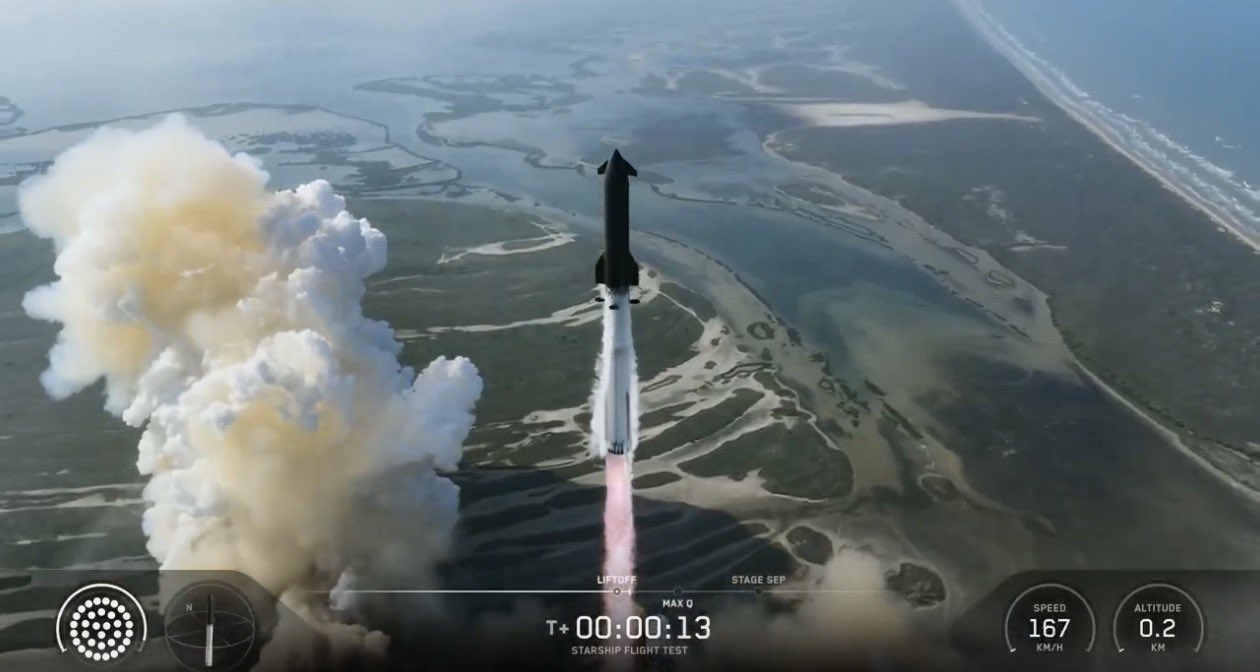
This image taken from video provided by SpaceX shows Starship lifting off from Starbase near Boca Chica Beach in South Texas.
SpaceX
SOUTH PADRE ISLAND — SpaceX launched its biggest-ever Starship from South Texas for a mostly successful first test flight of the mega-rocket CEO Elon Musk says will help ferry humans back to the moon and, eventually, Mars.

It was the first flight of the new Version 3 Starship and the first to take off from a new Starbase launch tower. Despite engine trouble, the hourlong mission saw Starship deploy satellites, complete maneuvers and splash down on its target in the Indian Ocean, where it exploded in a fireball as it slipped beneath the waves. Earlier, its redesigned booster had spun out of control and broken apart over the Gulf of Mexico.
Article continues below this ad
In this image from video provided by SpaceX, the Starship rocket re-enters the Earth’s atmosphere Friday after launching from Starbase in South Texas.
SpaceX
Starship V3 lifts off Friday from Starbase in South Texas for its first test flight. The most powerful Starship yet blasted off from the southern tip of Texas carrying 20 mock Starlink satellites and two observation satellites on a test flight extending halfway around the world. Nothing is being recovered. It’s the 12th test flight of the rocket that Elon Musk is building to get people to Mars one day. But first comes the moon and NASA’s Artemis astronaut program.
Eric Gay/AP Photo/Eric Gay
Trucks with nitrogen line up to help fuel the Starship mega-rocket for a Friday test flight from Starbase.
Eric Gay/Associated Press
Against a hazy sky, the 407-foot-tall rocket took flight at 5:30 p.m. Friday with thousands of people watching from towns and beaches around the region and millions more tuning in to the company’s online broadcast.
RELATED: SpaceX plans massive IPO as losses mount, with its future hinging on Starship
“We have liftoff,” the flight controller said as the craft jumped from its launch pad a day after cascading problems led to the flight’s last-second cancellation. The lower-stage booster’s 33 engines sent two giant plumes of smoke high into the sky as the craft gained momentum.
Article continues below this ad
From South Padre Island, Starship at first appeared to rise silently from its Starbase launch tower. Then, the sound waves rolled across the island like a minute-long boom of thunder.
Brandon Lingle/San Antonio Express-News
Across the bay on South Padre Island, spectators saw the orange glow of the craft’s engines at ignition. For about 20 seconds, the rocket appeared to climb silently as sound waves traveled across the miles from Boca Chica Beach. Then, the low-thunder rumble of rocket engines crackled through the air, pulsing like a boom of thunder that continued for more than a minute.
San Antonio Express News Logo
Make us a Preferred Source on Google to see more of us when you search.
Add Preferred Source
A few minutes into the flight, the Super Heavy booster separated from the upper-stage Starship spacecraft as planned. But not all of the booster’s engines fired for its expected controlled return to the Gulf of Mexico and it was lost. Later Friday, the Federal Aviation Administration said it was assessing the deviation from SpaceX’s flight plan, which it said caused six commercial aircraft departure delays and put five flights into airborne holding patterns.
Article continues below this ad
The outcome was far better than test flights last year, two of which disintegrated soon after launch, showering debris that disrupted air traffic over the Caribbean.
Plumes of smoke rise above Starbase after SpaceX launched its Version 3 Starship on Friday. This was the view from South Padre Island.
Brandon Lingle/San Antonio Express-News
The upper-stage Starship also had to make do with at least one engine inoperable but kept heading eastward. A pair of modified, camera-equipped Starlink satellites ejected from Starship along with 20 dummies provided brief views of the spacecraft — a remarkable first — as it aimed for the Indian Ocean.
Starship is meant to be fully reusable, with giant mechanical arms at the launch towers designed to catch both returning rocket stages. Though it has landed Super Heavy boosters before, SpaceX hadn’t intended to recover either stage Friday.
Article continues below this ad
It was the 12th test flight of the rocket and the first Starship mission since October.
SpaceX eyes moon and Mars missions
The redesigned rocket made its debut two days after SpaceX filed registration documents to take the company public next month in what could be the biggest-ever initial public offering of stock. Friday’s success could boost prospects for the IPO.
NASA Administrator Jared Isaacman flew in for the launch, eager to see the new rocket that’s key to his agency’s Artemis program to return to the moon.
Article continues below this ad
“Congrats @SpaceX team and @elonmusk on a hell of a V3 Starship launch,” he said in a post on X after the flight. “One step closer to the Moon…one step closer to Mars.”
Musk congratulated SpaceX in his own social media post.
“Congratulations @SpaceX team on an epic first Starship V3 launch & landing!” he said. “You scored a goal for humanity.”
In SpaceX’s filing for its IPO, the company said it would help finance projects to make humans an intergalactic species as it faces existential threats on Earth that could wipe out civilization.
Article continues below this ad
“We do not want humans to have the same fate as dinosaurs,” it said. Musk has long dreamed of human civilization on Mars and believes Starship will enable that.
In this image from video provided by SpaceX, the Starship rocket re-enters the Earth’s atmosphere Friday after flying halfway around the world.
SpaceX
With Starship’s development running behind schedule though, NASA has raised the possibility that it could switch to a lander from Blue Origin, the rocket company started by Jeff Bezos, the founder of Amazon.
NASA is paying SpaceX billions of dollars to provide the lunar lander that will be used to land Artemis astronauts on the moon. With Starship’s development running behind schedule, though, NASA has raised the possibility it could switch to a lander from Jeff Bezos’ Blue Origin.
Article continues below this ad
The two companies are scrambling to be first.
NASA weighs options for Artemis moon lander
While Starship has reached the fringes of space on multiple flights, Bezos’ Blue Moon has yet to lift off, although a prototype is being readied for a moonshot later this year.
NASA is following April’s successful Artemis II lunar flyaround by four astronauts with a docking trial run in orbit around Earth planned for next year. For that Artemis III mission, astronauts will practice docking their Orion capsule with Starship, Blue Moon or both.
Article continues below this ad
A moon landing by two astronauts — Artemis IV — could come as as soon as 2028 using either Starship or Blue Moon, whichever lander is safer and ready first. It will be NASA’s first lunar landing with a crew since 1972’s Apollo 17. The goal this time is a moon base near the lunar south pole, staffed by astronauts as well as robots.
FRIDAY’S LIVE COVERAGE:
6:37 p.m.: After performing several tests and maneuvers as it returned to Earth, the new version of Starship hit its mark in the Indian Ocean, where it fired its boosters to land.
Article continues below this ad
Starship is seen as it maneuvers into position Friday for its splashdown landing in the Indian Ocean.
Starlink
6:31 p.m.: Here’s the view from Starship’s onboard cameras as it heads for its Indian Ocean landing site.
The view from Starship’s onboard camera as it begins re-entry to Earth’s atmosphere.
SpaceX
6:28 p.m.: Starship is slowing as it approaches its water landing site in the Indian Ocean. If it makes it through re-entry to touchdown, the view will be seen from Starship’s onboard cameras and cameras on the ocean.
Article continues below this ad
6:25 p.m.: The view of Starship from one of the Starlink V2 satellites deployed by Starship during Friday’s test flight.
An image of Starship provided by one of the so-called dodger dog Starlink observation satellites deployed on Friday’s test flight.
SpaceX
6:10 p.m.: The view inside Starship’s cargo bay as it began deploying 20 dummy Starlink V3 satellites and two Starship observation satellites.
Article continues below this ad
A view inside Starship V3’s cargo bay as it begins deploying its payload of dummy satellites.
SpaceX
5:50 p.m.: Starship has begun releasing 20 dummy Starlink satellites and two specially modified Starlinks.
The newest version of Starship, known as V3, roars away from Starbase on Friday. The biggest, most powerful Starship yet blasted off with 20 mock Starlink satellites and two observation satellites on a test flight extending halfway around the world.
Eric Gay/AP Photo/Eric Gay
The two modified satellites “will scan Starship’s heat shield and transmit imagery down to operators to test methods of analyzing Starship’s heat shield readiness for return to launch site on future missions,” SpaceX said.
Article continues below this ad
The company also has removed one of the craft’s heat-protection tiles to see what happens to adjacent tiles when one is missing.
Starlink is the company’s biggest moneymaker for three years running and expected to generate $20 billion in revenue this year.
5:45 p.m.: SpaceX announced Thursday that Chun Wang, a Chinese cryptocurrency billionaire, is the first crew member named for Starship’s first mission to Mars. The two0year mission will explore the area outside of the Moon’s orbit before doing a flyby of Mars.
Article continues below this ad
Prior to that, he will be part of a Starship mission to fly around the Moon along with billionaire space tourists Dennis and Akiko Tito.
Starship’s first commercial Moon flight was to be funded by Japanese billionaire and art collector Yusaku Maezawa, who was going to take eight creatives on the mission dubbed “dearMoon.”
Maezawa backed away from the mission in the Summer of 2024.
Starship has a long way to go before it can carry passengers.
Article continues below this ad
SpaceX hasn’t said when it will attempt to fly a person on the prototype spacecraft that has yet to achieve orbit.
5:36 p.m.: The Super Heavy booster that lifted Starship from the southern tip of Texas successfully separated from the upper-stage Starship and returned to Earth, where it splashed down in the Gulf of Mexico. Starship, with one of its six engines apparently malfunctioning, continued on its space-skimming trajectory. The mission is to last 65 minutes.
SpaceX’s biggest and most powerful Starship yet takes off Friday from Starbase in South Texas.
Eric Gay/AP Photo/Eric Gay
5:30 p.m.: The new version of Starship, the world’s most powerful rocket, has lifted off from Starbase in South Texas. NASA is counting on the rocket known as V3 to land astronauts on the moon.
Article continues below this ad
5:28 p.m.: With about 90 seconds left in the countdown, propellant load has been completed and Starship is ready for launch.
Jared Isaacman is seen in the SpaceX Crew Dragon spacecraft in 2021, when was commander of the Inspiration4 mission. The NASA administrator is at Starbase today to witness the second attempt of the new version of Starship.
SpaceX
5:20 p.m.: NASA Administrator Jared Isaacman did a flyby of Starbase in one of his privately owned Northrop F-5 Tiger II fighter jets, then appeared on the company webcast to discuss the recent Artemis II mission and future plans for the program intended to return humans to the moon. Starship is to play a major role in the program.
Article continues below this ad
The booster for SpaceX’s mega rocket Starship is prepared Tuesday for a test flight from Starbase. It’s set to take off from the all-new Pad 2. Starbase’s original launch tower is seen at right.
Eric Gay/Associated Press
5:10 p.m.: SpaceX worked overnight to repair the faulty tower arm that was responsible for shutting down Thursday’s launch attempt. Employees made both software and hardware changes, company spokesman Dan Huot said, including welding that was required to fix the balky pin.
SpaceX is using what it calls Pad 2, its new launch tower, for the first time for this test flight. It has a more strongly reinforced pad and concrete flame trench to help dampen the force of Starship’s 33 big Raptor engines.
Article continues below this ad
All previous test flights departed from the original Pad 1 at Starbase.
SpaceX begins livestream webcast of Friday launch attempt
5 p.m.: SpaceX has begun its livestream webcast of today’s launch attempt. A 90-minute launch window opens at 5:30 p.m. View the webcast on the SpaceX channel on the X social media channel. The livestream is also available on the company’s website.
Company spokesman Dan Huot said the rocket is on track for launch at 5:30 p.m.
Article continues below this ad
4:55 p.m.: SpaceX said it has begun loading propellant into Starship. It was fueled Thursday ahead of the failed launch attempt, but must be refueled for today’s attempt. It uses a mixture consisting of sub-cooled liquid methane and liquid oxygen.
4:50 p.m.: SpaceX closed Boca Chica Beach access Friday morning in preparation for the launch.
Article continues below this ad
A series of problems thwarted Thursday’s attempt, the first for the newest generation of Starship, a new launch tower that SpaceX recently completed and a new flight path that will take the rocket between Cuba and the Yucatan Peninsula.
First, upper-level winds delayed the planned launch from 5:30 to 6, then to 6:30 p.m. Next, problems with the new Starbase launch tower caused SpaceX to pause the countdown with 40 seconds to go. Then, with the launch window closing, the flight was scrubbed.
CEO Elon Musk later said the hydraulic pin holding the launch tower’s arm in place did not retract. Crews worked through the night to repair the part.
The Starship awaiting launch has been loaded with 20 mock Starlink satellites and two “specially modified” Starlinks to be released before the spacecraft’s controlled entry into the Indian Ocean at the end of the 65-minute mission. It will be the 12th test flight for a Starship from South Texas and the first since last October. The two modified satellites will be used to scan Starship’s heat shields and transmit images for analysis.
Article continues below this ad
4:40 p.m.: The countdown is back on for the 12th flight of the Starship mega-rocket from South Texas after a series of problems forced a scrub in the final seconds of the count last night.
Last-second problems with the launch tower got the best of Elon Musk’s rocket firm Thursday, but conditions are looking good for a launch Friday evening.
Weather is better than yesterday, with SpaceX saying it had an 85% chance of being acceptable for a launch attempt when the 90-minute launch window opens at 5:30 p.m. Central.
Article continues below this ad
“T-zero is currently 5:30 Texas time,” said Musk in a post on X at 4 p.m.
Mostly sunny skies are expected across deep South Texas by launch time, according to Anthony Franze, newsroom meteorologist. Rain chances are minimal, but an isolated pop-up storm can’t be ruled out. Overall rain chances will be from 10% to 20%.
“Weather and winds looking good so far for launch today,” posted director of Starship engineering Shana Diez on X. “Shoutout to the logistics team at Pad 2, these back to back flight attempts rely on a huge behind the scenes effort to get all our commodities refilled in the ground tanks. Ready to give it another try today.”