
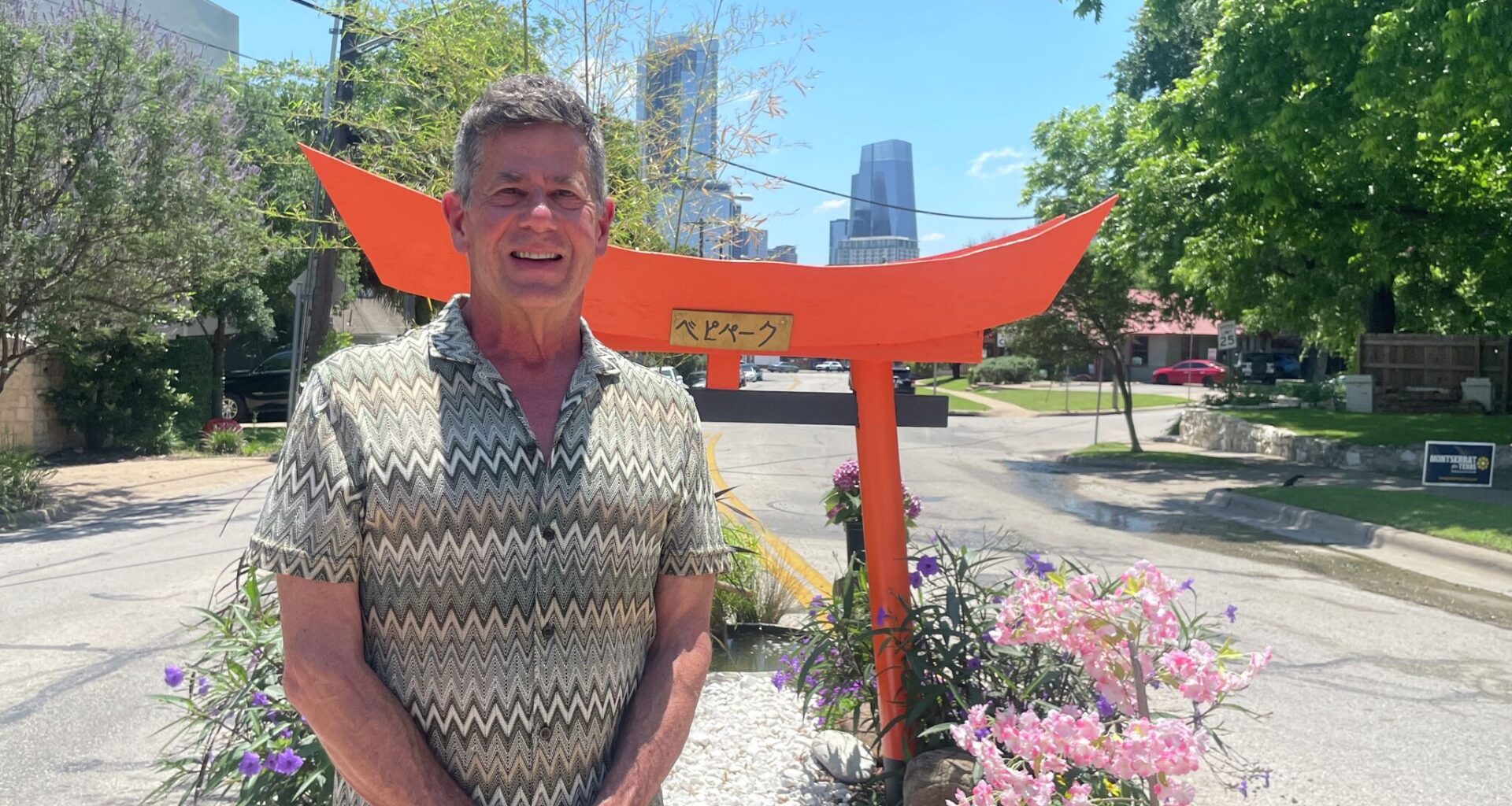
Austin resident Gary Schumann created BEPI Park nearly a decade ago as a beautification effort of a then-newly installed pedestrian island and traffic median.
Kelsey Thompson/MySA
On a sunny spring day in Central Austin, cars whiz past a vibrant orange archway, adorned with Katakana calligraphy. Brilliant floral displays hug the gate’s exterior as a miniature fountain burbles in the background.

To some, it might just be a well-decorated pedestrian island and traffic median. But to Austinites at large as well as residents surrounding the Baylor, Enfield and Parkway intersection, it’s the site of the tiniest park in Austin, cultivated and nurtured for nearly a decade.
Article continues below this ad
Neighborhood resident Gary Schumann is the mastermind behind the miniature greenspace oasis now known as BEPI Park. Back in 2017, Schumann said he walked outside his front door and saw a mound of asphalt in the roadway, alongside a slew of city personnel marking the ground. Crews were preparing to install a pedestrian traffic island as a way to provide safer access for people crossing the intersection.
Designs called for a landscaped area adjacent to the island and crosswalk. Schumann asked the city’s assigned project engineer what exactly that green space would entail, later described as some sod and dirt. In Schumann’s mind, that immediately equated to a breeding ground for unkempt weeds down the road.
Austin resident Gary Schumann created BEPI Park nearly a decade ago as a beautification effort of a then-newly installed pedestrian island and traffic median.
Kelsey Thompson/MySA
“Since it’s right in front of my house, I asked what would be involved in me taking charge and taking care of it. There’s a whole city process to go through, but [the engineer] said if I just go out and start doing it, no one would say anything,” he said. “So that’s what I did.”
Article continues below this ad
With the blessing of his neighbors, Schumann’s inaugural teeny picket fence and flowers planted the seed for nearly 10 years’ worth of imaginative designs, swapped out three to four times annually, and often inspired by his own travel escapades around the world. As time went on, those artistic visions became even more “outlandish and more outrageous,” Schumann quipped, adding statues and intricacies that transformed it from a garden space to a tiny work of art.
Locals transform city space the Austin way
The traffic median’s past lives have included cosplays as Poseidon, the Greek god of the sea, storms and earthquakes; bite-sized Christmas displays adorned by a Santa tree topper; a neighborhood vegetable garden; and even the BEPI Park Troll, an ode to the now-destroyed Pease Park troll, Malin.
Article continues below this ad
Poseidon, the Greek god of the sea, storms and earthquakes, was installed at BEPI Park in June 2025.
Courtesy of Gary Schumann
A miniature Santa-adorned Christmas tree, installed at BEPI Park in late 2024.
Courtesy of Gary Schumann
BEPI Park transformed into a neighborhood vegetable garden back in spring 2022.
Courtesy of Gary Schumann
The BEPI Park Troll, a nod to Malin the Pease Park Troll, was installed at BEPI Park in spring 2024.
Courtesy of Gary Schumann
The latest piece, a tribute to Schumann’s trip to Japan with his husband, involved extensive analysis on how to properly write “BEPI Park” in Katakana calligraphy, as well as observing various garden motifs in Japan to recreate it authentically in Texas.
Article continues below this ad
“I want every garden to be completely different from the one before, and there are only so many types of gardens,” he said. “But we’re still coming up with new ideas.”
Despite beginning as a tongue-in-cheek, little bureaucratic workaround and beautification project has since earned recognition courtesy of a BEPI Day in Austin back in 2017. The site itself is, quite literally, a designated landmark now recognized on Google Maps. While city officials don’t formally recognize it as the tiniest park in town, Schumann — and this author here — begs to differ.
“The whole thing was a goof and calling it BEPI Park and we have a BEPI Park Conservancy, it was all made up. It’s all just a goof,” he said. “But somehow, it started off as a joke and sort of morphed into a reality.”
Article continues below this ad
Beyond the semantics of a park designation or not, Schumann’s overarching hope is BEPI Park helps inspire other Austinites to tap into their own creative spirits and find ways to beautify this city we all call home.
“If I’m ever feeling low, I’ll just come out here and work in the garden, and invariably cars will stop, and people will roll down their windows and tell me how much they love it and how much they look forward to seeing the different displays,” he said with a smile. “So yeah, it’s very affirming.”