
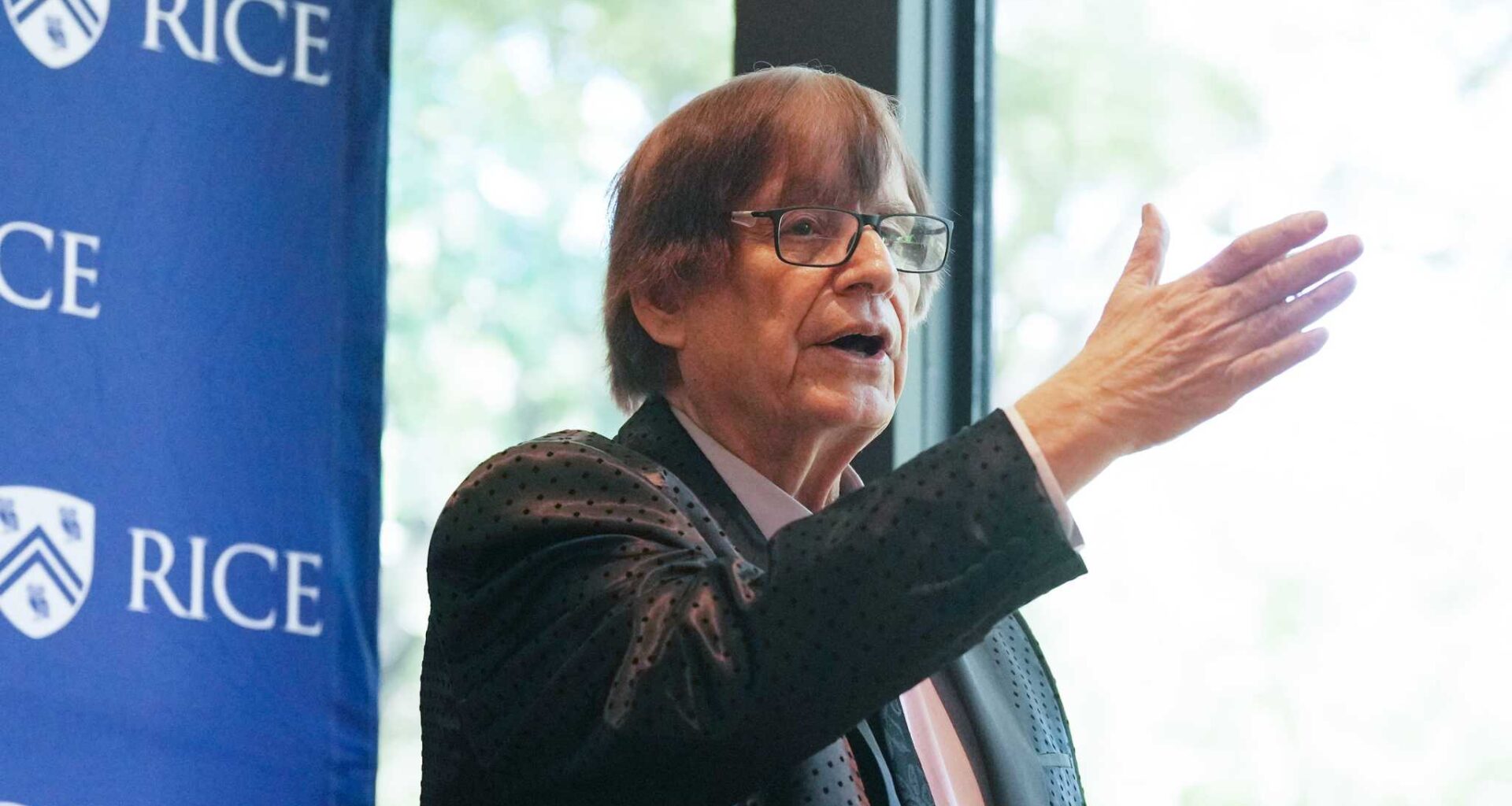
Richard Tapia, a nationally recognized science and mathematics professor at Rice University, gives remarks during a reception in honor of his five decades of service to the university on Wednesday, April 3, 2024 in Houston. Tapia is also widely recognized as a national leader in the preparation of women and underrepresented minorities for advanced degrees in science, engineering and mathematics.
Elizabeth Conley/Staff Photographer
Richard Tapia, a nationally renowned Rice University mathematics professor and fierce advocate for minority representation in STEM fields, died at the age of 88, the university said in a news release Saturday.
Tapia won some of the United States’ highest honors for his advocacy and his more than 50 years of teaching mathematics at Rice, including a Presidential Award for Science, Mathematics and Engineering Mentoring in 1996, and the National Medal of Science in 2011. He was also a founding member of the Society for the Advancement of Chicanos and Native Americans in Science, the university said.
Richard Tapia, shakes hands with a member of Rice’s Mariachi band during a reception in honor of his fifty years of service to the university on Wednesday, April 3, 2024 in Houston. Tapia, a nationally recognized science and mathematics professor at Rice University, is also widely recognized as a national leader in the preparation of women and underrepresented minorities for advanced degrees in science, engineering and mathematics.
Elizabeth Conley/Staff Photographer
Rice University employee Tamara Siler, leans into Richard Tapia, a nationally recognized science and mathematics professor at Rice University, during a reception in his honor on Wednesday, April 3, 2024 in Houston. Tapia is also widely recognized as a national leader in the preparation of women and underrepresented minorities for advanced degrees in science, engineering and mathematics.
Elizabeth Conley/Staff Photographer
Rice University computational and applied mathematics professor Richard Tapia at the Duncan Hall, Saturday, Sept. 4, 2021, in Houston. Tapia is a winner of the National Medal of Science and director of the Tapia Center for Excellence and Equity. Tapia has spent his career supporting and advocating for Latinos and other members of marginalized groups in STEM educational careers.
Marie D. De Jesús/Staff photographer
University Professor Richard Tapia is featured in a 1993 edition of Rice University’s Sallyport magazine.
Rice University
“There are a handful of people that have truly shaped the trajectory of Rice University in our nearly 115-year history. Richard Tapia was one of them,” Rice President Reginald DesRoches said in a statement. “He was truly a pioneering figure in computational mathematics and a champion for expanding access to science and engineering education.”
Article continues below this ad
ALSO READ: Texas Tribune union journalists secure artificial intelligence protections in first-ever contract
The son of Mexican immigrants, Tapia was born in Santa Monica, Calif., and became the first in his family to attend university when he enrolled at the University of California, Los Angeles, where he completed his bachelor’s, master’s and doctorate degrees. Tapia was one of Rice’s first faculty members of color when he joined the school in 1970 as an assistant professor of mathematical sciences.
At Rice, Tapia conducted research on numerical optimization methods, helped author more than 100 research papers and supervised over 30 doctoral candidates, many of them women and students from minority backgrounds, according to the university.
He also dedicated himself to opening pathways in STEM to students from underrepresented communities. He founded Rice’s Tapia Center to advance access to STEM education, a set of initiatives including residential STEM summer camps for high school students and professional development programs for K-12 educators. Tapia also led initiatives to support minority STEM students at Rice, such as the Rice Graduate Education for Minorities and Empowering Leadership Alliance programs.
Article continues below this ad
Richard Tapia (center) on the Rice University campus.
Rice University
“Dr. Richard A. Tapia changed the face of STEM education as ‘the Lion’ of underrepresented communities,” Tapia Center Board of Advisors chair Nicolás Medina said in a statement. “We will miss his indefatigable ‘roar’ to increase the number of minority students and women entering and succeeding in STEM, insisting that ‘yes we can’ and ‘yes we belong.’”
In March 2026, Harris County recognized Tapia’s impact by voting to rename the Ship Channel Bridge, which is part of the Sam Houston Tollway along Beltway 8 East, in Tapia’s honor.
“That seems to be quite the accomplishment, but I never expected a bridge,” Tapia said after the March vote, according to Rice. “I want to be remembered as someone who made other people believe they, too, could do the things that I did.”
On campus, Tapia was known for his passion for mentorship and his outspoken personality. When he wasn’t teaching, Tapia loved to build cars and spent years as a drag racer.
Article continues below this ad
“I don’t want people to look at me and say, ‘Oh, he’s a university professor, and he shows it,’” Tapia said in a 2011 video produced by Rice. “I want them to say, ‘I didn’t know he was a university professor. I didn’t know that he did this, I didn’t know that he did that. I just thought that he built cars for a living.’”
Rice did not specify the circumstances of Tapia’s death, but at a campus event celebrating his 50 years of teaching in 2024, Tapia said that he had been diagnosed with late-stage liver cancer.
“No one is going to say when I die, ‘His life was cut tragically short,’” Tapia said at the 2024 event. “I feel complete in my contributions, and I feel incredibly appreciated by everybody, almost to the point of feeling guilty.”
Richard Tapia, a nationally recognized science and mathematics professor at Rice University, hugs an attendee during a reception in honor of his five decades of service to the university on Wednesday, April 3, 2024 in Houston. Tapia is also widely recognized as a national leader in the preparation of women and underrepresented minorities for advanced degrees in science, engineering and mathematics.
Elizabeth Conley/Staff Photographer