
This article is part of a series of pieces celebrating Glasstire’s 25th anniversary. To see other stories from this series, go here. To see pieces from the month of May, around the theme Training Grounds: Studios, Students & Schools, go here.
I do not call myself a Texan. But Texas is my home. Why are the descriptors “Texan” and “Texas” so potent with meaning? And why are the stakes so high to define things as Texan, especially in the art world? Such high stakes are reflected in the number of books written about Texas artists with the purpose of creating a list or canon of these figures.* Canons are about inclusion but also about exclusion — who makes the cut and who does not. And apparently it matters for Texas art history more than I ever realized.
It does seem that lists of Texas artists become less of a concern or necessity with artists working since 1960. Glasstire does not appear overly interested in constantly justifying the artists it covers as Texan; rather, if it is happening in Texas, it is fair game for inclusion and discussion. But then again Glasstire was not founded as an art historical publication; it was established for the purpose of “art writing” more broadly, and to produce quality, up-to-date art criticism of current art events in Texas. However, in celebrating its 25-year anniversary, the magazine is also thinking more historically. So perhaps it is the right moment to explore, in this very publication, what can or should constitute a “Texas artist” in 2026.
I am pretty adamant about not playing the game of “are they Texan enough” because my own work has been dismissed in this game. Instead, I believe we should examine how Texas, as a place, has shaped so many artists in so many ways. And a place can impact an artist who visits our great state, who passes through it, who stays a while, who comes back several times, who moves here for years, who was born here and moves away, who was born here and stays, and so on.
At first, when thinking about writing this piece, I assumed the distinctions would be between Texas “born-and-bred” artists and everyone else. But when I started reading all those canon-making books with their lists of hundreds of Texas artists, I realized that a large percentage of them were transplants, born elsewhere who migrated to Texas. I am a transplant myself. So, then I started to think the distinction might be between the “native” and the “transplant.” But to transplant oneself in or to Texas, a person must arguably plant and grow some roots. Transplants are therefore folks who have been deeply “nurtured” by the metaphorical soil of Texas, influenced and inspired by Texas as a place. And a significant number of the artists we think of as unquestionably Texan fall into this category.
But then what about the visitors, the pass-throughs, the artists who do not stay put in Texas and plant deep roots, but who are still changed by their time in Texas? I am very interested in such artists and have made a career out of writing their stories. In my previous article in Glasstire, I mentioned Ed Ruscha, whose expansive series of Standard Station images grew out of his numerous, but always brief, visits to Amarillo along Route 66.
I’ve also long studied Georgia O’Keeffe, who only called Texas home for part of the two years from 1912 to 1914, and part of the two years from 1916 to 1918: a total of 37 months if I am counting right. And yet, Stieglitz wrote about O’Keeffe in those years as “the little girl of the Texas Plains.” That of is a powerful and fascinating word. He didn’t say “from” Texas because that would have been false; she was born in Wisconsin. But when O’Keeffe sent work that she made in and about the Texas Plains back to New York City, to be hung in his famous Gallery 291, Stieglitz saw O’Keeffe as being “of” Texas. And he promoted her in the art world according to these terms.**
Another artist I have researched is Elaine de Kooning, who came to Texas 16 times between 1957 and her death in 1989, twice annually in 1959, 1960, 1966, and 1975 (on this, see Three Women Artists). Yet, she only stayed each time for a brief visit, teaching art workshops, making friends and patrons, attending openings of exhibitions featuring her work, but also visiting area ranches, attending fairs and festivals, and exploring the Palo Duro Canyon. Because of these visits, her art shifted dramatically. So, I would argue that Elaine de Kooning can also be of Texas if not from it.
In 1966, The Pampa Daily News described her as “New Yorker by birth, but a Texan at heart.” The article went on to explain how she was “painting Texas” and wearing an orange sweatshirt emblazoned with the word “Texas.” Rather than an easily dismissible small-town paper’s exaggeration, this printed evidence captures an artist actively performing being Texan. For de Kooning, the identity of being Texan was something she loved and admired, and she declared as much in an interview:
“I love Texans… They just do everything in a natural and big way. An easy way. They drink big and drive fast in big cars. I think it has to do with all of that space, and all of that frontier energy that’s still there. In Texas, everything is possible. And Texans are open to new ideas and to art. New things just make sense to Texans.”
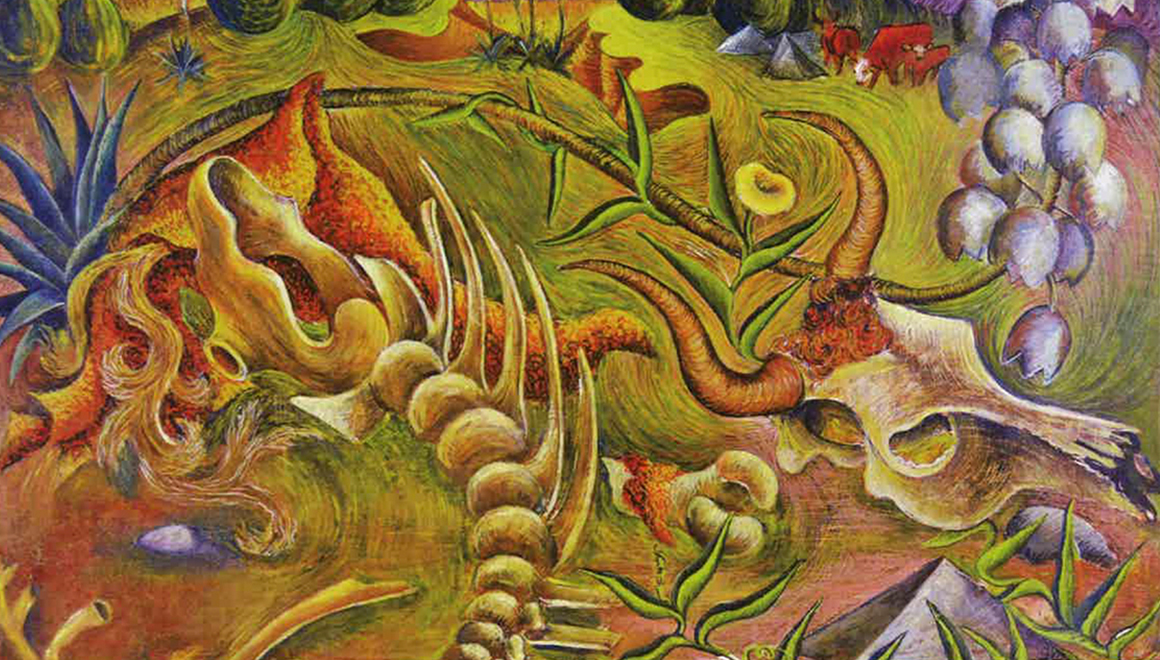
 Elaine de Kooning, “Bull,” c. 1960, acrylic on board, 30 3/4 x 48 1/4 inches. Private Collection in the Texas Panhandle. Photo: Rik Andersen
For someone who never settled in the state, de Kooning sure seemed to understand what makes Texas such an inspiring place for artists. De Kooning’s art also distinctly shifted after her exposure to Texas. Her paintings changed from vertical to horizontal in response to the big skies and wide-open spaces. They embraced warm, arid, and vibrant colors inspired by the canyonlands and sunsets. And they found new subject matter, including images of bulls and bullfights. One could argue these changes occurred because she also spent time in New Mexico and Mexico during these same years. But for de Kooning, Texas was both completely unique and deeply interconnected with these other areas of the Southwest. Her attitude toward Texas makes her a very study-able Texas artist.
And yet, unlike O’Keeffe who gets included in nearly all the canon-writing books on Texas artists, de Kooning never does. Regarding O’Keeffe, authors such as Light Townsend Cummins have asserted “it would be a stretch to call O’Keeffe a Texas artist,” but the book in which he says this — Making the Unknown Known: Women in Early Texas Art 1860s to 1960s — takes its title from an O’Keeffe quote, illustrates her work created in Texas, and mentions her more than a dozen times (pg. 136).
During the planning stages of this book, I co-authored a chapter (with Bonnie Roos) on New York-based artists working in Texas (including de Kooning), which was slated to be featured in this volume. Our chapter focused on the period from 1960 to the 1980s. It examined more than a dozen artists not born in Texas and who never transplanted there. And it explored things happening in the Panhandle, so not in Houston, Dallas, San Antonio, Fort Worth, or Austin. For one or all these reasons, our chapter was ultimately not included in the book. We then reworked it for inclusion in Woman’s Art Journal, and it lives on in a format I am proud of.*** But the exclusion of our chapter has kept me wondering. In what ways was our work not “Texan enough?”
The subtitle of Making the Unknown Known is worth highlighting: “women in early Texas art.” These little prepositions again matter so much. Here, the defined category is “early Texas art” and the book explores the women who were arguably in it. But what does being in the art of a U.S. state mean? It’s kind of like Stieglitz’s of. Are we in Texas, of Texas, or from Texas? The editors of Making the Unknown Known clarify that they mean “within the context of Texas art,” so in points to historical context for them, an important clarification. My playing with words here is not for the purpose of nitpicking semantic choices to find one perfect word, because there is never one to find. But it demonstrates the utter fluidity of the categories of Texas art and Texas artists, and highlights how impactful Texas as a place has been for so many artists in so many different ways.
Going back to O’Keeffe being of Texas, we don’t just have to take Stieglitz’s word for it; O’Keeffe also saw herself according to this of. When she designed and authored her autobiography, published in 1976, she included a significant number of artworks she made in Texas and wrote beautifully about how Texas inspired them. As a woman of 88 years, she looked back on her time in and of Texas as foundational for her artistic career. O’Keeffe lived in many locations during her life: Wisconsin, Virginia, New York, Illinois, Texas, South Carolina, and New Mexico. She traveled worldwide, being inspired by Hawaii, Japan, and Egypt. So, she is arguably of all these places — and that doesn’t make her less of a Texas artist. In fact, the majority of artists in the established Texas canons similarly traveled widely, moved around often, and kept their eyes wide open to inspirations both in and outside Texas.
 Mildred Norris Compton, “West of Town,” c. 1940-41, oil tempera on canvas board, 30 1/4 x 36 3/4 inches. Private collection
In light of my previous article in Glasstire, and recent conversations with Houston art historian Randolph K. Tibbits prompted by my article, I am paying close attention to the Texas artists who spent time in and were inspired by Mexico, as well as Mexican-born artists who lived and worked in Texas — and my list keeps growing. For example, I have now learned that Emma Richardson Cherry, Grace Spaulding John, Forrest Bess, Mary Aubrey Keating, Clara Caffrey Pancoast, Nione Carlson, Anna Keener, and Edith Mae Brisac all traveled to Mexico.**** The artists Santa Duran and Lia Cuilty were both born in Mexico and moved to Texas during the Mexican Revolution, with Duran settling in San Antonio and Cuilty in El Paso and Fort Worth, while Consuelo González Amézcua lived most of her life on the Texas-Mexico border and traveled often between the two. The artist Mildred Norris Compton created some beautiful works inspired by Mexican surrealism while she lived and worked in Texas, and Dorothy Hood resided in Mexico for nearly 20 years, befriended many Mexican artists, and had her first solo show there. So a “Texas artist” can of course appreciate all that the state of Texas has to offer, which includes its international flavors, fluid borders, and long history of migration.
Another important concept here is influence. If an artist like O’Keeffe is influenced by Texas but does not leave an artistic impact on other artists in Texas, does that lessen her “Texasness?” For example, O’Keeffe has been identified by several scholars as the first abstractionist to work in Texas.***** So her influence from Texas has helped shape the development of American and global modernism; in other words, a Texas-based artist was a key player in that history. I would also agree, though, with the assertions that O’Keeffe’s impact on the Texas art scene was minimal in those years; she never publicly exhibited her works of art in Texas while living there, and her students at West Texas State Normal College did not go on to be recognized Texas artists.******
 The faculty in the Art Department of Texas State College for Women, as published in “The Daedalian” (the college yearbook), 1944. Standing: Edith Mae Brisac, Toni LaSelle, Carlotta Corpron, Marjorie Baltzel, Mattie Lee Lacy. Seated: Thetis Lemmon, Coreen Spellman, Mary Marshall, Marie Delleney
In contrast, the cohort of women artists who taught at what is now Texas Women’s University in Denton are not credited with being foundational artists of modernism comparable to O’Keeffe — although they perhaps should be, as D. Jack Davis convincingly argues.******* But they collectively influenced thousands of Texas artists through their roles as educators in arguably “the first studio art department in a public institution of higher education in Texas,” while also exhibiting their art within and beyond Texas. These examples illuminate how variations of influence matter and its directionality is worth examining. Texas artists are inspired by Texas as place, while Texas artists also shape the developments of art within the state. At the same time, Texas-based artists share their work beyond Texas, helping broader audiences see the importance of Texas on the history of art. All these are important for the stories of Texas artists.
To summarize, I have argued several things about the idea of a “Texas artist.” One, the place of Texas has been profoundly influential for a great number of artists, some born here, some not, some transplanted here, some not. Two, a Texas artist need not be only inspired by Texas. Texas artists traveled widely, kept open minds about influences beyond the state, and maintained artistic networks across the U.S. and beyond its borders. Three, one city or region of Texas cannot claim a monopoly on Texasness. El Paso with its deep connections to Mexico, New Mexico, and the American Southwest is still just as Texan as Houston, with its networked roots in the U.S. South or the Caribbean or Latin America. Texas has meant many things to many artists; its richness in nurturing the visual arts is unquestionable. But the history of that nurturing is not fully written yet, and that’s okay. Let’s keep writing it; there’s plenty to say.
*****
*See, for instance, Frances Battaile Fisk, A History of Texas Artists and Sculptors (Abilene, Texas: Self-published, 1928); Esse Forrester O’Brien, Art and Artists of Texas (Dallas: Tardy, 1935); William H. Goetzmann and Becky Duval Reese, Texas Images and Visions (Austin: University of Texas at Austin, 1983); Paula L. Grauer and Michael Grauer, Dictionary of Texas Artists, 1800-1946 (College Station: Texas A&M University Press, 1998); and John Powers and Deborah Powers, Texas Painters, Sculptors, and Graphic Artists: A Biographical Dictionary of Artists Before 1942 (Austin: Woodmont, 2000).
**See especially my article “‘The Little Girl of the Texas Plains’: Georgia O’Keeffe’s Panhandle Years,” Panhandle-Plains Historical Review 85 (2014), 21-56.
***Amy Von Lintel and Bonnie Roos, “The Women: Tops in Art, 1960: Abstract Expressionism in Amarillo, Texas,” Woman’s Art Journal 42, no. 2 (Winter/Fall 2021), 12-21.
****On the artists mentioned in this paragraph, see Making the Unknown Known, passim, and South and North of the Border: Houston Paints Mexico (Houston: The Heritage Society in conjunction with the Houston Public Library, 2018)
*****Making the Unknown Known, in chapters by Light Townsend Cummins and D. Jack Davis, 137, 158, as well as Katie Robinson Edwards, Midcentury Modern Art in Texas (Austin: University of Texas Press, 2014), 6, 21.
******Making the Unknown Known, in chapters by Michael Grauer and D. Jack Davis, 117, 137, as well as Robinson Edwards, 21.*******D. Jack Davis, “Pioneers in Modernism: Women Artists at the College of Industrial Arts (Texas Women’s University),” in Making the Unknown Known, 154-71.