
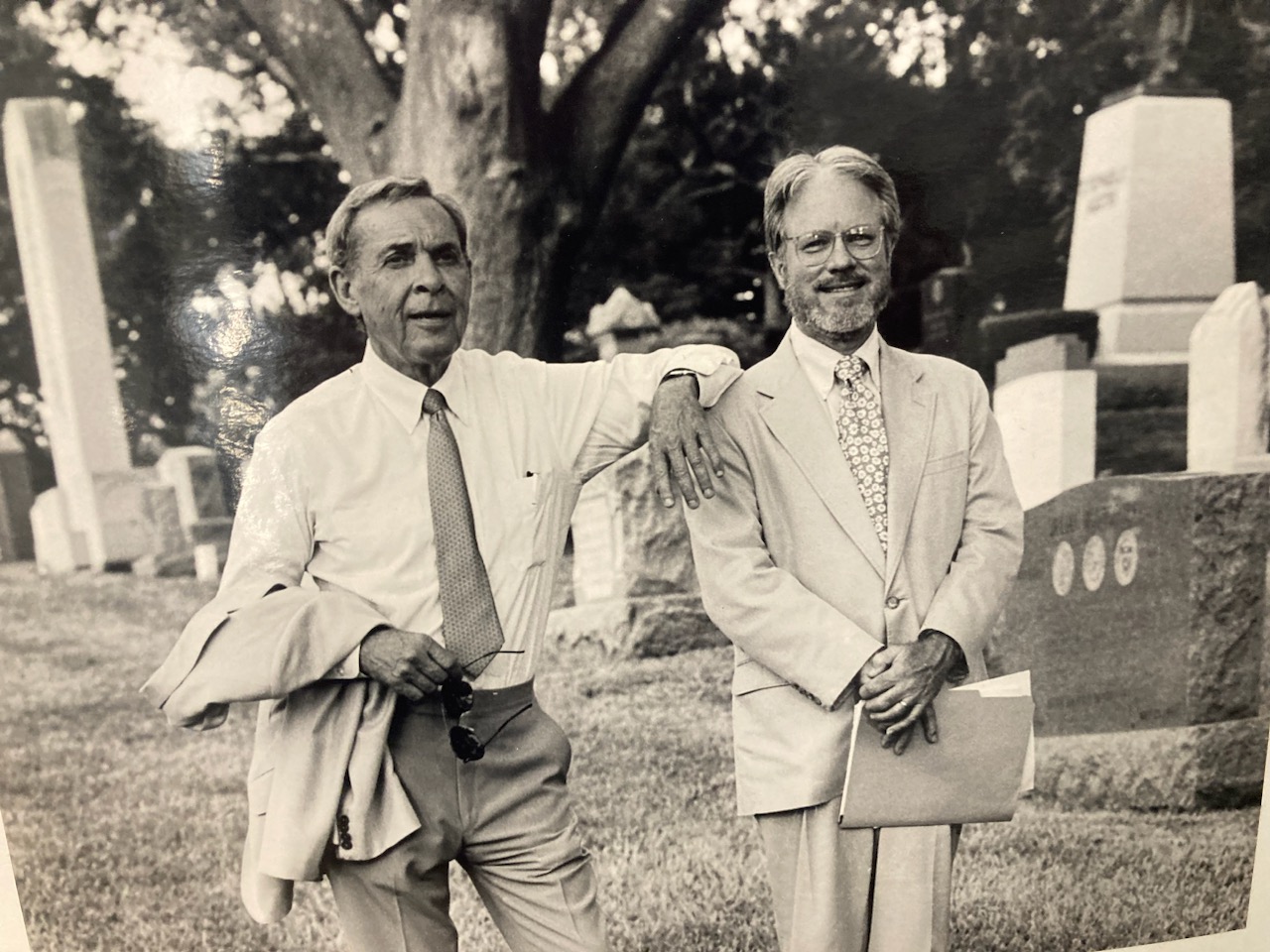
Andrew Sansom (right) with Lt. Gov. Bob Bullock at the Texas State Cemetery in March 1997.
Courtesy of Laura Raun
Given the scarcity of public land in Texas, we should be grateful for the heroes who have, in modern times, set aside millions of acres for parks, preserves and conservation easements.

Last week, we interviewed author, educator and birder Jennifer Bristol, who wrote the eye-opening account of the leaders of this nature-loving movement in her new book, “Wild Women for Good: Stories of Conservation in Texas” (Texas A&M University Press).
Article continues below this ad
In Big Bend National Park, Texas, the Chisos Mountains rise from the Chihuahuan Desert. The mountains, which are volcanic in origin, provide habitat for black bears and mountain lions. The slopes support oaks, junipers, maples, hackberries, ponderosa pines and Douglas firs.
Provided by Linda Lange
This week, we turn to “Andrew Sansom: A Life in Conservation” by former journalist and award-winning public relations counselor Laura Raun (Texas A&M University Press).
We sorely needed this biography, since Sansom has touched every aspect of land and nature protection, especially as head of the Texas chapter of the Nature Conservancy, the Texas Parks and Wildlife Department and the Meadows Center for Water and the Environment at Texas State University.
He could talk the most ornery private landowner — and we’ve got a lot of them in the state — into protecting the legacy of their beloved ranch, farm or recreational acreage.
Article continues below this ad
On a personal note, Sansom told two tired, rumpled road-trip buddies — teacher Joe Starr and yours truly — to document and share our adventures as we traced 50 Texas rivers by car, on foot and in the water. That simple encouragement, delivered in his office overlooking dappled Spring Lake at the headwaters of the San Marcos River, turned into more than 50 newspaper stories, a magazine article in Texas Highways, and a chapter in the book, “Viva Texas Rivers!” edited by Steven L. Davis and Sam L. Pfiester (Texas A&M University Press).
Recently, biographer Raun and I exchanged thoughts on this outstanding conservationist.
How Samsom became a protector of the land
“Andrew Sansom: A Life in Conservation” is a biography by Laura Raun.
Texas A&M University Press
American-Statesman: You call Andrew Sansom the “Teddy Roosevelt of Texas.” Big statement. Why do you think he deserves that title based on his long and effective career in land and nature conservation?
Article continues below this ad
Andy followed in the footsteps of Teddy Roosevelt in the sense that both men spent much of their lives protecting wilderness and wildlife through parks and nature preserves. Roosevelt is credited with helping to protect 230 million acres of land across the U.S., while Andy is credited with helping to preserve a half-million acres just in Texas alone.
Both men loved the outdoors from an early age and were avid hunters. Roosevelt believed that life in nature was good for the soul and he sought to protect it so that future generations could find moral and spiritual renewal there. Andy deeply shared that view.
As leaders, both cultivated relationships to achieve their dreams — building networks of like-minded conservationists and experts.
Talk a bit about his youth in Lake Jackson, right there on a bend of a scenic bayou?
Article continues below this ad
Andy had an idyllic childhood, growing up in a planned community in Lake Jackson with lots of green space to run and play on the banks of the Brazos River. His childhood often sounded like scenes from 1950s TV sitcoms like “Dennis the Menace” or “Leave it to Beaver.” He learned to fish from his grandmother, who taught him how to dig up worms for bait. His father built a boat for him to use on the nearby river and he was an active Scout, attending camps that built character. In his teenage years, he worked as a lifeguard at the public pool, sang in the high school choir and played guitar.
Laura Raun speaking about her book at the 2024 Texas Book Festival.
Courtesy of Laura Raun
How did Sansom’s education and early career set him up for success in the field of conservation later in his career?
As early as his sophomore year at Austin College (in Sherman, Texas), Andy had an idea of where he wanted to take his career. He saw that Texas Tech University had a nationally recognized program in parks and recreation management, and so he transferred there to pursue a degree. Inspired by a professor, Andy had an epiphany — he realized that the outdoors, where he’d spent so much time as a child, needed safeguarding. That became his calling.
Article continues below this ad
Even before graduating from Texas Tech, Andy landed a job as an intern for the National Recreation and Park Association in Washington D.C. That position led to jobs at the Interior Department where he could build skills and gain experience that set him up for environmental leadership down the road.
Saving the Big Thicket, whooping cranes
A wooden bridge crosses a swampy area along the Kirby Nature Trail in the Turkey Creek unit of the Big Thicket National Preserve.
Austin American-Statesman
He joined the campaign to save the last remnants of the Big Thicket in East Texas. What was his role in that fight?
Article continues below this ad
Andy’s role in protecting the Big Thicket was akin to playing best supporting actor to Tom Hanks in the movie “Charlie Wilson’s War.”
Wilson, the larger-than-life congressman from East Texas, not only campaigned for Afghan freedom fighters against Soviet invaders, he also waged war to save the Big Thicket from devastating logging by huge timber interests.
Wilson was aided by Buddy Temple, an East Texas timber baron who pledged to save the Big Thicket from destruction. Andy played supporting roles to Wilson and Temple by ensuring that legislation to protect the swampy thicket made it through Congress. The legislation was a priority of the Interior Secretary Rogers Morton, who told Andy to make sure it passed.
A whooping crane stops at Old Settlers Park, the largest park in Round Rock.
Ricardo B. Brazziell/American-Statesman
How did Andy get involved in protecting whooping cranes on the Texas coast?
Article continues below this ad
His first effort to protect the whooping cranes ended in Andy getting fired for speaking truth to power. In 1972, while working for the Interior Secretary on special projects, he leaked to the media his findings from an onsite study of cranes on Matagorda Island.
Andy argued that military activities on the island should end because they were stopping expansion of the cranes, and he recommended that the island be made a national wildlife refuge. The story was carried on CBS’ “60 Minutes” and other media, prompting the Defense Department to pressure the Interior Department to fire Andy, which eventually happened.
His second effort came in 1994, when Texas Parks and Wildlife combined its state natural area on the island with the federal Matagorda Island National Wildlife Refuge — resulting in his dream of a refuge for the cranes.
When Republicans were greens
Andrew Sansom with kids and baby alligator.
Courtesy of Laura Raun
How did his ties to the Republican Party help him in Texas once we became virtually a one-party state? He seems to be able to work across party lines, right?
Article continues below this ad
Andy got in on the ground floor of the Republican Party resurgence in Texas in the 1980s by virtue of Karl Rove, the political strategist often credited with turning the Lone Star State red. Andy had been impressed by the environmental credentials of leading Republicans in Washington such as Richard Nixon and Nelson Rockefeller. Moreover, he sensed an opening for the GOP in a state that had been heavily Democratic.
Still, Andy believes the current direction of the Republican Party is endangering the future of democracy in the U.S. While he maintains ties to classic R’s like former Texas House Speaker Joe Straus and former Congresswoman Liz Cheney, he has publicly supported Democrat James Talarico for U.S. Senator from Texas.
Land conservation was his area of expertise and his gift. He seemed to be able to talk any landowner into agreeing to keep natural lands intact while making them available to the fair uses of owners. Conservancies have been around for a long time, but they seem particularly right for Texas. Why?
Land conservancies, also known as land trusts, are ideal for Texas because they fit well into a state where 95% of all property is privately owned. Not surprisingly, Texas is one of the strongest private-property rights states in the U.S.
Article continues below this ad
Land trusts allow private property owners to retain some control over their land while giving up certain rights to develop — thus protecting land, water and wildlife.
Andy kick-started the use of land trusts in Texas in the 1980s after the federal Highway Beautification Act, championed by Lady Bird Johnson, created “scenic easements.” The easements also took on conservation purposes and were legally enabled by land trusts, which became one of Andy’s most valuable tools in environmental conservation.
The Santa Elena Canyon Trail in Big Bend National Park runs along the Rio Grande.
Austin American Statesman
Besides his signature role at the Nature Conservancy, he also served as head of the Texas Parks and Wildlife Department. What were some of his wins there.
Article continues below this ad
Andy’s biggest win at Texas Parks and Wildlife was doubling the acreage of state parks while he was at the agency. In 1988, he began as head of acquisitions, where his job was to expand the amount of land protected by the agency. His first deal was monumental — acquiring the Big Bend Ranch State Park. That transaction alone almost doubled the acreage of state parks in Texas.
He followed it with the Devils River State Natural Area, which protected a portion of the most pristine river in the state.
In 1990, he became head of TPWD and continued to focus on acquiring land for management of wildlife that were not hunted for food, sport or fur — activities such as birding. For example, the Caddo Lake Wildlife Management Area was established in 1997.
A think tank for the future
Abby Najera and Riley Yarbrough look at an aquarium in Discovery Hall at The Meadow Center for Water and the Environment at Texas State University on Thursday, Oct. 7, 2021.
Mikala Compton/American-Statesman, Austin American-Statesman
His last main career step was a standalone: the Meadows Center for Water and the Environment at Texas State University in San Marcos. How did he bring so many forces together for this critical think tank?
Article continues below this ad
The Meadows Center brought to bear Andy’s greatest gifts — vision, relationships and compromise. He had to persuade Texas State University that the center was capable of publishing academic research sufficient to justify its existence. He also had to convince the Meadows Foundation that the center was capable of producing white papers that would shape public policy in Texas.
The Meadows Center came to stand as the third leg of its philanthropy — beside its arts school at Southern Methodist University and its mental health policy institute in Dallas.
Andy’s accomplishment was in bringing the players together and guiding the center through the trial-and-error required when charting a new path.
Samsom and his family seem so personable. I think of his friendships with people over land they treasured. Talk a little about his personality and how that helped make him so effective.
Article continues below this ad
Andy has very high emotional intelligence — meaning that he is aware of his own emotions, manages those emotions, has empathy for other people, and communicates intentionally. He’s an excellent listener and a keen observer of body language.
These traits made him a very effective leader, for example, when he ran Texas Parks and Wildlife. He wanted to lift up the parks side of the agency to be on a par with the wildlife side — and he managed to do that without causing an exodus of staff members.
His emotional IQ also made him a trusted party when negotiating with others, for example, to acquire land for public parks and nature preserves.
Article continues below this ad
He persuaded landowners that the emotional return on their property was just as rewarding as the financial one.