
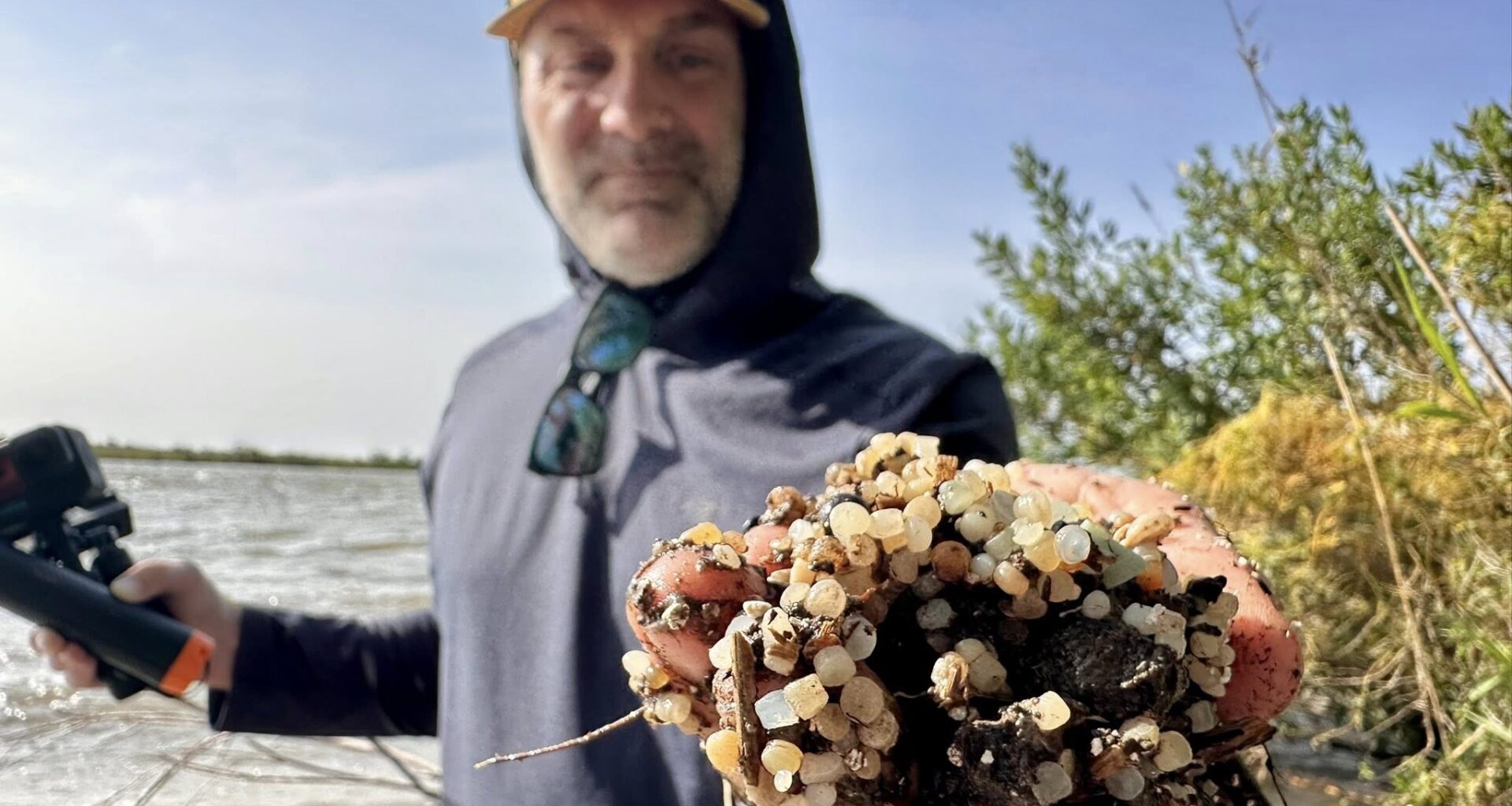
A volunteer at the second annual International Plastic Pellet Count shows a handful of nurdles discovered near the Dow plant in Seadrift, Texas.
Courtesy Luke Metzger
If you walk some Texas shorelines long enough, you’ll eventually start noticing something common that you probably never noticed before: tiny popcorn kernel-sized pellets, that are white, gray or translucent. At first they look insignificant. Then you realize they are everywhere.
These plastic pellets, often called “nurdles,” are the raw material used to make nearly every plastic product in our lives. And they are escaping by the billions into Texas waterways, where they spread toxic chemicals and harm wildlife.
Earlier this month, as part of the second annual International Plastic Pellet Count, volunteers across the country surveyed rivers, bays and beaches for plastic pellets, finding them at 70% of the locations where they looked.
Article continues below this ad
But nowhere was the problem more visible than in Seadrift, Texas, where Diane Wilson and her team with the San Antonio Bay Estuarine Waterkeeper documented an astonishing 715,000 pellets on a single day.
The discovery highlights why Texas regulators should be tightening oversight of pellet pollution — not weakening it.
However, Dow, which owns a petrochemical facility in Seadrift, is asking Texas regulators to loosen regulations on discharges of plastic pellets from its Seadrift facility into surrounding waterways.
After Wilson announced plans to sue Dow over ongoing pellet pollution, the chemical company and its subsidiary, Union Carbide Corporation, filed a request with the Texas Commission on Environmental Quality (TCEQ) to amend its wastewater permit to authorize the discharge of pellets. An attorney representing San Antonio Bay Estuarine Waterkeeper told the Texas Tribune that request is “unprecedented.”
Article continues below this ad
TCEQ should deny Dow’s request.
Despite protestations to the contrary by some, pellet pollution is largely preventable. A landmark settlement last year proves it and should serve as a blueprint for other states to enforce pollution laws. Through the settlement, the plastic manufacturing company Styropek, Pennsylvania state regulators and environmental groups all agreed that it was possible to completely eliminate plastic pellet pollution from the company’s facility in Monaca, Pa., imposing penalties on the company if even a single pellet escapes into local waterways. Similar settlements had already been reached in Texas and South Carolina.
Facilities can install filters and screens. They can cover drains, improve containment systems, strengthen cleanup procedures and redesign loading operations. And they can implement cutting-edge monitors to verify pellets are not escaping. Some facilities already operate under zero-discharge standards for pellets.
TCEQ should set a clear “zero discharge” standard for plastic pellet pollution and require companies to monitor their wastewater and stormwater and report any illegal discharges.
By contrast, if TCEQ grants Dow’s request, preventing pellet pollution could become even more difficult.
Article continues below this ad
Texas officials appear to recognize the seriousness of the problem. Attorney General Ken Paxton recently sued Dow, Union Carbide and Braskem over alleged pellet pollution and wastewater violations at the same Seadrift complex.
According to the lawsuit, investigators found pellets floating on waterways, along shorelines and in and around facility outfalls. The state described the companies as being in “habitual non-compliance” with permit requirements.
That makes Dow’s request even harder to justify. As other states like Colorado clamp down on plastic pellet pollution, Texas shouldn’t retreat.
The Texas coast, home to a variety of marine wildlife, is a place where Texans and out-of-state visitors love to go for fishing, birding and recreation. Protecting this special place is worth the effort. Texans should not accept the idea that preventing visible plastic pollution is somehow too much to ask from anyone, let alone one of the world’s largest petrochemical companies.
The volunteers documenting pellet pollution this spring are doing work regulators should pay attention to. They are showing, in plain sight, that this problem is real, widespread and ongoing.
Article continues below this ad
Texas now faces a choice: Require plastic companies to keep pellets out of our waterways, or continue allowing our bays to be plastic dumping grounds.
Luke Metzger is the Executive Director of Environment Texas, a nonprofit working to protect the natural world.