
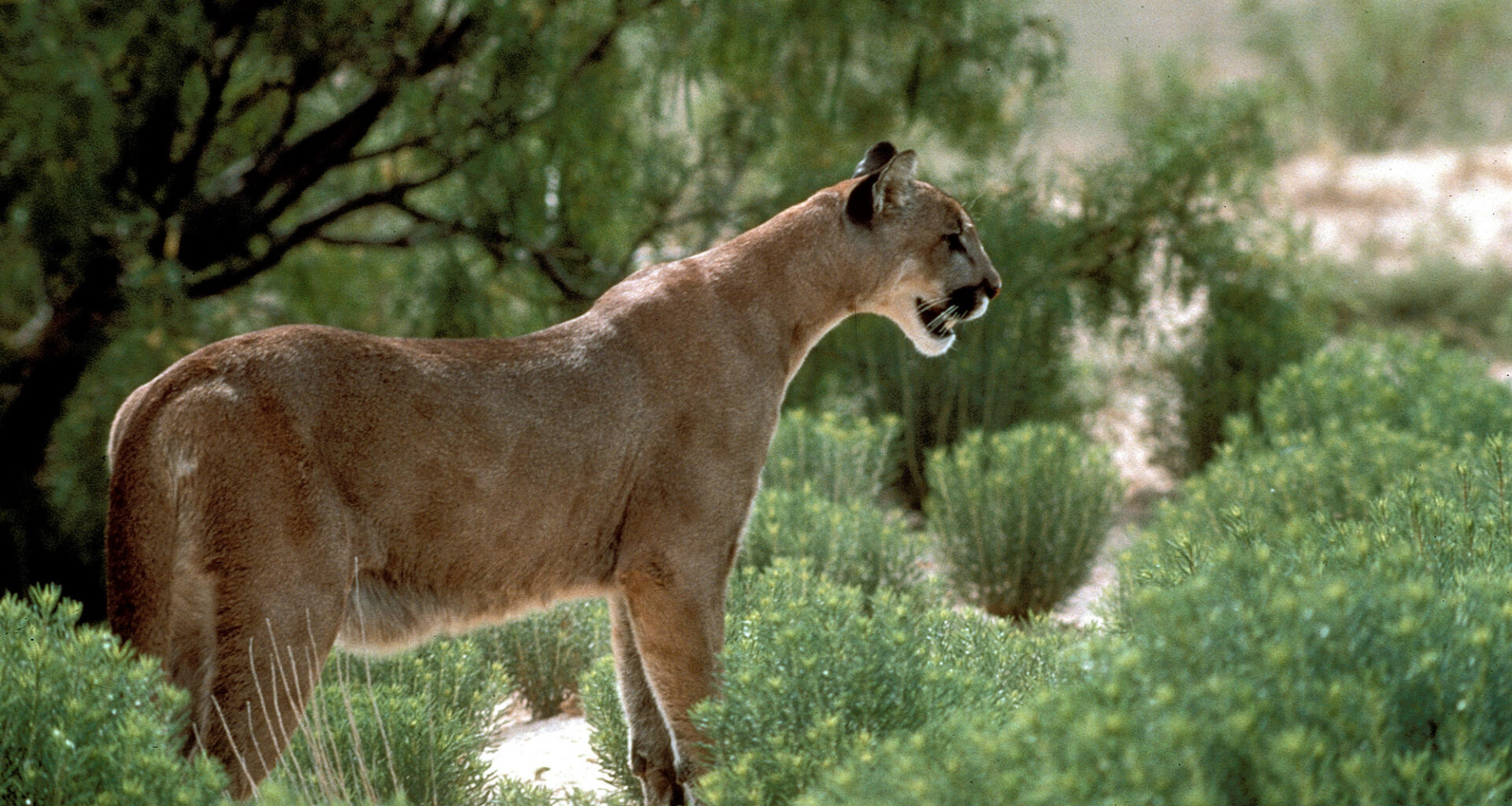
Mountain lion populations exist in the Trans-Pecos and South Texas regions, but Texas does not have an official population estimate for the species.
TPWD/Texas Parks and Wildlife Department
The Texas Parks and Wildlife Commission’s consideration of mandatory harvest reporting for mountain lion hunters and trappers this week marks a pivotal moment in the state’s approach to the species.
If the proposal is approved, Texas hunters and trappers would have to report their harvests within 24 hours and submit a premolar and tissue sample within 60 days to confirm the animal’s age and sex. Reporting would be confidential and at the county level. No ranch or landowner would need to be identified.
While the proposed mandate has been met with opposition as a potential steppingstone to future regulation, supporters of mandatory harvest reporting consider it a necessary tool for monitoring and collecting data on one of the state’s most enigmatic animals.
Article continues below this ad
“Nobody knows if there are 100 mountain lions, 500 mountain lions, 1,000 mountain lions, 10,000 mountain lions. And that’s just insane for us to have this awesome apex carnivore that nobody wants to see extirpated, and we have no idea how many of them there are,” said Ben Masters, a filmmaker whose work has spotlighted the plight of Texas mountain lions.
“That’s extremely irresponsible to be living in ignorance like that, especially whenever we have a state that is fragmenting so quickly with such large population growth and the stresses on these cats are just increasing over time.”
Masters is a member of Texans for Mountain Lions, a coalition of scientists and conservationists urging the Texas Parks and Wildlife Department to monitor and manage the species. Efforts in Texas to initiate mountain lion management have spanned back decades. In 1991, the Sierra Club submitted a petition for rulemaking requesting the Texas Parks and Wildlife Commission “to adopt rules, first on an emergency basis and then permanently, to regulate the taking of the mountain lion in Texas.” That petition was ultimately denied.
Texans for Mountain Lions submitted a petition for rulemaking to TPWD in 2022 that outlined a six-step plan for enhancing the management of mountain lions in the state, including a call to conduct research, mandate harvest reporting, require trap checks within 36 hours, limit the take to five animals per year in all counties of TPWD’s South Texas Plains Wildlife District, outlaw canned hunting and create a stakeholder advisory group.
Article continues below this ad
TPWD’s Mountain Lion Stakeholder Group formed in 2023 and was helmed by former Texas Parks and Wildlife Commission chairman Joseph Fitzsimons and included ranchers, researchers, trappers/houndsmen and advocates. They agreed that the state lacked sufficient data and needed a management plan. The group also agreed that the state’s ability to monitor mountain lions suffered from a lack of harvest data, but was split on the notion of whether harvest reporting should be made mandatory.
Jonah Evans, TPWD’s nongame and rare species program leader, said voluntary reporting is insufficient for the purposes of constructing a population model for mountain lions. The death rate is a key component in assessing mountain lion populations, and currently a missing piece. Mandatory harvest reporting would be a fundamental part of the state’s 10-year mountain lion research and monitoring plan.
“For several decades, the department has attempted to engineer an effective voluntary reporting system for mountain lions. And other states with hunted lion populations, they rely on mandatory harvest reporting. And compliance is generally high enough to represent total harvest,” Evans told the commission in March.
An elusive apex predator, mountain lions are difficult animals to survey with sprawling home ranges that can extend more than a quarter-million acres. Individuals are difficult to identify through photographs and videos as mountain lions do not have the distinct rosette coats of other big cats like ocelots or unique spotting like bobcats. Mandatory harvest reporting is considered by TPWD to be the most cost-effective manner to put together an accurate population estimate.
“You don’t do very well in Texas by mandating people do anything,” said Jeremy Harrison, founder of the West Texas Big Bobcat Contest.
Article continues below this ad
“We’re a very rebellious bunch. ‘Come And Take It.’ Remember that? So, if you want to help people or get people to do something, you can do it a lot easier by rewarding them rather than threatening them with a ticket or mandating.”
Harrison said he’d like to see a mountain lion data-collection program that is incentive-based, not mandated.
“A common misconception is that we simply need more voluntary reporting. However, the underlying issue is that the number of voluntary reports received fluctuates unpredictably from year to year, and they are an unknown proportion of the total harvest,” Evans told the commission in March.
“Staff have sought input from outside statisticians and population modeling experts, and received widespread agreement that voluntary harvest data are simply too unreliable to be used for population estimation purposes.”
Harrison sees mandatory harvest reporting as a “slippery slope” that will lead to more regulation and an infringement of private property rights.
Article continues below this ad
“The mandatory harvest reporting program is going to bite us in the ass,” Harrison said.
Harrison views mandatory reporting as a double-edged sword. Regardless of the level of compliance or the total lions reported, Harrison says the numbers will be used to justify further regulatory change.
“Regardless of which way it goes, it’ll be detrimental to hunters,” he said.
Harrison believes mountain lions are flourishing in Texas and that the debate over mandatory reporting is more about culture than science. He does not want Texas to replicate the predator management policy of western states.
Though mountain lions are considered nongame and an act of the Texas Legislature would be required to change that, TPWD still has the statutory authority to limit take of nongame species. TPWD has no current plan or proposal for bag limits on mountain lions.
Article continues below this ad
Asked what ideal predator management in Texas would look like, Harrison said, “Leave it alone.”
Masters has a different take on harvest reporting.
“Harvest reporting is the most critical tool in all of the other states for understanding their mountain lion populations and their age structure and the health of those populations,” Masters said.
“It’s a very supported practice amongst hunters and the conservation community because it is a cost-efficient manner to obtain data that can allow us to better manage wildlife.”
Masters and other members of Texans for Mountain Lions want mandatory harvest reporting to provide information that will clear up what they consider to be a mystery.
“My hope is that harvest reporting will show that our mountain lions are doing well. That we have old cats. That this anecdotal information of ‘cats are doing well’ is true. I sincerely hope that,” Masters said.
“I hope mountain lions are doing great in Texas because what that would mean is that not only does our private land stewardship model produce the greatest quail habitat left, the best deer, some of the best-managed landscapes in the world, but also that this private land stewardship model is supporting a large carnivore. And what a pride we should take in that. And if that’s the case, we shouldn’t have any more regulations. And I sincerely hope that’s what we find.”
However, Texans for Mountain Lions cite research that shows cause for concern.
Mountain lions were extirpated from much of the species’ historic range in Texas by the early 20th century, largely because of aggressive hunting and trapping efforts. Today, distinct breeding populations exist only in the ecoregions of the Trans-Pecos and South Texas, with a 2011 Texas A&M-Kingsville study indicating a decrease in genetic diversity in the South Texas population, which could mean it’s isolated and vulnerable to blinking out. Research also shows that humans are the main driver of mountain lion mortality in the state. The 16 cats collared in a Big Bend Ranch State Park study in the 1990s all died on adjacent private lands; 15 were trapped and one shot. A more recent study in the Davis Mountains showed a nearly 50% annual mortality rate with most deaths occurring in traps.
Harvest reporting is not unprecedented in Texas for other species. It’s been the statewide rule for turkey hunters the past two springs and a requirement for East Texas turkey hunters since 1995. Alligator gar is another example. Anglers who harvest the species in public waters other than Falcon International Reservoir must report it within 24 hours.
Hunters and trappers in Texas can harvest as many mountain lions as they want throughout the year if they possess a valid hunting license and landowner permission. Texas and Utah are unusual in allowing recreational trapping of mountain lions without bag limits, though Utah requires harvest reporting. Management of mountain lions in Texas, a state that is more than 95% privately owned, has largely been left to the landowner.
Texas’ approach is a stark contrast to the way mountain lions are handled in other states with breeding populations.
In Colorado, for instance, the state manages mountain lions as big-game animals and intensively regulates the hunting of the species. Hunters are allowed to harvest one lion per year during a set season with the proper licenses. They are also required to report the harvest within 48 hours and take the head and hide to a Colorado Parks and Wildlife Department office within five days for inspection. Other states with confirmed breeding populations that regulate mountain lion hunting and require harvest reporting are Arizona, New Mexico, Nevada, Wyoming, Montana, Idaho, Washington, Oregon, Nebraska and the Dakotas.
Both coasts provide more stringent examples.
The California Wildlife Protection Act of 1990 permanently outlawed recreational hunting of mountain lions nearly two decades after Gov. Ronald Reagan signed the first moratorium on lion hunting in the state. Today, mountain lions can be legally killed in California only under depredation permits to protect livestock, in self-defense, or by law enforcement to protect public safety.
The Florida panther is protected as an endangered species and killing one could result in severe punishment under both state and federal laws, including prison time and heavy fines.
Mountain lions are also protected in nearby Louisiana, Arkansas and Oklahoma, where two mothers with kittens were documented in 2024 and later confirmed by the Oklahoma Department of Wildlife Conservation. The discovery is an initial indicator that lions could be breeding in the state. Mountain lions are considered a game species in Oklahoma, but the hunting season has been closed since 1957. Lions can only be killed in self-defense or because of depredation, and in those cases ODWC must be notified immediately and the carcass turned in within 24 hours.
Texas is on the other end of the spectrum. Before canned hunting was banned and trap checks were required every 36 hours in 2024, Texas was the only state with breeding populations of mountain lions without any form of protection for them.
“We have the worst mountain lion management and monitoring of pretty much any place in the world, which is just ridiculous because people want to see mountain lions out there. They’re cool,” Masters said.
“Whenever you remove mountain lions from a landscape, you just neuter that landscape. It’s a huge step into turning it into pavement. And I love wild country. I love Texas. A Texas without mountain lions is definitely a place that pretty much nobody wants to live in. We should monitor these cats. We should manage these cats. We should have them into the future.”
Harrison echoed his admiration for mountain lions, too.
“I love them. I don’t think there’s another predator in the world like a mountain lion. They’re iconic. They’re part of our Texas history. They’re part of our very makeup. I mean, they are unbelievable animals. The last thing in the world I would ever want to do is wipe them out,” he said.