
Kori DelaPeña’s six-year-old daughter drowned in a pool. Michelle Bannon’s teenage son died in a sailing accident.
Both women, along with other families who have lost children to drowning, were at the Texas Capitol early this month to remind people of the risks they face as summer approaches.
Their stories of loss were part of Texas Water Safety Day, an event hosted earlier this month by the Texas Water Safety Coalition, a partnership of organizations, advocates, and professionals dedicated to preventing fatal and non-fatal drownings.
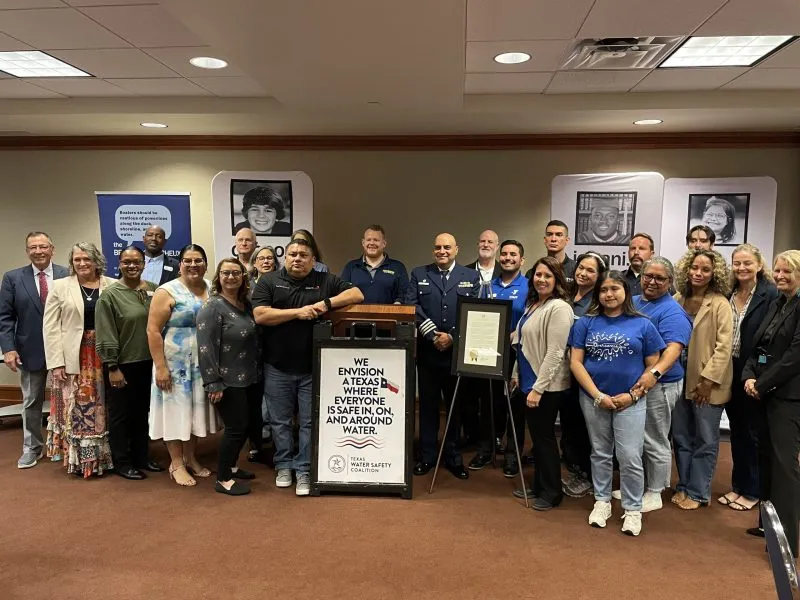 The Texas Water Safety Coalition and local advocates marked Water Safety Month by promoting safe swimming, boating safety and drowning prevention initiatives.
Credit: Piper Guinn
The aim of Texas Water Safety Day, the beginning of Texas Water Safety Month, was to raise awareness of the continuing tragedy of deaths by drowning, which begin to rise in May and peak in July.
Alongside Austin Public Health and the YMCA, the affected families discussed prevention methods and legislative actions that are planned to extend beyond just this month.
“We can’t bring our child back, but we can protect yours,” said Bannon, who with her husband founded Boat Safe and Live following the death of their son, Will.
 Kori DelaPeña
“All of these deaths were preventable,” added DelaPeña, founder of water-safety nonprofit Live Like Cati. “When we educate our legislators as a coalition, we always say, ‘Hey, you know, these stories are important because we want you to understand that they were all preventable.’”
Cati’s story
In June 2019, DelaPeña dropped her daughter Cati off at a summer camp. Despite DelaPeña telling the staff that Cati couldn’t swim, she was allowed to enter a pool without a life jacket. Because of this, Cati never came home.
That same year, DelaPeña launched Live Like Cati to promote water safety. She now travels Texas to educate about the value of life jackets.
DelaPeña also pushed the state legislature to enact a comprehensive water safety law, resulting in Cati’s Law, also known as House Bill 59, in 2023. Authored by State Rep. Vikki Goodwin (D-Austin), the law prohibits child-care facilities licensed by the Health and Human Services Commission from allowing a child 12 or younger to enter a pool or body of water without written consent from a parent or legal guardian.
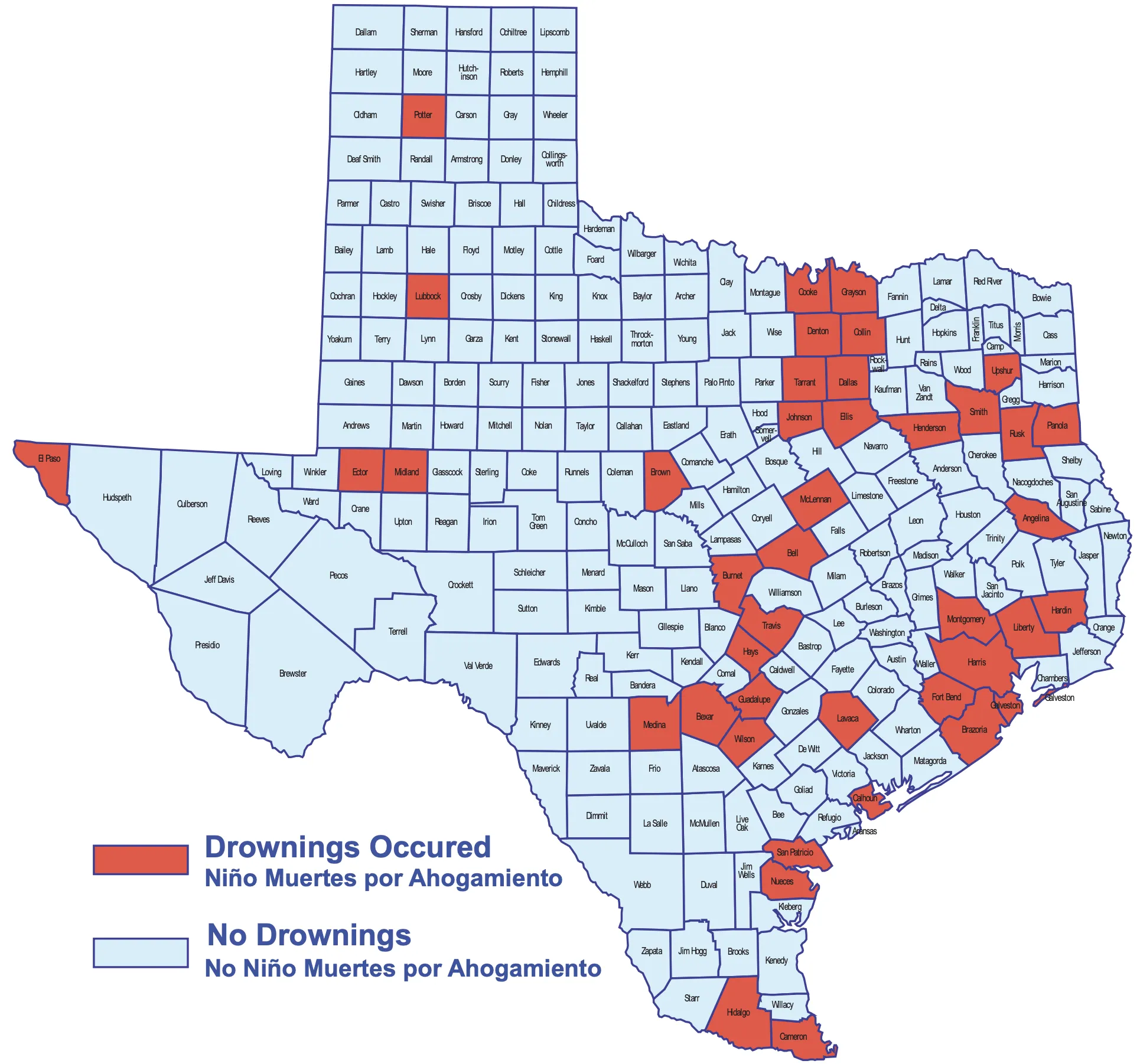 2025 fatal drownings by county in Texas
Credit: Texas Department of Family and Protective Services
The bill also mandates that facilities ensure each child who cannot swim is wearing an appropriate life jacket. According to DelaPeña, Cati’s Law was the first of its kind in the nation.
The Live Like Cati founder said that she would like to see Cati’s Law expanded to apply to children 18 or under rather than just those 12 or under.
The Austin Independent School District “had a drowning of a 15-year-old boy last year at a school field trip. And because the state doesn’t require a field trip form for any kid over the age of 12, this kid did not have one,” DelaPeña said. “So nobody knew if he could swim or not, and he drowned.” In the year since, Austin ISD has expanded its water safety policy to cover all children under 18.
Drowning disparities
According to the CDC, the U.S. drowning death rate moves with the temperature, rising in May, reaching a peak in July, and declining in September. The highest monthly number of fatalities in the last five years was 790 in July 2022.
From 2018 to 2021, the age-adjusted drowning death rate in Texas was 1.44 per 100,000, placing it in the middle of the pack compared to other states. Last year, 88 children drowned in the Lone Star State, according to the Department of Family and Protective Services. Nationwide, the CDC has found that more children aged 1 to 4 die from drowning than from any other cause.
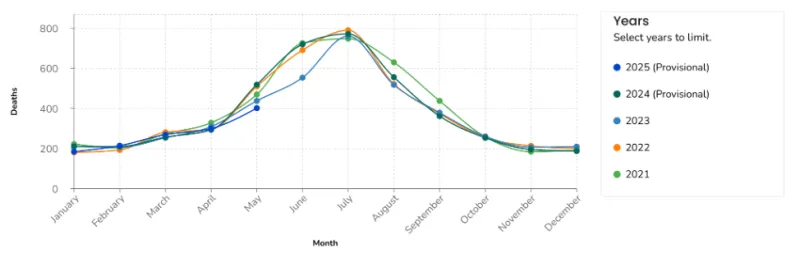 Year-over-year fatal drownings by month nationwide
Credit: Centers for Disease Control and Prevention
The death by drowning rate is not consistent across demographics. According to the CDC, from 1999 to 2019 the drowning rate for American Indians or Alaskan Natives under 30 was 2.5. For African-Americans it was 1.8. Those rates were, respectively, 2.0 and 1.5 times higher than among Whites. The CDC attributes this to different swimming abilities across racial/ethnic groups in combination with environment, behavior, and underlying medical conditions.
Additionally, U.S. counties with high social vulnerability, meaning more poverty and other negative socioeconomic factors, experience fatal drownings 1.59 times as often as counties with low social vulnerability, according to the CDC.
Layers of protection
 Todd Mers
, a public health program manager for the City of Austin who was present at the Capitol for Water Safety Day, later discussed measures that Austin Public Health is taking to prevent drowning.
He described five layers of protection: barriers and alarms, supervision, water competence, life jackets, and emergency preparation.
Mers works for the Environmental Protection Division of Austin Public Health, which oversees pool inspections throughout the city. He noted that his division is doing its part to cover the barriers, alarms, and emergency preparation aspects of protection.
“We’re going to work with the contractor to make sure everything is installed properly,” Mers said. He added that correctly latched pool gates prevent children from entering dangerous areas without supervision, and proper pool cleanings allow lifeguards to see if anyone is sinking – though not all pools in Austin require lifeguards.
On the water competence side, Mers pointed to the Greater Austin YMCA as a local leader. Through Project SAFE, a collaborative effort with the nonprofit Colin’s Hope, the YMCA educates children on safety in and around water.
 Octavio Sanchez
At the Capitol on May 1, Greater Austin YMCA’s executive director of aquatics, Octavio Sanchez, spoke to the organization’s approach to aquatics lessons through the equity lens, emphasizing that its services are available at no cost.
“We try to make sure our program is accessible to everyone,” Sanchez said. “You don’t have to be a member of the Y to take swim lessons. We also offer membership-for-all scholarships so that families can join the YMCA at a discount. Learning how to swim is just one layer we can do to help our kids.”
“None of us can do this work by ourselves,” Mers emphasized. “Each of us has a part.”
DelaPeña similarly highlighted the need for collaboration in ensuring water safety.
“That’s why the (Texas Water Safety) Coalition to me is so important,” she said. “We work with hospitals and entities all across the state of Texas, and we’re all working toward the same purpose: to prevent drownings.”
Piper Guinn is the health equity reporter for the Austin Free Press, covering the disproportionate health burden carried by our city’s most vulnerable. Piper is a native Texan and recent graduate of Whittier College, where she received a B.A. in political science.