
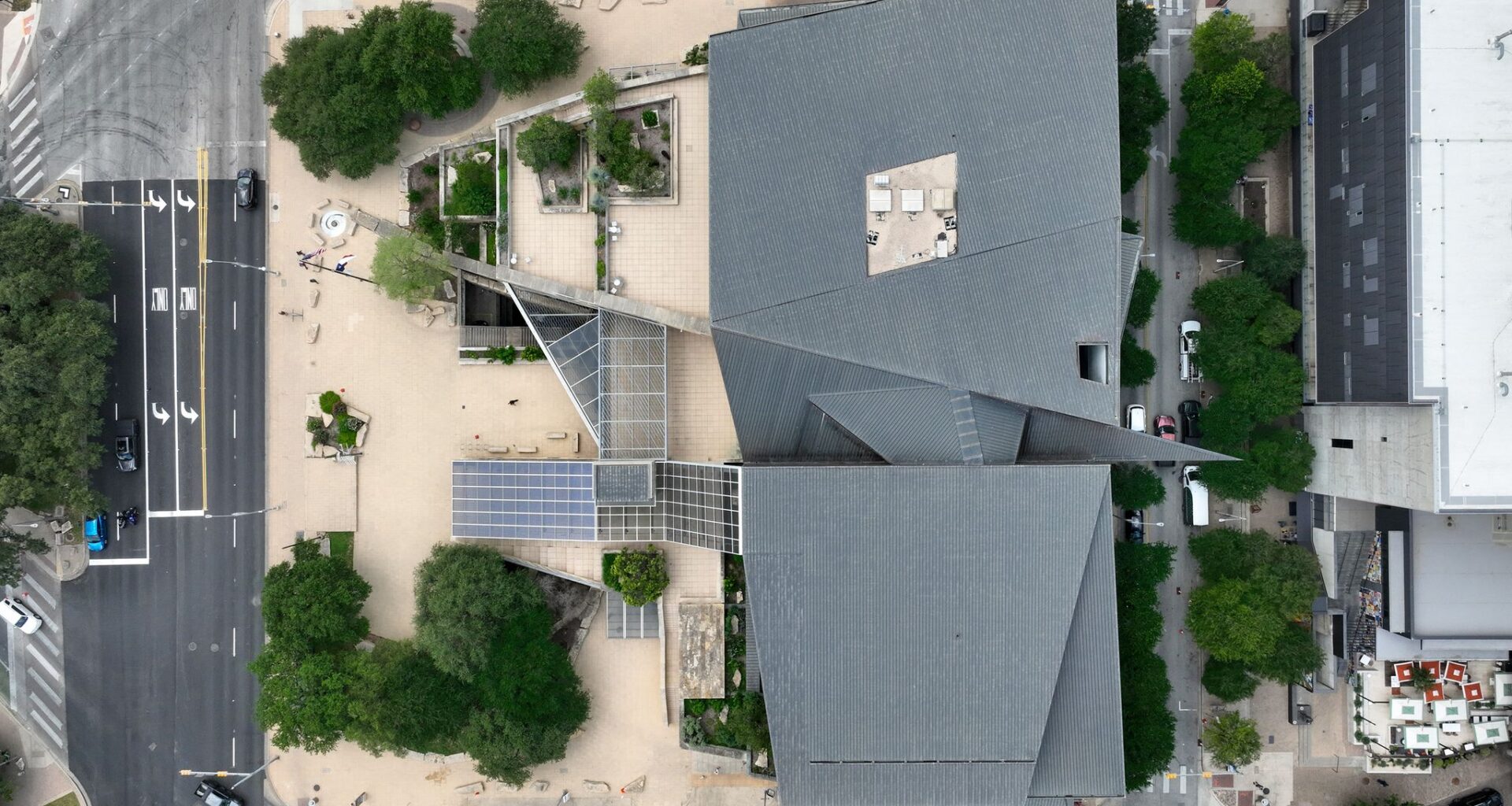
At the back entrance to Austin City Hall, a sharp metal point juts out over West Second Street — a strange architectural flourish that has fueled one of the building’s most persistent legends: That it is shaped like an armadillo.
For a city that prides itself on staying weird, the story feels almost too perfect: The people’s house is secretly configured as the revered state animal, which has a long pointy tail. The tale prevailed in part thanks to the building’s primary architect, the late Antoine Predock, who referred to the project as “the animal” during the design phase and later seized on the armadillo comparison while presenting his work.
Austin City Hall on Monday, May 18, 2026.
Jay Janner/Austin American-Statesman
“He actually loved it,” former Austin City Manager Toby Futrell said of the analogy. “Later when he lectured about the design of City Hall when he was going through his body of work, he would call it the ‘armadillo tail.’”
Article continues below this ad
But from the air, City Hall looks nothing like an armadillo. The building reads instead like a collection of sharp angles, layered stone and contemporary forms inspired by the Hill Country landscape. Other former city officials around at the time, as well as Predock’s design partner, say the inspiration for the pointed projection was more likely the local topography.
Austin architect Phil Reed, who worked with Predock, said the cantilever was never described internally as an armadillo tail.
“Looking back at it, no one could really say definitively what Predock thought that part of the building was, because he never really elaborated about it,” Reed said. Predock “probably thought of it like a shard, or broken bedrock. The strata of the building were meant to represent the way limestone erodes — hard layer, soft layer, hard layer.”
Article continues below this ad
Inspired by Bull Creek, not an armadillo
Austin City Hall on Monday, May 18, 2026.
Jay Janner/Austin American-Statesman
Though the building wasn’t designed to resemble an animal, it was intentionally rooted in Austin’s landscape.
Predock sometimes rubbed city leaders the wrong way — at one point joking about Austin’s “terminal democracy” — but he also spoke openly about being inspired by the city’s terrain and atmosphere.
Article continues below this ad
“The moonlights, the magic, the exuberance always grabbed me,” he told the American-Statesman in 2004. “When I’m working on a project, I need to tune into the place, so I took trips to the Hill Country and brought back impressions of escarpments, which struck me as an abstraction for the building.”
Futrell recalled Predock spending weeks wandering Austin while developing the design. Much of that time was spent walking Bull Creek and studying limestone outcroppings whose cream and copper tones later influenced City Hall.
Futrell still keeps two of Predock’s original Bull Creek sketches framed in her office.
The building’s jagged edges and layered forms — including the pointed feature over Second Street — were intended to echo those natural formations, she said.
Article continues below this ad
Current Mayor Kirk Watson, who also served as mayor from 1997 to 2001 during the project’s early stages, said City Hall was designed to feel distinctly Austin, though not in any literal sense.
“No, the building wasn’t designed by Predock to look like an armadillo,” Watson said. “However, he was very intentional to incorporate things that he thought made it distinctly Austin.”
Tail or stinger?
Austin City Hall on Monday, May 18, 2026.
Jay Janner/Austin American-Statesman
While the pointy projection was apparently never referred to as an armadillo tail until much later, Reed and others recalled another animal-related nickname: The stinger.
Article continues below this ad
The moniker was likely born out of an incident at the old City Hall building that left Predock bleeding profusely.
Daryl Slusher, who was serving on City Council when the design was commissioned in 1998, recalled that the original architectural model included the same sharp spike now hanging over Second Street.
During one presentation, Predock accidentally leaned too close and cut his forehead on it.
Predock continued presenting anyway while holding a handkerchief to his head, Slusher said, and city staff later added a rubber tip to the model as a safety measure.
Article continues below this ad
The incident helped cement the “stinger” nickname.
“‘Stinger’ is good,” Predock later joked. “Because Austin has such an attitude.”
At some point, the armadillo comparison took over.
Article continues below this ad
In the end, the nickname became part of the building’s identity — not because that was the architect’s original vision, but because Austinites decided that was what they saw in it.
“He definitely was thinking of something more geological,” Reed said. “The armadillo reference was probably just a joke.”