
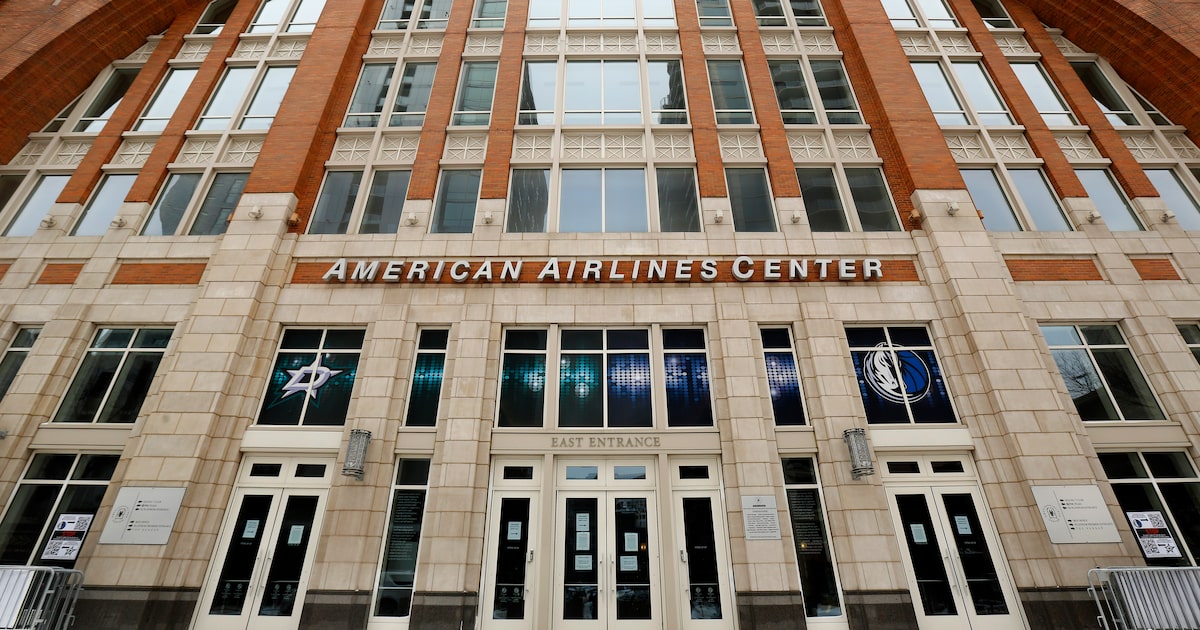
For most fans the news seemingly came from nowhere, like a thunderbolt on a cloudless afternoon.
Wait, what? The Mavericks and Stars for the last 12 months have been embroiled in a bitter cold war? The Mavericks have withheld tens of millions of dollars from the Stars? Dallas’ NBA and NHL franchises are suing one another?
As all of this sinks in and Mavericks and Stars attorneys prepare to skirmish in Texas Business Court, fans are left to ponder the falling-out’s potential short- and long-term repercussions.
How might it affect the teams on the court and ice? Should the public worry about bickering billionaire team owners? Or that the franchises only communicate through attorneys?
Sports Roundup
“It’s a non-issue for fans,” said Mark Cuban, who in December 2023 sold a controlling interest in the Mavericks to the Miriam Adelson and Patrick Dumont families, but still owns 27% of the franchise.
Answering emailed questions from The Dallas Morning News, Cuban diplomatically weighed in for the first time since MavsStar Wars became public.
Cuban described his relationships with Stars owners Tom Hicks (1996-2011) and Tom Gaglardi (2011-present) as cordial.
He said he can’t recall “one way or the other” whether he was aware of the clause in both teams’ 1998 franchise agreements requiring them to maintain their headquarters in Dallas.
In 2016, Cuban purchased 14 acres in the Design District and moved the Mavericks’ headquarters and training facilities there.
He told The News at the time he’d been approached by neighboring cities and “could have played the leverage game to get money, land or other incentives,” but “I want to be as loyal to Dallas as it has been to me.”
Whether that 1998 clause was known to the Cuban regime or unearthed and wielded only after Dumont became governor, it’s the crux of why the Mavericks and Stars are in court.
At issue is whether the Stars breached the clause by having their headquarters in Irving in the late 1990s and Frisco starting in 2003 – and whether the Mavericks had legal right to seize the Stars’ 50% of operational control of American Airlines Center.
Related

That’s the legal fine point. In reality, the Stars and Mavericks probably were destined for divorce long before their discord turned litigious.
It has to do with how dramatically pro sports economics have shifted in recent years. And how that shift has further strained the already rocky Mavericks-Stars relationship, sharing the same arena and its revenue within 1998-set parameters.
“I think the biggest issue that I had with the Stars as it applied to the future of the relationship was that they wanted to try to capture as much financial support as possible from the city and state,” Cuban said. “That wasn’t a focus of mine. But I understood why they wanted to take that approach.
“The second issue was the big difference in how NHL and NBA teams generate revenue. The NHL is much more ticket revenue dependent than the NBA. So we always had a different filter when looking towards the future.”
Staying friendly for the fans
Cuban often is the smartest person in the room, but his assertion that the Mavericks-Stars strife is a nonissue for fans certainly can be quibbled.
Fans care about arenas and stadiums because spending hard-earned money on tickets, parking, concessions and overall experience should feel worthwhile.
And make no mistake: Dallas’ NBA-NHL spat has profound venue ramifications. How well and by whom will American Airlines Center be maintained and operated until both teams’ leases expire in 2031? And where will the franchises play after 2031?
Separately, all but certain.
The Mavericks’ and Stars’ injunctions each claim the other team is keeping overdue AAC maintenance from occurring. The city sides with the Mavs, noting that last October the Stars walked away from a $300 million deal the parties were negotiating to renovate the arena.
“The Stars’ terrorist conduct is a hindrance to both teams, the Arena, the City, and the hundreds of thousands of fans the Arena opens its doors to every year,” the Mavericks’ injunction states.
“The goal of the Stars’ lawsuit is to ensure that the AAC continues to serve as a world-class venue for all who call Dallas home,” countered Stars’ counsel Joshua M Sandler.
In an Oct. 3 letter to Stars owner Gaglardi, Dallas City Manager Kimberly Bizor Tolbert wrote of the Stars’ 32-year intrinsic connection and importance to the city and implored Gaglardi to return to the negotiating table regarding AAC’s renovation and the Stars’ future there.
But with the city siding with the Mavericks on the alleged breach of contract, it’s impossible for the Stars to not feel like they’re in a two-against-one battle.
During a Tuesday sitdown with The News, less than two hours before the Mavericks’ lawsuit was filed, Stars CEO and president Brad Alberts was asked to characterize his franchise’s relationship with city officials.
“I think it’s similar to the relationship with the Mavs,” Alberts said. “I think it’s become very frustrating. We feel like, for whatever reason, we’re the enemy here. And I don’t understand why.
“We’re not trying to harm the city of Dallas. We just have to do what’s in the best interest of the Dallas Stars and the NHL. You have to understand where the business is going, not where it’s been.”
The irony behind this hockey-basketball staredown is both franchises actually agree on what matters most to their future abilities to survive and thrive amid pro sports’ exploding inflationary costs, especially soaring player salaries.
Both franchises believe external revenue streams are vital because it’s unfair and untenable to repeatedly hit fans with ticket-price increases.
That is why the Mavericks are working with the City of Dallas to find a 40-to-50-acre site for a new arena and entertainment district. And it’s why the Stars are considering a $1 billion arena as the epicenter of an entertainment district on Plano’s 107-acre Willow Bend Mall site.
Alberts declined to specifically comment to The News about Plano, but he acknowledges that at least eight neighboring cities have engaged the Stars about arena and entertainment district plans.
“Creating 365-day revenue, I feel, is essential to the health of sports and entertainment businesses, especially NHL businesses that depend on local revenue far more than others,” he told The News in early October.
During Tuesday’s sitdown, Alberts added:
“We want to continue to maintain our level of championship excellence. We want to ultimately win multiple Stanley Cups for this region. We’re not just Dallas’ team. We’re the region’s team.
“We have people from all over DFW that come to watch us play. Our fan base is why we want to continue to serve that, and we want to be good partners to the city of Dallas.”
Strange bedfellows from the beginning
If that sounds like an executive preparing fans for a future of commuting to Plano or elsewhere, well, there’s a logical reason. And there’s a Dallas sports history lesson behind it.
Frank Zaccanelli, 70, isn’t surprised to hear there’s tension between the hockey and basketball franchises. It’s been that way since he entered the fray in the mid-1990s, as Mavericks minority owner and team president under majority owner Ross Perot Jr. from 1996 to 2000.
“The organizations never completely got along,” he said. “It’s just the way it works. It’s a competitive thing. It’s a weird thing, but a thing.”
Weird also describes how Perot became the Mavericks owner and Hicks the Stars’ owner.
When the Stars franchise relocated from Minneapolis to Dallas in 1993 and joined the Mavericks as Reunion Arena co-tenants, the venue was 13 years old and lacked a crucial element that 1990s-constructed arenas boasted.
Suites.
In the mid-1990s, Perot and his Hillwood real estate company president Zaccanelli held an option to purchase the Stars from Norman Green for $75 million, Zaccanelli told The News.
They viewed the Stars as a real estate play for a new arena, as speculation percolated that an old power plant site near I-35 and Woodall Rogers would be an ideal site.
Zaccanelli vividly recalls he and Perot going to Mavericks co-founder and majority owner Donald Carter with the idea of him purchasing the Stars.
“We’ll build the arena for you. Now you can control both teams.”
Carter, according to Zaccanelli, asked for time to ponder the idea. The next day, he summoned Zaccanelli back to his office.
“I’ve got a better idea. I’m going to sell you the basketball team.”
That is how Perot became the Mavericks owner and Hicks purchased the Stars in 1996. Two years later, Hicks also purchased the Texas Rangers and synergized much of the Stars’ and Rangers’ operations, locating them at the Ballpark in Arlington.
When American Airlines Center was built in 2000, it was on Perot-controlled land, later known as Victory Park.
Perot ultimately sold much of Victory Park, but the fact that American Airlines Center and its surrounding real estate were separated from the start is why the Mavericks nor Stars receive the surrounding-arena entertainment and advertising revenue both franchises say they need.
And the AAC-related revenue they do receive has been split 50-50, at least until the Mavericks a year ago began withholding the Stars’ half and placing it in escrow.
The Mavericks informed the Stars through one another’s attorneys that they’ll release the escrowed funds if the Stars admit to the breach and agree that the Mavericks have 100% ownership of Center Operating Company, which manages AAC.
Zaccanelli, who says he negotiated the AAC agreements for both franchises in 1998, has followed the Mavericks-Stars tug-of-war with special interest.
“What seems 100% is the teams are going to separate. And we thought back in the day that was the dumbest thing anybody could do.
“We wanted an arena that had a lot of nights lit, both teams playing, concerts, more revenue-sharing. That made sense to us. But there’s so much money now in franchises that it doesn’t matter. Now it’s a rounding error.”
When Cuban purchased the Mavericks and half of Center Operating Company in January 2000, the Mavericks were coming off a decade in which they went 240-550 and were 0-3 in playoff games.
“When I first took over, the Stars had just won the [1999] Stanley Cup and the Mavs were awful,” he said. “So they generated more revenue. As that changed, we adjusted revenue splits. It definitely created friction about the AAC split, but we worked through it.”
Both franchises thrived through much of the first decade of the 2000s, with the Mavericks advancing to the 2006 NBA Finals and winning the championship in 2011.
The latter year was when the Stars declared bankruptcy, paving Vancouver businessman Gaglardi’s purchase of the franchise.
The Cuban-Gaglardi era has transitioned to Dumont-Gaglardi and now American Airlines Center’s co-tenants are like an estranged couple, though they’ll have to cohabitate in AAC through their lease expirations in 2031.
In separate bedrooms, obviously. And separate legal teams litigating in Texas Business Court the next step in what seems certain to become a Dallas sports divorce.
Staff writer Lia Assimakopoulos contributed to this story.
Letters to the Editor — Three Cheers to helpful worker, pickup driver, Clemson fans 2025 World Series: How to watch Dodgers-Blue Jays, start times and more
Find more Mavericks coverage from The Dallas Morning News here.