
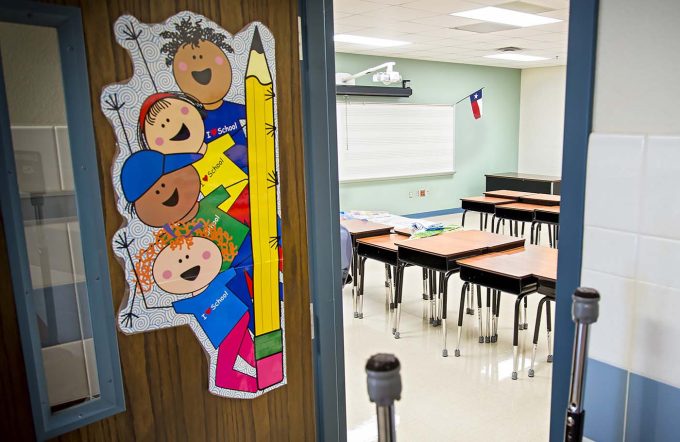
Texas public school enrollment declined by 76,000 students from the 2024-25 school year to the 2025-26 school year, but East Texas lost a relatively small number of students, data shows.
The Texas 2036 policy research group used data from the Texas Education Agency to calculate the large single-year drop in students statewide, and the organization predicts the state could lose significantly more students in the coming years. The declines could pose problems for public schools, whose state funding is tied to attendance.
The largest declines in enrollment in the state were in metropolitan areas such as Houston, Richardson and Fort Worth.
The Longview region, meanwhile, saw some of the smallest losses in the state. Enrollment declined by 270 students in Region 7, which includes schools in Smith, Gregg, Rusk, Panola, Harrison and Upshur counties.
The region’s overall enrollment was 184,645 in 2024-25 and 184,375 in 2025-26.
Longview ISD’s enrollment declined by 215 students, and Tyler ISD’s grew by 146 students, according to data from the Texas Education Agency.
Email newsletter signup

Further north, Region 8 – including Camp, Upshur, Titus and Cass counties – lost 727 students. That region’s overall enrollment was 55,432 in 2024-25 and 54,705 in 2025-26.
The cause of the enrollment declines is unclear, the Texas Tribune reported, though various political leaders and policy organizations have theories about it.
Hispanic students accounted for roughly 80% of the enrollment declines, and Democrats have said they believe immigration-related fears might have caused families to take their children out of school.
However, declining birth rates and a growing interest in private school and homeschool options also could be behind the decline in public school enrollment, the Tribune reported.
“The causes identified include smaller birth cohorts working their way through the grade levels, shifting migration patterns, and population movement between communities,” Matthew Prosser, chief of strategic initiatives for Longview ISD, said in an email. “Longview ISD is one district inside that demographic reality, and we’re certainly not an exception to it.”
This article takes a look at schools in Region 7 with enrollment changes of 75 or more students from the 2024-25 to the 2025-26 school year.
Several districts in Region 7 had enrollment changes involving fewer than 75 students, according to datal. Nearly all schools experienced some enrollment changes, and some schools in the region had changes of as few as five students.
Gregg County
Longview ISD’s enrollment decreased from 8,138 to 7,923, and its Hispanic enrollment decreased from 3,493 to 3,374.
Longview ISD leaders were not surprised by the change, Prosser said. District leaders have been studying long-range projections and tracking demographic trends at the neighborhood level.
“The district has strengthened our enrollment systems, improved how families access registration, and invested in program visibility, not in reaction to a number but as part of an ongoing, structured effort to serve families well and plan responsibly,” Prosser said in an email. “At the same time, our finance team is modeling the full range of enrollment and attendance scenarios in every budget cycle, because responsible institutions do not wait for a headline to start running the numbers. They run them continuously. The appropriate word for our posture is not alarm. It is preparation.”
No single variable can explain the single-year enrollment decline, Prosser said. When a large class of students graduates high school and a smaller group begins kindergarten, the district will have a net enrollment decline, “even when the district is doing everything right,” he said.
“Housing development patterns, family mobility rates, and neighborhood demographic shifts compound that,” Prosser said.
The impact on district revenue is unclear. Texas schools are funded based on their average daily attendance, but other factors affect a district’s overall funding as well. Districts receive additional funding to educate various student groups, including students with special needs, students who are in bilingual education and students who are in career and technical programs. Local property values are part of the funding formula as well.
School officials factor those variables into annual budgets, and they make multi-year budget projections – “not single-year enrollment snapshots, precisely because the formula is too complex to be reduced to a single number,” Prosser said.
Kilgore ISD’s enrollment decreased from 3,660 to 3,586, and its Hispanic enrollment decreased from 1,426 to 1,400.
Smith County
Tyler ISD gained 146 students, bringing its enrollment from 18,708 to 18,854. Its Hispanic student enrollment grew to 9,088 from 9,056.
Whitehouse’s enrollment grew from 4,676 to 4,874, and its Hispanic enrollment grew from 754 to 787.
Arp’s enrollment decreased from 1,008 to 921.
Cumberland Academy’s enrollment dropped from 2,047 to 1,519, and its Hispanic enrollment dropped from 562 to 417.
Harrison County
Enrollment at Hallsville ISD grew from 24,602 to 26,890, while Hispanic enrollment shrank from 10,510 to 10,034. Hallsville ISD operates the Texas Virtual Academy at Hallsville, which services thousands of students across the state.
Marshall ISD’s enrollment dropped from 4,957 to 4,736, and its Hispanic enrollment dropped from 1,969 to 1,927.
Rusk County
Henderson ISD enrollment decreased from 3,245 to 3,165. Its Hispanic enrollment dropped from 1,222 to 1,192.