
This article is part of a series of pieces celebrating Glasstire’s 25th anniversary. To see other stories from this series, go here. To see pieces from the month of May, around the theme Training Grounds: Studios, Students & Schools, go here.
Fieldworkers; community advocates; outreach professionals — the terms may vary, but what remains steadfast behind them is the commitment of those in the roles.
There is another constant: all of these individuals are fully aware of the temporal imbalance in the life and work they have chosen (or which has chosen them), namely that a moment of harm takes a lifetime of healing.
****
On July 26, 1998, the El Paso Times ran a feature headlined “Camp to unleash art on children.” The article spoke of “a pilot program” called Creative Kids Camp, which was still in the development stages but had already drawn local interest and attention. In its inception, the planned activities were designed for children with disabilities, but in an effort to be fully inclusive, it was adapted so that “any interested child” could join in. The team behind the initiative was Andrea Gates and Stephen Ingle.
Ingle had been living in California and moved to El Paso in 1998, where he enrolled at the University of Texas at El Paso (UTEP), studying Graphic Design at the College of Liberal Arts. There, he met Gates, herself engaged in earning her BA in Special Education from the College of Education. Gates had been teaching special education at Bill Childress Elementary in Canutillo, Texas, and invited Ingle to participate in one of her classes. He had some canvases and paints in his trunk, and decided to bring them out for the session. The kids in Gates’ class had always been in wheelchairs, but today the teachers took them out and had them sit and lie on the floor, where they started painting. It was messy, it was raw — and it was definitely real.
Sometime in the middle of the class, a young girl who never spoke looked up and asked for the color red.
****
However you break it down, this is a love story. Long form. But not the kind you think, because although it begins with of deeply personal love of Stephen Ingle and Andrea Gates (now Andrea Gates-Ingle), it expands out into every aspect of what has taken place across those 28 years since 1998, and which continues to materialize at the El Paso institution that is now known as Creative Kids Inc. Because, ultimately, when you break it down, love cannot draw boundaries; in being true to itself, it can never be a closed circuit.
 Creative Kids
The clarity around this point emerges at regular points whilst in conversation with the couple, as gaps of silence spontaneously bubble up as they take turns to recount the three-decade labor they have given themselves to. The short intervals are clearly not driven by a struggle to remember, even given the distance from then to now, but by an overweight of memory. Both feel it all as keenly in the present as they did at the beginning — perhaps even more so, given the reach and importance that their organization has come to have for the El Paso community and its surroundings.
“You can see the moment in the children,” says Ingle, “where the fear — the belief that they can’t do something — drops away, and passion and purpose comes out. You hear the silence in the gallery, the silence of engagement, of drive and focus. And after a while you start to see the confidence and self-esteem emerge. For us it’s about relationships, about being able to manage a relationship of trust.”
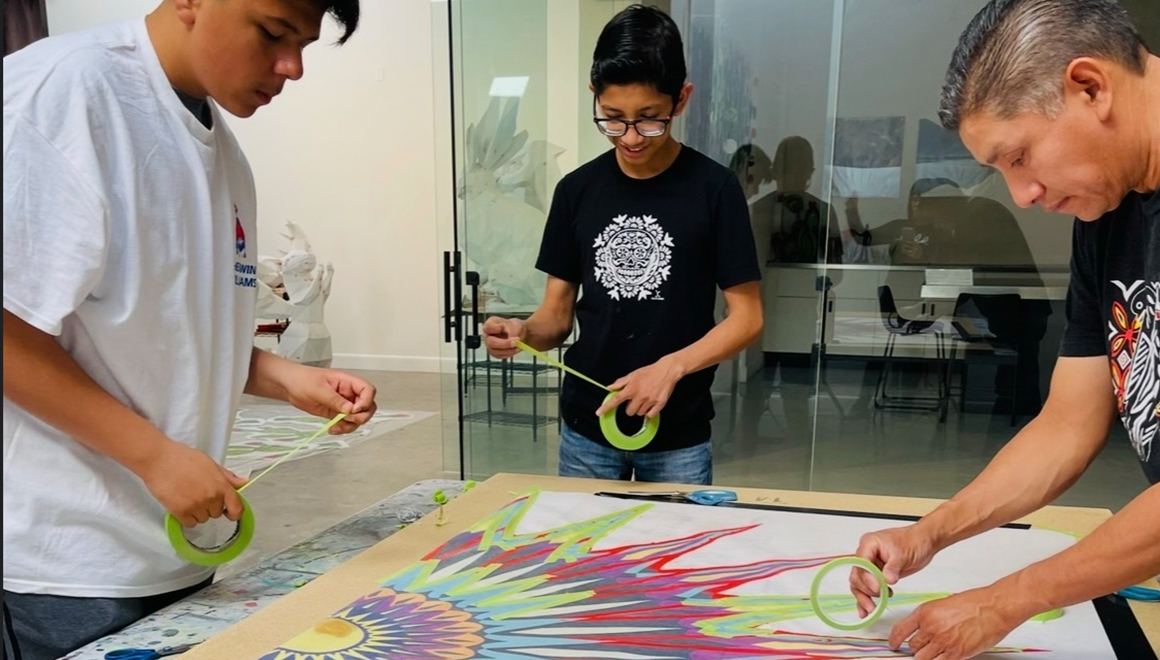
Today, the work of Creative Kids is built around multiple programs, including Project AIM (Art is Medicine) which delivers arts education to pediatric oncology patients at Providence Children’s Hospital, and Project TAP (Transformative Art Program), a multistate initiative focusing on justice-involved youth. This latter project — already in place in El Paso but recently expanded to Las Cruces — collaborates with local juvenile justice departments and uses art to encourage and empower young people to meaningfully “process their stories, reclaim their voices, and build the confidence needed to rewrite their futures.”
 Creative Kids, Project ABLE
Creative Kids now serves about 600 children every week in and around El Paso, and has just moved into rural districts in southern New Mexico, supporting isolated communities who are experiencing an absence of public transportation or other youth initiatives. For young people in the area, the presence of Creative Kids and their classes serves as a regular point of expressive sanctuary, removed from their daily challenges and complexities.
All of the Creative Kids’ art programs are evolved bodies of work, built slowly, committed to over time. One, however, has achieved particular prominence in El Paso over the last few years, and happens on Saturdays, where the community affected by the local mass shooting of August 3, 2019, come together. Known as the Resiliency Art Program (RAP), what began as — in the words of Ingle and Gates-Ingle —“an immediate crisis response” gradually evolved into a space where “mental health is the priority.”
It’s about “bridging creative expression with emotional healing,” they say, and “replacing isolation with a sense of belonging, paving a path toward a brighter, collective future.” You get the sense that this is exactly the point, one which they have learned through devout, repeat actions: the understanding that the only possible path to a shared horizon where hope is inclusive and not based on income levels or social status must be pursued assiduously — not under lights, or on one-off occasions — sought for on the ground, day after day, after day.
“Over the years we’ve learned that art is our tool,” says Ingle. Of course it is, being the centerpiece: an independent, nonverbal language for widely diverging communities and people on the borderlands. “When you look at El Paso, we’re a point in transition; we come with three states and two countries that meet, and visual arts communicates, it speaks through the barriers.”
 Creative Kids, Project ABLE
Truth be told, art has always communicated differently. Often it is criticized for being too open to interpretation, too variable, but it’s exactly this enigmatic nature that enables it to draw in all manner of people, from all kinds of background and experience. Its openness is part of its existential rationale, and why it refuses to go away.
All of which makes Creative Kids’ programs potent enough in their own right, but the fact is that when you look at it collectively, it’s something even more encompassing. Yes, we’re talking about marginalized communities, about vulnerable youth, about the arbitrary lines of history dividing communities, but in the inclusive-creative-art response to all this, in the therapeutic and humanistic work being undertaken by everyone at Creative Kids, what we really have is much bigger than the sum of its parts, and is nothing less than a North Star for all involved. So maybe it’s exactly right that this is all set against the backdrop of that great point in transition: El Paso del Norte.
****
Right across what we now know as the Americas, Indigenous communities will tell you, unwaveringly, that if you give yourself to your surroundings, you become a part of the land. Ultimately, where you are born is nothing but an accident, they say, but who and where you choose to be is your choice. In some senses, it’s about a cosmovision; in others it’s also about finding greater, shared purpose. It’s also always about recognizing that the individual alone is unable to provide any meaningful solution to the deepest challenges of our lives.
For both Stephen Ingle and Andrea Gates-Ingle, between the start and the here-and-now, there have been nearly three decades of life lived, and “so many things which make you appreciate life a lot more.” In fact, Ingle continues, “we’ve evolved into who we are now through the work; it’s inseparable from us.” The challenges, necessarily, “have been ongoing,” and they never go away, relating above all to “the ongoing economics of improving the bottom line and keeping the lights on.” But it’s always been “the best way to reach kids and the community. We’re very clear on that. That and the fact that we’re not trying to build artists, but people.”
****
Like I said, a story about love, long form.
It’s also about a great many other things, but there can be little doubt that all which holds it together is love. First to last. Love of others; love of community; of the transformative possibilities of art; love of the regenerative strength of young people, which with each generation offers us the possibility of starting again. For Creative Kids, every day and every interaction is a point of inception and opportunity, one in which art and creativity are the sinews, the synapses, and the nervous system. The muddy waters of the Rio Grande may have flowed many years and seasons, since all this began, but there is plenty more water to run before it ends.