
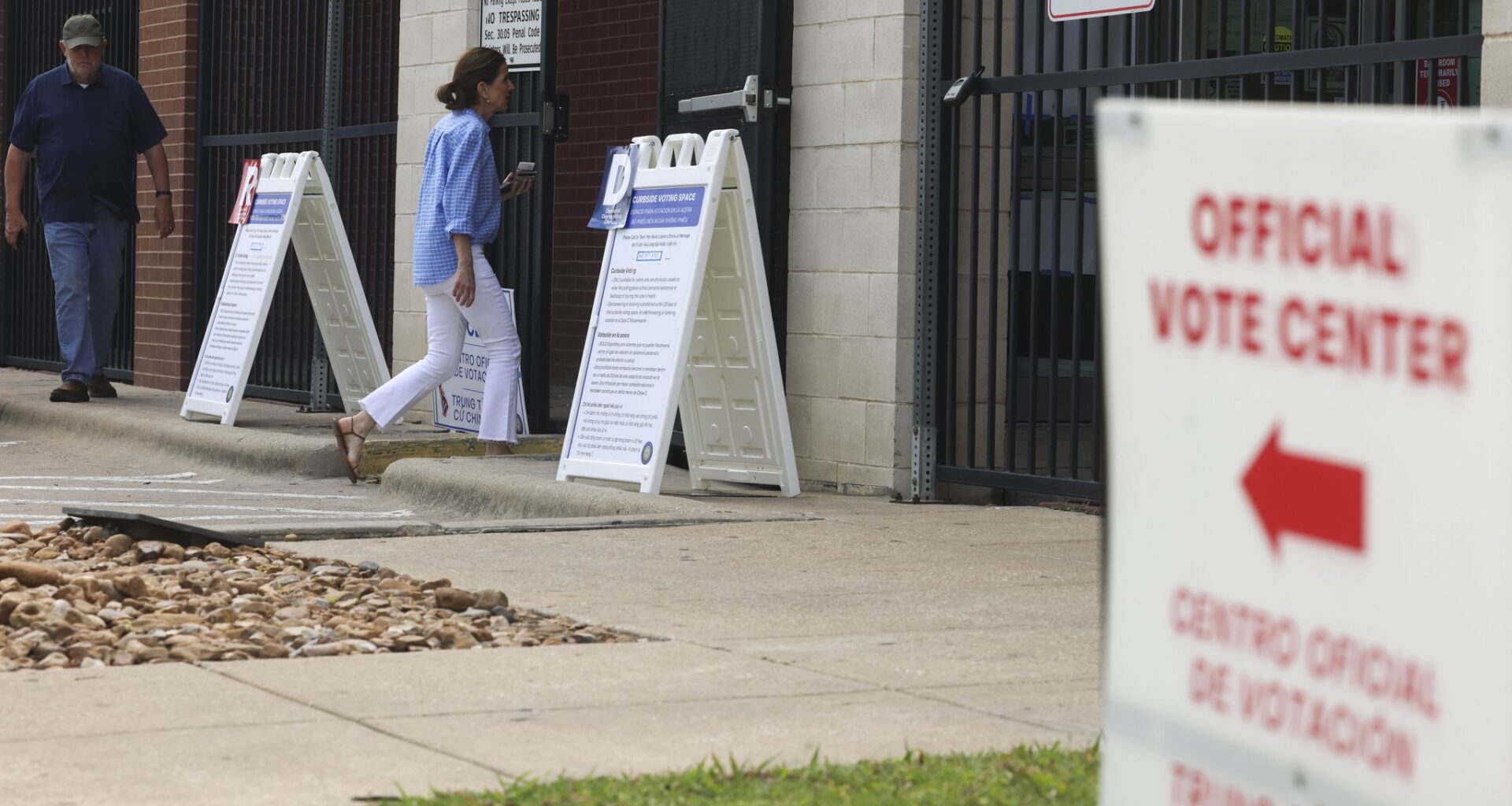
Voters enter a voting center during primary election runoff day at Oak Lawn Library on Tuesday, May 26, 2026 in Dallas.
Shafkat Anowar/The Dallas Morning News
A slow stream of voters trickled into The Father’s Church on Abrams Road after polls opened on Tuesday, but the calm was a relief to the election workers inside.

There were no confused voters, no clerks having to send them to another location to cast their ballots, no frustration in the air.
Article continues below this ad
“It’s been quiet, thank goodness,” said Republican election judge Lila Farmer.
Voting unfolded slowly but smoothly in Dallas County’s runoff on Tuesday, a change from the chaos that took place during the March 3 primary election. After the county Republican Party forced a switch to precinct-based voting, thousands of confused voters from both parties, accustomed to the vote-anywhere system, were turned away from polls and redirected to their neighborhood voting sites.
Making matters worse, some voters were sent to the wrong polls by incorrect maps on the Secretary of State’s website and others received bad information from navigators stationed at voting sites. It prompted former Republican Party Chair Allen West to amend the GOP’s contract with the county to revert to the countywide system for the runoff, citing a fear of being sued for voter disenfranchisement.
Make Dallas News a preferred source so your search results prioritize writing by actual people, not AI.
Add Preferred Source
Because county officials control early voting in Texas, the Republicans’ push for precincts applied only to the primary and runoff election days.
Article continues below this ad
At the request of the local GOP, the runoff remained a non-joint election, meaning Democrats and Republicans were required to announce their affiliation by using separate check-in tables, voting machines and election workers within the same locations. In a joint primary, voters from both parties use the same machines and clerks and only disclose their affiliation to the worker printing their ballot.
“I did think that felt weird,” voter Michael Salas, 46, said of the lack of privacy at Oak Lawn Library.
Signs are displayed outside of a voting center during primary election runoff day at Oak Lawn Library on Tuesday, May 26, 2026 in Dallas.
Shafkat Anowar/The Dallas Morning News
After West made the switch to countywide voting, he resigned amid pushback from party members who had voted amongst themselves to use the precinct-based system for the primary cycle. Precinct Chair Barry Wernick filed two lawsuits to reinstate precinct voting for the runoff, alleging West acted illegally when he changed terms without his party’s approval, but both attempts failed in court.
Article continues below this ad
“It’s unfortunate, but it is where we are,” Wernick said of the outcome.
Wernick and other Republicans have pushed back on countywide voting, alleging it makes ballots less private and less auditable than the precinct system. Countywide voting is sanctioned by the Texas Secretary of State.
On Tuesday, election workers were dealing with a different issue: low turnout. Based on past elections, turnout is expected to be about a quarter of the participation of the primary.
An hour after polls opened, about a dozen voters had stopped by The Father’s Church in East Dallas.
Article continues below this ad
Fewer than 100 had cast a ballot before 9 a.m. at Oak Lawn Library, traditionally one of the busiest voting centers.
Election workers at The Father’s Church were looking forward to one lunchtime voter, a delivery driver for I Fratelli Pizza, who drops off a few pies when he casts his ballot.
Democratic election judge Emily Lamberty said voters so far did not have questions about whether they could vote at the site, but some had grumbled about having to line up by party and the resulting lack of privacy.
“We are all united, but a lot of people would prefer to vote anonymously,” Lamberty said.
Article continues below this ad
Oak Lawn Democratic election judge David Fisher said voting was going without a hitch Tuesday. This came after one hiccup during early voting at the site, when a flasher exposed himself to voters before fleeing.
Rikeda Taylor said she was passing out campaign cards for judicial candidate Kim Cooks when the man exposed himself.
“I said ‘I’m going to call the police,’ and he said, ‘I’ll be gone by then,’” and he was, Taylor said.
Charles Beavers, 34, said he always takes advantage of the convenience of early voting, but with the condensed window for the runoff, he cast his ballot on Tuesday.
Article continues below this ad
As a child, Beavers’ parents took him to the polls to watch them cast their ballots, something that inspired him to vote throughout his adult life. He said he likes to wear his ‘I voted’ sticker to encourage others to participate in the process.
Ron Stuart, 72, cast his ballot in between pet-sitting jobs in what he called Americans’ duty to be part of the process. On his mind were the price of food and the quality of the community’s schools.
“I do this just to keep the planet in its orbit,” he said of voting.
Article continues below this ad
At least, he said, he was in and out in a few minutes with no issues.