
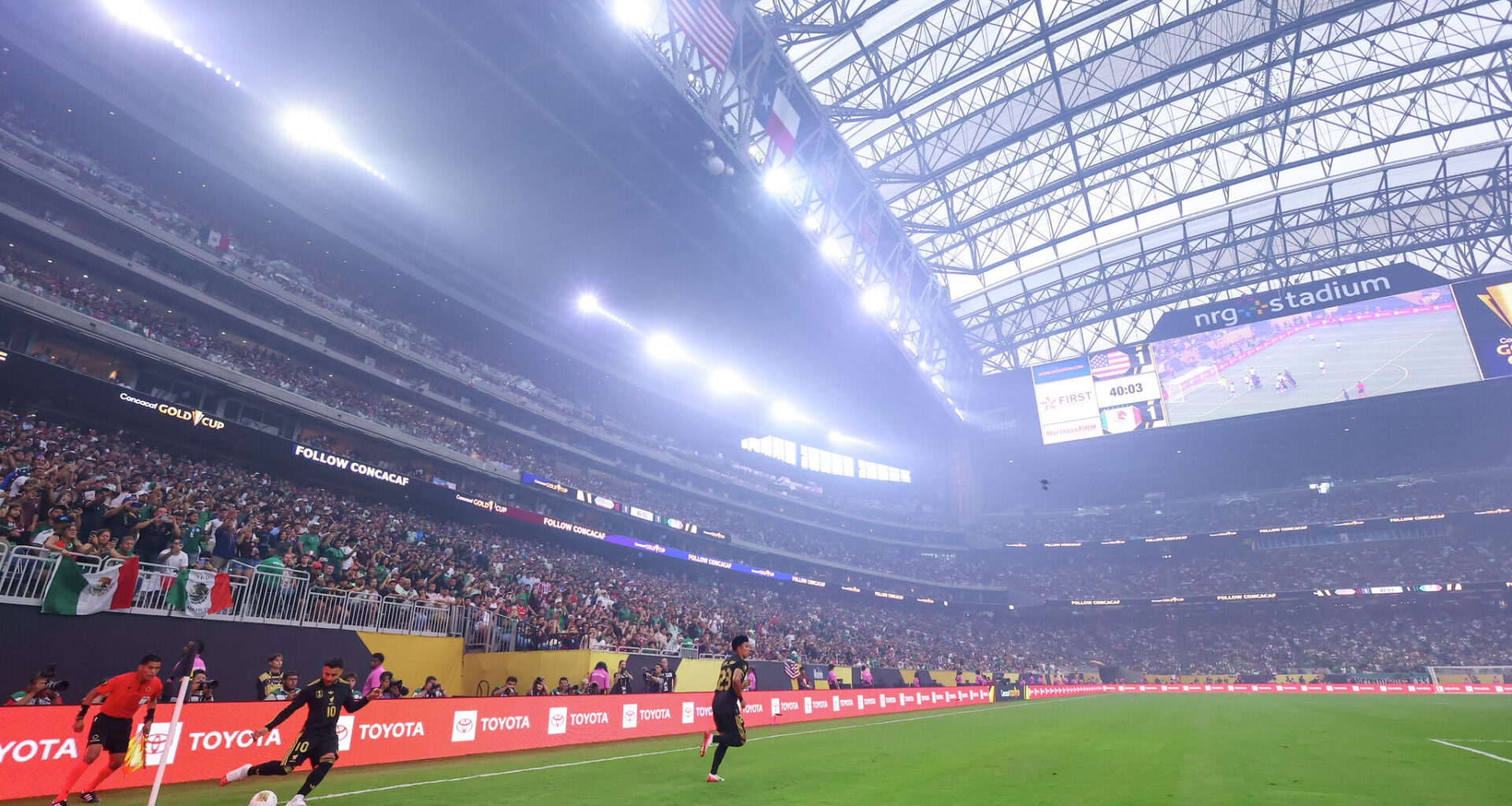
NRG Park alone could use between 12 and 15 megawatt hours during peak demand periods during the tournament—roughly equivalent to powering between 3,000 and 5,000 Houston homes. (Photo by Robbie Jay Barratt – AMA/Getty Images)
Robbie Jay Barratt – AMA/Getty Images
Powering Houston during the FIFA World Cup won’t be as simple as flipping a switch.

Unlike events such as the Houston Livestock Show and Rodeo, energy experts say the international tournament will require years of planning, localized grid preparation and contingency plans for everything from triple-digit heat to tropical weather.
Article continues below this ad
“The rodeo is kind of like plug-and-play,” Sam Luna of BKV Energy told Chron. “But this is a much larger-scale event.”
Luna said the biggest concern isn’t necessarily whether ERCOT can handle the World Cup overall, but whether localized infrastructure around hotels, event zones and entertainment hubs can keep pace during peak summer demand.
“We’re not talking about six million Houstonians,” he said. “We’re now talking about billions of people across the world looking at Houston.”
Localized strain, not grid failure
According to Luna, NRG Park alone could use between 12 and 15 megawatt hours during peak demand periods during the tournament—roughly equivalent to powering between 3,000 and 5,000 Houston homes.
Article continues below this ad
But unlike a Texans game or the rodeo, where energy usage patterns are already familiar, Luna said the World Cup introduces variables Houston utilities don’t normally have to manage all at once.
“For the FIFA World Cup, they’re setting up all these alternative venues for fan engagement all throughout the city for different parts of each of the matches,” Luna explained. “Then you have each of these visiting countries setting up their own team activation events.”
That also includes accommodating international broadcast crews and equipment arriving from around the world.
Article continues below this ad
Energy experts say Houston’s FIFA World Cup preparations involve far more grid planning than events like the rodeo, especially during peak summer heat
Cameron Spencer/Getty Images
“Even for a Texans football game, they know exactly what to expect. It’s the same vendor and same equipment,” Luna said. “But when you have broadcast companies coming in from Portugal, Curacao and Saudi Arabia, there is new equipment and language barriers. So it’s new.”
Heat, crowds and added complexity
The timing of the tournament also adds another challenge.
Article continues below this ad
Unlike the rodeo or football season, the World Cup will stretch through June and July—historically some of the hottest and most unpredictable weather months in Texas.
“We’ve had multiple 100-degree summers,” Luna said. “How do we prep for the weather? What if we get an early hurricane or some other weather event that we’re not used to seeing when we’re usually hosting these events over multiple days?”
Still, Luna said he remains cautiously optimistic that Houston and ERCOT are prepared for the greater demand.
“This summer we’re expecting peak demand around 90,000 megawatt hours,” he said. “Any one of these events is only going to be 15 megawatt hours peak demand. For ERCOT, it’s a much larger scale. The grid’s going to hold.”
Article continues below this ad
“Preparedness, not panic,” experts say
Where Houstonians could still feel the strain, however, is through localized conservation requests during periods of extreme heat and heavy demand.
“Yeah, it’s going to happen,” Luna said when asked whether Texans may again be asked to adjust thermostats or reduce electricity usage during peak periods.
He said Texas remains heavily dependent on solar generation during critical evening hours when residents return home, crank up their air conditioning and increase household electricity use.
Article continues below this ad
HOUSTON, TX – MAY 15: An artist rendering of the FIFA Fan Festival 2026 is seen during a news conference releasing details about the event in Houston, Thursday, May 15, 2025. (Kirk Sides/Houston Chronicle via Getty Images)
Houston Chronicle/Hearst Newspap/Houston Chronicle via Getty Imag
“If it’s a cloudy day or the wind isn’t blowing up north, then we have that power crunch and ERCOT is going to send out that Texas alert and say, ‘Hey guys, we need you to reduce demand and change your AC habits right now,'” Luna said.
Even with those concerns, Luna said preparation—not panic—remains the bigger takeaway for Houstonians ahead of the tournament.
Article continues below this ad
“There’s an ease and comfortability in knowing that you were prepared,” he said. “This wasn’t a stressful event. You were actually able to pivot to looking forward to spending time with family and friends. That’s what I want Houstonians to be able to pivot to instead of that panicked emergency.”