
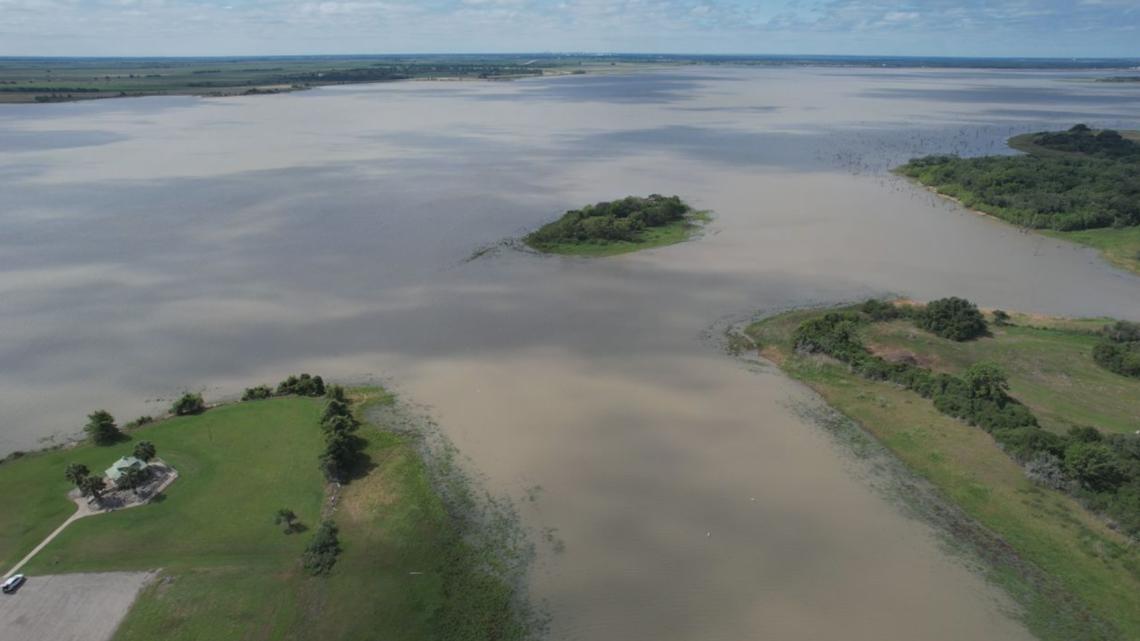
Today, Lake Texana, and the Mary Rhodes Pipeline system are delivering the majority of Corpus Christi’s daily water supply with the system now operating at its max.
CORPUS CHRISTI, Texas — For decades, Corpus Christi’s water future depended largely on reservoirs west of the city like Choke Canyon and Lake Corpus Christi.
But as South Texas continues facing one of the most severe prolonged droughts in regional history, a much smaller East Texas reservoir near Edna has quietly become the backbone of the Coastal Bend’s water supply.

This story continues below.
Today, Lake Texana, and the Mary Rhodes Pipeline system are delivering the majority of Corpus Christi’s daily water supply with the system now operating at or near maximum capacity.
During a recent community water information session on Padre Island, Peter Zanoni explained just how dependent the city has become on East Texas water sources.
RELATED: Large crowd turns out for Corpus Christi water supply discussion
“Today, because of improvements that we did over a year ago on the Mary Roads pipeline, we are bringing in about 70% of our water every day from East Texas to the Mary Rhodes pipeline,” Zanoni said.
In the busiest time during summer use, the city uses about 130 million gallons a day. Zanoni said without the more than $20 million invested in infrastructure improvements to the Mary Rhodes, we would be in “real trouble.”
He said that water comes from both Lake Texana and the Lower Colorado River.
“So about 70 million gallons, about 70%, each day comes from East Texas,” Zanoni said. “And those two water supplies that the city acquired decades ago are really paying off given our low levels of water in our western reservoirs.”
The water is transported through the Mary Rhodes Pipeline named after former Corpus Christi Mayor Mary Rhodes, who championed the controversial project decades ago.
The system begins at the Lake Texana intake facility operated by the Lavaca-Navidad River Authority.
Standing near the spillway overlooking the reservoir, LNRA General Manager Patrick Brzozowski described why Lake Texana has become so valuable.
“The Lavaca watershed and Lake Texana are placed well on the Texas coast,” Brzozowski said. “Annually we receive on average about 42 inches of rain, which is not quite double what the city of Corpus Christi or the Nueces Basin receives.”
Because of the lake’s size and watershed, Brzozowski said even moderate rainfall can quickly refill the reservoir.
“We’re a very efficient system,” he said. “It doesn’t take much rainfall to have an effect on the lake and lake elevation.”
But that same efficiency also creates challenges during drought conditions.
“On the flip side of that because of the diversions that we have from Texana… we can decrease as rapidly as we increase it seems like,” Brzozowski said.
Earlier this year, Lake Texana neared a critical drought trigger level close to 50% capacity.
Under LNRA’s drought contingency plan, mandatory water reductions would have been triggered if lake levels fell below that mark.
“At 50% our response to meeting that drought trigger is to reduce our diversions by 10%,” Brzozowski said. “At 40% capacity, the next trigger, we would reduce our diversions by 20%.”
Zanoni said those reductions would have had major consequences for Corpus Christi.
“Once that lake drops to below 50%, all customers and the primary ones of the city and Formosa Plastics would have to have taken a 10% curtailment or a 10% use reduction,” Zanoni said.
“A 10% reduction is about 4.5 to 5 million gallons of water a day,” he added.
Recent rains across the watershed, however, dramatically improved conditions at the reservoir.
Brzozowski said rainfall helped rapidly refill the system.
The lake has risen from near 50% to almost 90% as of late May.
He said officials now feel far more comfortable heading into summer.
Still, both city and water officials acknowledge the Mary Rhodes system is already operating near its limits.
“We’re already pretty much at max capacity with Lake Texana,” Zanoni said.
Brzozowski confirmed the system is currently operating at its highest diversion schedule.
“We’re running Schedule 4, so we are at maximum flow presently,” he said.
The scale of the operation is enormous.
Brzozowski said the Mary Rhodes Pipeline stretches approximately 104 miles, while the Phase Two pipeline connected to the Lower Colorado River adds another 47 plus miles.
“That’s over 150 miles that water is being moved conveyed to satisfy the demand in the Corpus service area,” he said.
Every day, the system moves roughly 72 million gallons of water toward Corpus Christi.
“That’s what we’ll divert today and that’s every day,” Brzozowski said.
Officials also acknowledge Lake Texana alone cannot fully sustain the city’s long-term future water demands.
When asked whether Corpus Christi’s current use is sustainable, Brzozowski pointed to the importance of maintaining both Texana and Colorado River diversions.
“The Colorado is important. Lake Texana is important,” he said. “Between those two, if we can keep both diversions going… I think that the water’s sustainable.”
Zanoni said the city is now working to diversify beyond surface water sources that rely heavily on rainfall.
“Our only water supply had been surface waters,” Zanoni said. “Those are all replenished from rain.”
The city is now pursuing groundwater projects, treated wastewater reuse and potential seawater desalination projects as part of its long-term water strategy.
For now though, officials say the decades-old pipeline system continues serving as a critical safeguard for the Coastal Bend.
“With every decision it takes will,” Brzozowski said, referring to the original pipeline project. “Those predecessors who came before us… the political will they had to see some of these things through.”
“Hopefully people look back and go, OK, they did the right thing.”