
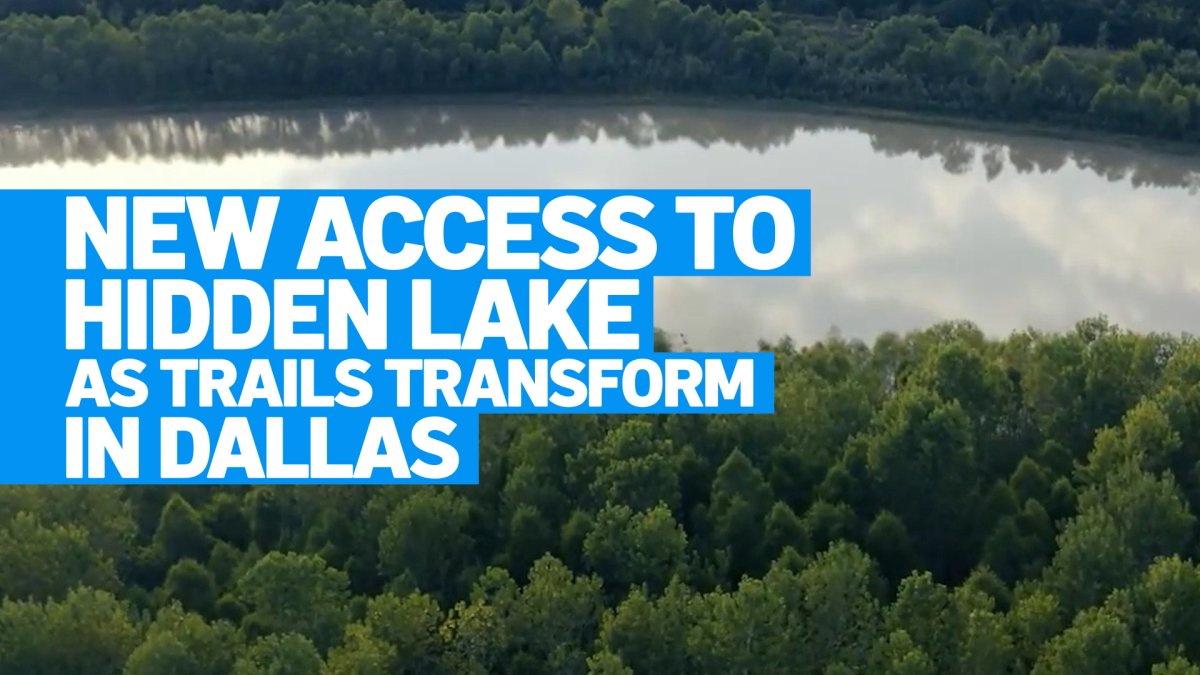
A secluded lake hidden in Southeast Dallas for more than 70 years could soon become one of the city’s newest public green spaces.
“It’s a really incredible lake that’s been there for over 70 years now, and I bet less than a thousand people have ever visited it,” said Philip Haigh, executive director of The Loop Dallas.
The 110-acre Parkdale Lake sits even closer to downtown Dallas than White Rock Lake, Haigh said, but decades of limited access kept most residents away.
City leaders say that could finally change.
On Wednesday, the Dallas City Council approved a $16-million construction award for the third phase of the Trinity Forest Spine trail.
The new phase will extend the trail toward Parkdale Lake from both the north and south, helping close a critical gap between the Lawnview DART Station and the existing Trinity Forest Spine Trail near Samuell Boulevard.
The funding approval clears the way for work to begin on what leaders describe as the most technically complex portion of The Loop Dallas’ 50-mile trail network.
When complete, the Trinity Forest Spine Trail will connect White Rock Lake to the Trinity River Audubon Center through a continuous nine-mile corridor.
The first phase opened in 2023, connecting the Santa Fe Trail at White Rock Lake to Far East Dallas. The second phase, which opened in April, added to the existing AT&T and Trinity Forest Trails. The third phase will connect the two sections through the middle of the corridor.
“We’re moving from the north to the south and meeting in the middle, at Parkdale Lake,” Haigh explained.
But leaders say the project is about more than recreation.
The Loop Dallas said the larger goal is improving mobility, access, and connectivity for neighborhoods in southern Dallas that have historically lacked pedestrian and bicycle infrastructure.
“With the Trinity Forest Spine Trail specifically, you know, that’s going to be a $90 million project with over 80 million of that being invested south of I-30,” Haigh said.
Haigh said projects like this can also improve public safety and access to public transportation.
When the second phase of the trail opened, Haigh said it also included widened sidewalks, a new elevated trail segment, and improved pedestrian access near U.S. 175 and the Lake June DART Station.
“This type of infrastructure isn’t just about recreation,” Haigh explained, “it’s about mobility and transportation and equity.”
The project is part of the larger Loop Dallas initiative, which aims to connect trails across the city into a unified network.
According to The Loop Dallas, more than $86 million has been invested in trail infrastructure projects across the city over the last seven years.
The organization also helped facilitate the donation of the Parkdale Lake property from Oncor to the city of Dallas.
Leaders say the land acquisition was essential to completing the trail alignment and opening the lake to the public for the first time.
Construction on phase III is expected to begin soon.
“We know for a fact that the Trinity Forest Spine Trail will be finished and open to the public in just a few years,” Haigh said.
The trail project is funded through a combination of public and private partnerships involving the City of Dallas, Dallas County, TxDOT, and federal transportation funding sources.
Haigh said the larger goal is to make Dallas’ green spaces more accessible to residents across the city.
“There are a ton of parks and a ton of green spaces out here, but people don’t feel like they have access to them easily,” Haigh said.