
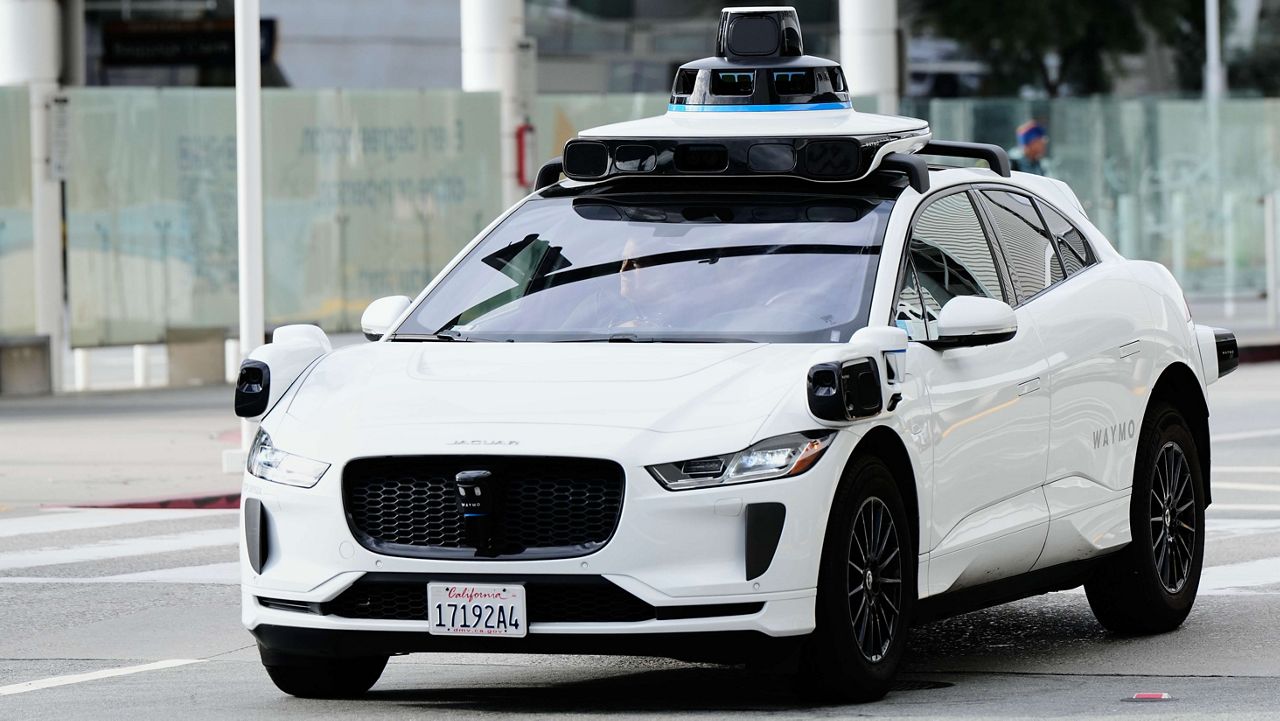
TEXAS — Starting Thursday, May 28, a new law has gone into effect across Texas roadways, but it’s not for drivers. It’s focused is on autonomous vehicles (AVs).
The new law puts a lot of authority on the Texas Department of Motor Vehicles to make sure driverless cars have proper authorization to carry paid passengers.
It’s the latest in a series of state laws dating back to 2017 that regulate AVs, and it’s one way our state could lead the nation in setting a precedent for driverless cars.
More commercial rides have been given in driverless cars in Texas more than anywhere else. And that’s taught us a lot about what it’s like to share the road when there’s no one in the driver’s seat.
From Waymo to Tesla to Avride, roughly 300 fully autonomous vehicles operate on Austin roads alone, with even more now in Dallas, San Antonio and Houston. For riders, it’s an experience.
“I called a Waymo by accident. I had no idea what I was getting into. At first, I was terrified. Then I FaceTimed my parents. They said, ‘You better be wearing your seat belt,’” one first-time rider said.
Some people love it, while some are still not sure what to make of it.
From Austin to cities nationwide, thousands of AVs are rolling out. But Texas came first, thanks to a law putting AVs under state control, not city control. That means companies face one set of rules statewide instead of a patchwork from city to city.
“The Texas Legislature passed a law on autonomous vehicles back in 2017. What it did is it says municipalities cannot have additional regulations on these cars on top of the state,” said David Dunmoyer with the Texas Public Policy Foundation.
That legal green light helped make Austin one of the biggest and earliest proving grounds in the country. But the test drives came with some detours, which raises another question: what happens when something goes wrong?
“They’re going to be a little bit slower on some of their approaches, so you have to keep that in mind when you are sharing the road with an autonomous vehicle,” said Daniel Armbruster with AAA Texas.
That may sound simple, but in the moment, it may not feel simple at all. Just recently in Austin, a Waymo was caught on camera blocking emergency crews responding to a deadly shooting downtown. Across social media, the vehicles have been spotted speeding through school zones in the city and stopping unexpectedly on train tracks.
Which leaves the question: are AVs safer than human drivers?
To find out, we pulled every crash report in Austin over the past three years. In 2025 alone, there were about 12,000 crashes citywide. Only 85 involved autonomous vehicles. But that number can be misleading because of the 834,000 total vehicles on Austin roads and only about 300 are fully autonomous.
To get a fair comparison, we compared crash rates. Only approximately 1% of human-operated cars were involved in a crash. For vehicles operating with no human driver, that number increases to 28%.
We examined injuries as well. Crashes involving human drivers led to about 8,000 injuries and 99 deaths. Autonomous vehicle crashes resulted in eight injuries and no deaths. Per vehicle, autonomous cars crash more often, but the crashes tend to be far less severe.
“If Waymo is engineering their cars to be more cautious such that it’s fender benders and not T-bone accidents, what does it look like in terms of the accidents per capita writ large?” Dunmoyer said.
So the question is not whether these vehicles make mistakes — they do — the question is whether they make fewer deadly ones. Waymo’s chief security officer says test drives like the ones in Texas make roads safer.
“Data from our first 127 million fully autonomous miles indicates our driver is 10 times less likely to be involved in a serious injury or worse crash compared to human drivers,” said Waymo representative Mauricio Peña.
Lawmakers in Washington are still trying to decide who should regulate them and how.
“America is at a crossroads in transportation policy,” said Sen. Ted Cruz, R-Texas. “My home state of Texas understands that clear rules enable growth, investment and safety. But AVs can’t just stop at Texas’ border.”
In February, leaders in Congress, including Cruz, debated if state governments or the federal government should decide AV laws.
“Without federal oversight, we risk a fragmented patchwork of state laws,” said Cruz.
“Let’s not kid ourselves. While self-driving technology is exciting, it has a long way to go and our regulatory system is incredibly behind,” said Sen. Tammy Duckworth, D-Illinois.
For now, the future is already here. And the question is not whether to share the roads with them — you’re already doing that — it’s whether people in charge of keeping you safe are moving just as fast as these cars are.