
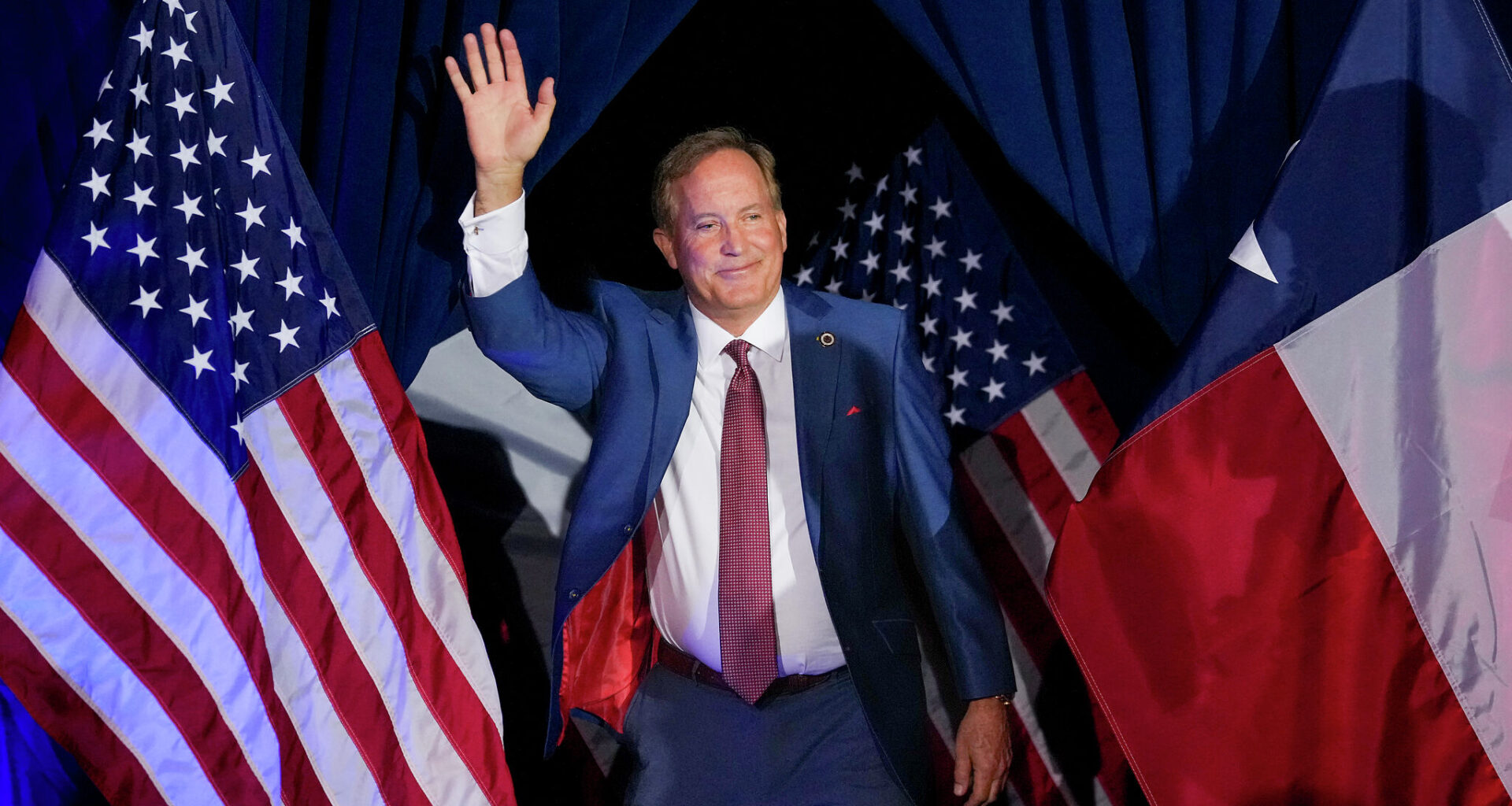
Texas Attorney General Ken Paxton, and U.S. Senate candidate, waves to supporters as he takes the stage during a primary runoff election night watch party in Plano, Tuesday, May 26, 2026.
Smiley N. Pool/The Dallas Morning News
Texas Attorney General Ken Paxton, and U.S. Senate candidate, addresses supporters during a primary runoff election night watch party in Plano, Tuesday, May 26, 2026.
Smiley N. Pool/The Dallas Morning News
Texas Attorney General Ken Paxton, and U.S. Senate candidate, reaches out to supporters as he takes the stage during a primary runoff election night watch party in Plano, Tuesday, May 26, 2026.
Smiley N. Pool/The Dallas Morning News
John Cornyn, Ken Paxton and their allied PACs spent upwards of $30 million pushing Texans to vote in Tuesday’s GOP primary runoff for U.S. Senate.
Paxton got the better bang for his buck.
The Republican attorney general spent roughly $8 for every vote he received in the election he won handily. Cornyn’s team spent $45.
Article continues below this ad
READ MORE: Ken Paxton win gives Texas Democrats new hope of ending their statewide losing streak
The barrage of ads helped drive record turnout, with 7.4% of registered voters casting a ballot in the high-stakes U.S. Senate race.
Paxton defeated Cornyn, who has been in the U.S. Senate for more than two decades, by a 28-point margin. He will face Democrat James Talarico in November.
To calculate the spend per vote, the Houston Chronicle looked at media buys by Paxton and Cornyn’s campaign funds and supporting PACs between March 4 and May 26, as tracked by the company AdImpact.
Article continues below this ad
Texans for a Conservative Majority and the Cornyn Lonestar Victory Fund combined spent $21.5 million on media in that time frame, with another million coming from groups. Cornyn received just over 501,000 votes.
The Lone Star Liberty PAC and Ken Paxton Victory Fund spent only $5.5 million on advertisements, even as roughly 886,000 Texans voted for the attorney general. Other groups spent $1.2 million in support of Paxton. He was also aided by a late endorsement by President Donald Trump.
READ MORE: Does U.S. Sen. John Cornyn’s defeat mark an end to Bush-era Texas politics?
“Forty-five dollars per vote is a lot to spend for just over half a million votes,” said Joshua Blank, the research director of the Texas Politics Project at the University of Texas at Austin.
“While Paxton will be pleased to win the nomination with such a significantly constrained budget relative to Cornyn’s, he still needs to face the fact that nearly all of the money spent by the Cornyn campaign was used to confront Republican voters with concerns about Paxton’s electability,” he said.
Article continues below this ad
Paxton’s campaign declined to comment. Cornyn’s campaign did not respond to a request for comment.
Most runoff elections are usually sparsely attended, with turnout in the low single digits.
Record turnout on Tuesday is not unexpected, Blank said, because voters were weighing in on such a high-profile race. Most runoff elections are localized to a single district or are for statewide offices – like railroad commissioner – that capture less attention.
“Money isn’t everything in politics,” said Brendan Steinhauser, a Republican strategist who previously worked for Cornyn. He said he’s heard from Republicans worried that Paxton’s matchup against Talarico would siphon GOP donors away from races in other states. “Didn’t we just learn that it may not matter that much? It matters but it’s not determinative.”
The last time Texans weighed in on a U.S. Senate race during a runoff election was 2012, when Ted Cruz faced Lt. Gov. David Dewhurst in a July election. Just over 8.5% of registered voters, or 1.1 million Texans, cast ballots, electing Cruz by a nearly 14-point margin.
Article continues below this ad
Tuesday’s Republican runoff eclipsed that total, with 1.4 million voters weighing in.
The election looked more like a primary than a runoff, Blank said. “With the support of tens of millions of dollars, most of the voters that cast ballots in the first round probably came back,” he said.
In March, 11.6% of registered voters – roughly 2.2 million Texans – cast ballots in the Republican primary.
Article continues below this ad
Still, he noted, 9 out of 10 registered Texans didn’t weigh in on either the primary or runoff. “In some ways, it’s surprising that turnout isn’t even higher,” Blank said. “Given that a Democrat hasn’t won statewide election in more than 20 years, the primary has been the determinative race for most of Texas’ statewide officeholders.”
Across all races, candidates and PACs spent $104.3 million between March and May, according to AdImpact, with $35 million of that focused on the U.S. Senate race.