
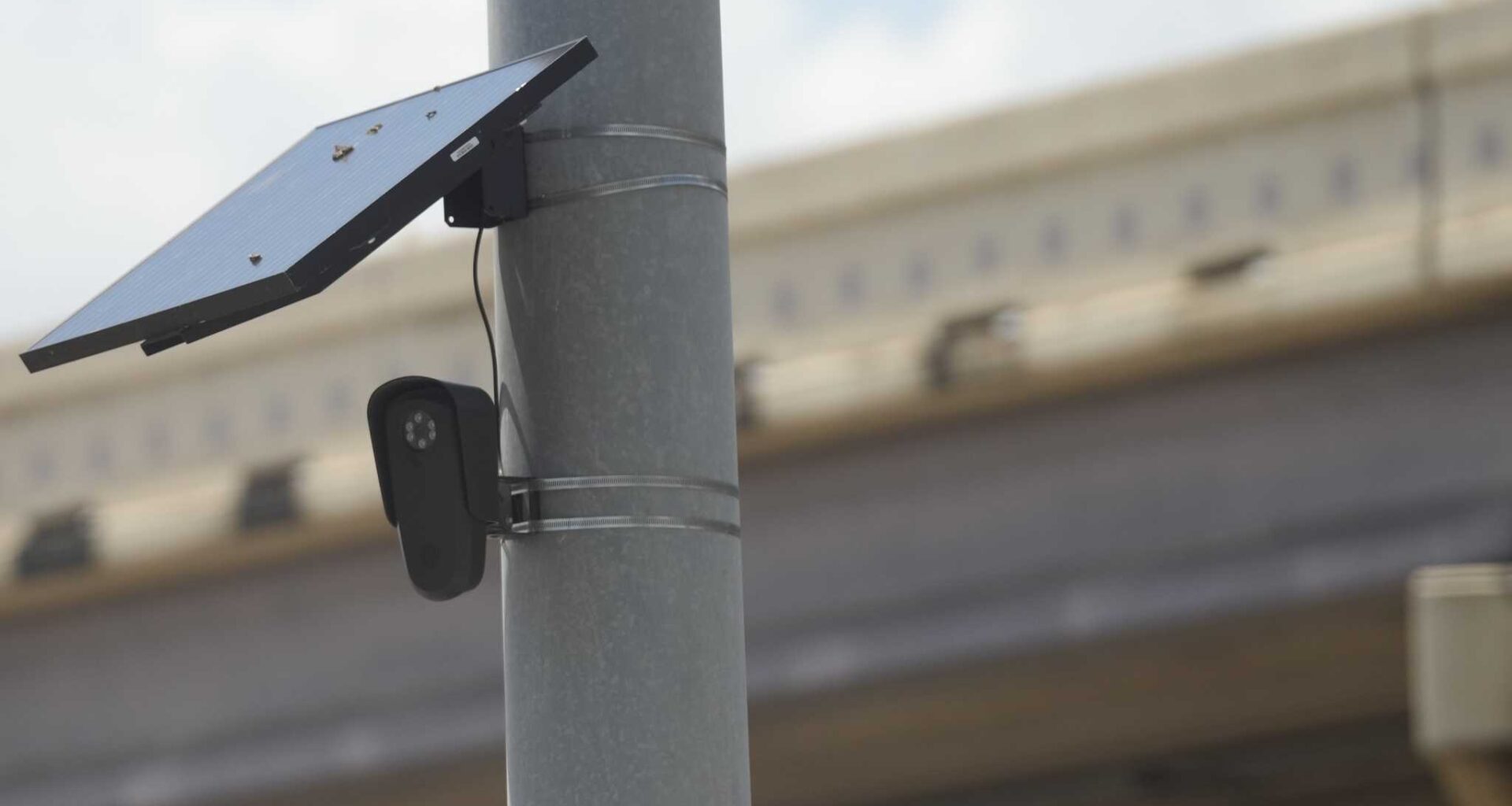
A Flock security camera on Yale Street, near I-10 in Houston on Monday, June 2, 2025.
Elizabeth Conley/Houston Chronicle
A contract renewal for Harris County’s network of license plate-reader cameras drew criticism from residents and sparked a dust-up between County Judge Lina Hidalgo and her colleagues on Commissioners Court Thursday.
Commissioners voted to renew a roughly $860,000 annual contract with Flock Safety Group during a brief but contentious meeting. Dozens of residents criticized the item, with some labeling the technology “fascist.” Hidalgo, who abstained from the vote, sparred with commissioners over what she viewed as a failure to adequately discuss residents’ concerns.
Thursday’s meeting was a procedural gathering, intended for commissioners to approve mundane items without discussion. When residents objected to the Flock item, Hidalgo tried to allow discussion on the contract, a motion that initially was voted down.
Article continues below this ad
“I represent all the voters in Harris County, unlike my colleagues, and I oppose a lack of discussion,” Hidalgo said. The commissioners are elected in precincts, whereas the judge is elected countywide.
PREVIOUS: Texas DPS finds Flock surveillance violated state law by operating without a license
Among residents’ criticisms were concerns about mass surveillance and the security of the data the cameras gather, as well as the perceived risk that the information could be used by U.S. Immigration and Customs Enforcement agents.
“When corporations and the government come together to surveil neighbors and communities, especially low-income Black and brown communities, it is abhorrent, it is vulgar and it is inherently fascist,” resident Sara Rehman told the commissioners.
Article continues below this ad
Law enforcement agencies nationwide can grant each other access to their system of Flock cameras that they can then use to search for license plates that might be connected to a crime.
But Maj. Anthony McConnell of the Harris County Sheriff’s Office pushed back on residents’ concerns, saying ICE doesn’t have a contract with Flock and that the sheriff’s office must approve outside agencies’ requests to access local cameras.
Sheriff’s office leaders this week said they’d only allow agencies access to their cameras if they could identify a specific crime they were working to solve.
Commissioners ultimately allowed discussion on the item, which ended with the court approving the renewal with the caveat that the contract may later be amended.
“If purchasing (staff) had known there would be a controversy, they probably would’ve put this item on the agenda earlier,” Commissioner Rodney Ellis said. “But the reason we designed these business courts is so we could move expeditiously.”
Article continues below this ad
EXEC RESPONSE: Flock camera CEO responds to scrutiny over how Houston police use surveillance technology
Ellis later said in a statement that while Flock cameras served as a tool for public safety, any technology that is used in a public surveillance capacity must be closely monitored.
“Our job is to protect people, not to further systems of fear and intimidation. Public safety must never come at the expense of basic civil rights,” Ellis said.
How does Harris County use Flock cameras?
Harris County has had a contract with Flock Safety for almost three years, according to officials with the sheriff’s office.
Article continues below this ad
County law enforcement personnel oversee a network of almost 500 cameras scattered across subdivisions and businesses in Harris County. But the county owns very few of those cameras. Most are purchased by homeowner’s associations and municipal utility districts, whose leaders then name the sheriff’s office as the administrator.
Former Houston Police Chief Larry Satterwhite said in 2024 he thought the Houston region had the most license plate-reading cameras of anywhere in the country. Local suburban police departments and homeowner’s associations have since installed more of the cameras.
McConnell, who runs the sheriff’s office special investigations bureau, said his colleagues are working on an agreement with the Texas Department of Public Safety to use the state agency’s vast network of more than 1,600 cameras to further aid their investigative capacity.
Officials in the sheriff’s office pushed back on some of residents’ criticisms, saying they had strict rules governing how the cameras are used, and have used the technology in four cases this year – to find a stolen vehicle, to pursue a car used in a child abduction case and to identify a suspect vehicle in two separate fatal hit-and-run crashes.
Article continues below this ad
The sheriff’s office list of eligible Flock searches wouldn’t include things that have caused controversy elsewhere in the country, officials said, such as when a Texas sheriff’s office conducted a search for a vehicle owned by a woman suspected of self-administering an abortion.
A 2025 Chronicle investigation into the nearby Houston Police Department’s use of Flock, however, found officers were using the technology largely without justifying their reason for doing so. Some legal experts have also raised questions about Flock’s repeatedly operating in Texas without a license.