
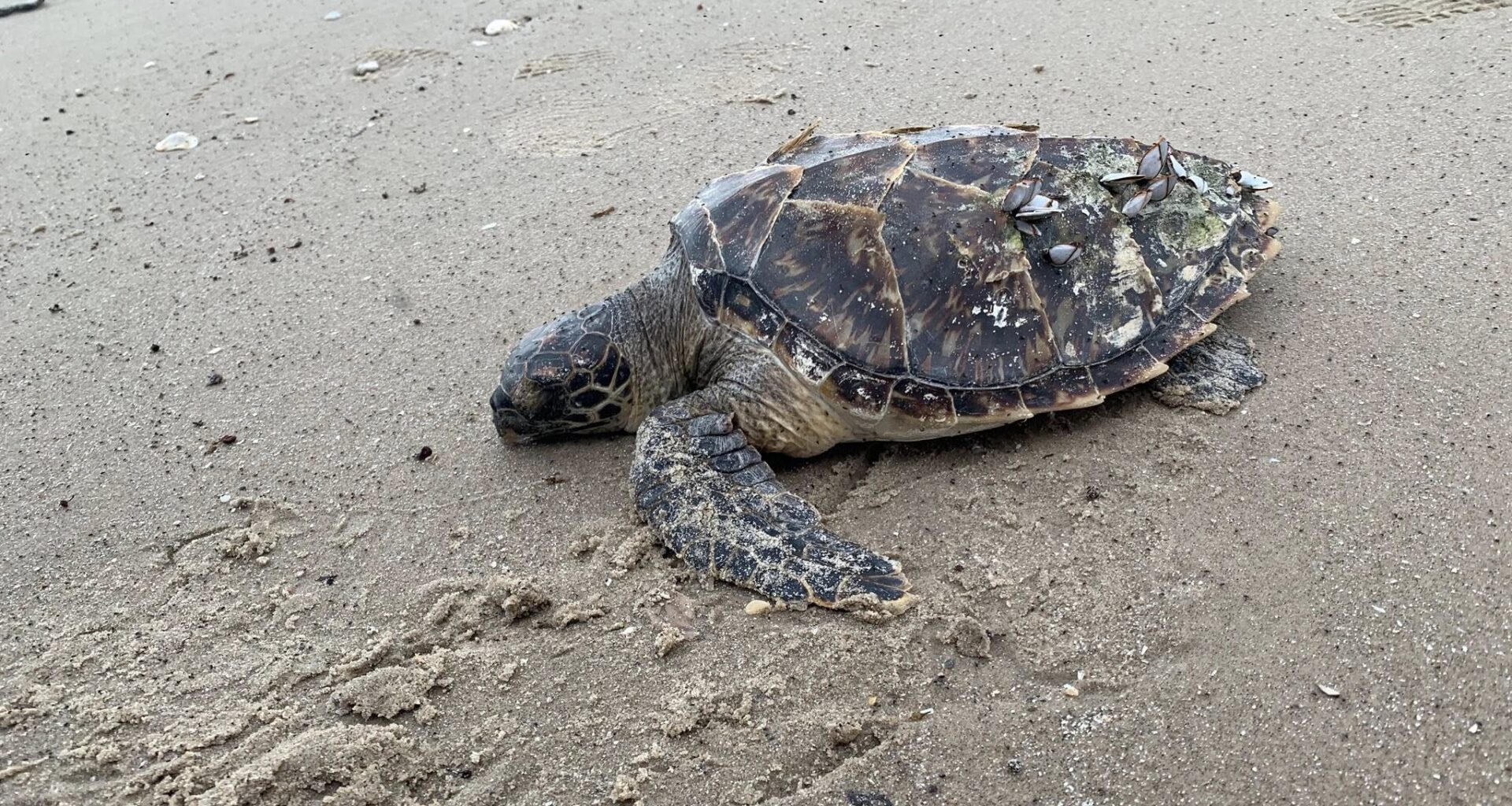
When Lisa Sherrard spotted what looked like a dead sea turtle tangled in seaweed on a Bolivar Peninsula beach Friday, she wasn’t expecting it to move.

The Pollok resident and her husband were riding along the shoreline near Gilchrist when they noticed the small turtle lying among rocks and piles of sargassum near the dunes.
“It had little bugs and barnacles on it and looked as though it was dead,” Sherrard told Chron.
Article continues below this ad
After calling the Gulf Center for Sea Turtle Research’s (GCSTR) rescue hotline, Sherrard stayed with the turtle while waiting for responders to arrive.
“It moved its head, and we knew then it was alive,” she said. “It was somewhat exciting, but we were worried for it at the same time.”
For Sherrard, who was vacationing at her family’s Gilchrist beach house, the rescue was unforgettable. For marine biologists, it was the second time in less than a week that a juvenile hawksbill sea turtle had stranded along the Texas coast.
Article continues below this ad
Lisa Sherrard spotted the juvenile hawksbill sea turtle stranded in seaweed near Gilchrist and called rescuers, helping save one of Texas’ rarest sea turtle species.
Lisa Sherrard
Named for its distinctive hawk-like beak, the federally endangered hawksbill is one of the rarest sea turtle species found in Texas waters. According to the National Park Service, only one hawksbill nest has ever been documented in Texas, at Padre Island National Seashore in 1998.
The juvenile hawksbill was later transported to the GCSTR’s rehabilitation hospital.
“Rescue Wesley soon arrived and said he believed it would make it,” Sherrard said. “That was music to our ears.”
Article continues below this ad
“A medical assessment was conducted with our Houston Zoo veterinary partners, and a treatment plan was established to support recovery and release back into Gulf waters,” the center wrote.
A rare double-stranding
The rescue came just days after another juvenile hawksbill stranded on the west end of Galveston Island. That turtle remains in rehabilitation and has been passing a significant amount of plastic debris, according to the center.
A juvenile hawksbill sea turtle rests in a pile of sargassum after stranding on Galveston Island.
Gulf Center for Sea Turtle Research
“Plastic fragments are often found in the seaweed and sea turtles will eat them,” the center wrote. “Sometimes they get lucky and can pass them through their digestive system.”
Article continues below this ad
A photo shared by the center showed dozens of plastic fragments recovered from the turtle so far.
Dozens of plastic fragments recovered from a juvenile hawksbill sea turtle stranded on Galveston Island. Researchers say the endangered turtle remains in critical condition.
Gulf Center for Sea Turtle Research
According to Christopher Marshall, a marine biologist at Texas A&M University at Galveston and director of the GCSTR, finding two hawksbills of this age in less than a week is highly unusual.
Most hawksbills found in Texas are tiny hatchlings, known as washbacks, that spend a month or two drifting ashore in floating mats of sargassum.
Article continues below this ad
The two turtles rescued this week are older and larger.
“One is probably under a year old,” Marshall told Chron. “The other is probably several years old.”
Large amounts of sargassum have washed onto Texas beaches in recent weeks. Scientists believe the floating seaweed may be linked to two rare hawksbill sea turtle strandings in less than a week.
Gulf Center for Sea Turtle Research
Marshall believes recent storms and the massive amounts of sargassum washing onto Texas beaches are likely connected to the strandings. Young hawksbills spend years living among the floating seaweed, which serves as both shelter and feeding grounds.
Article continues below this ad
“These are basically floating habitats for them,” Marshall said. “Those habitats have a lot of little fish, a lot of little shrimp and crustaceans that the turtles feed on.”
Both turtles arrived at the rehabilitation hospital in critical condition.
“One is for sure full of microplastics,” Marshall said. “The other one is probably full of plastics, too, but they’re both dehydrated, very weak and couldn’t fight the wind blowing the sargassum in.”
A juvenile hawksbill sea turtle receives care at the Gulf Center for Sea Turtle Research’s rehabilitation hospital after washing ashore on Galveston Island.
Gulf Center for Sea Turtle Research
The cases are unusual enough that Marshall said he would not be surprised if another hawksbill appears soon.
Article continues below this ad
“One is kind of like, ‘All right, well, that’s weird,'” he said. “Two, it’s like, ‘Oh, OK.’ And if a third one comes, it’s like, ‘All right, we’ve got a pattern here.'”
What beachgoers should know
The recent strandings have prompted researchers to urge beachgoers to watch carefully around piles of seaweed accumulating along the Gulf Coast.
“As beachgoers enjoy the coast this season, we encourage everyone to stay observant when walking near seaweed accumulations and shoreline wrack,” the center said.
Article continues below this ad
Marshall said anyone who spots a sea turtle on the beach should call 1-866-TURTLE-5 rather than handle the animal.
“That’s how we got these two hawksbills,” he said. “The public called.”