
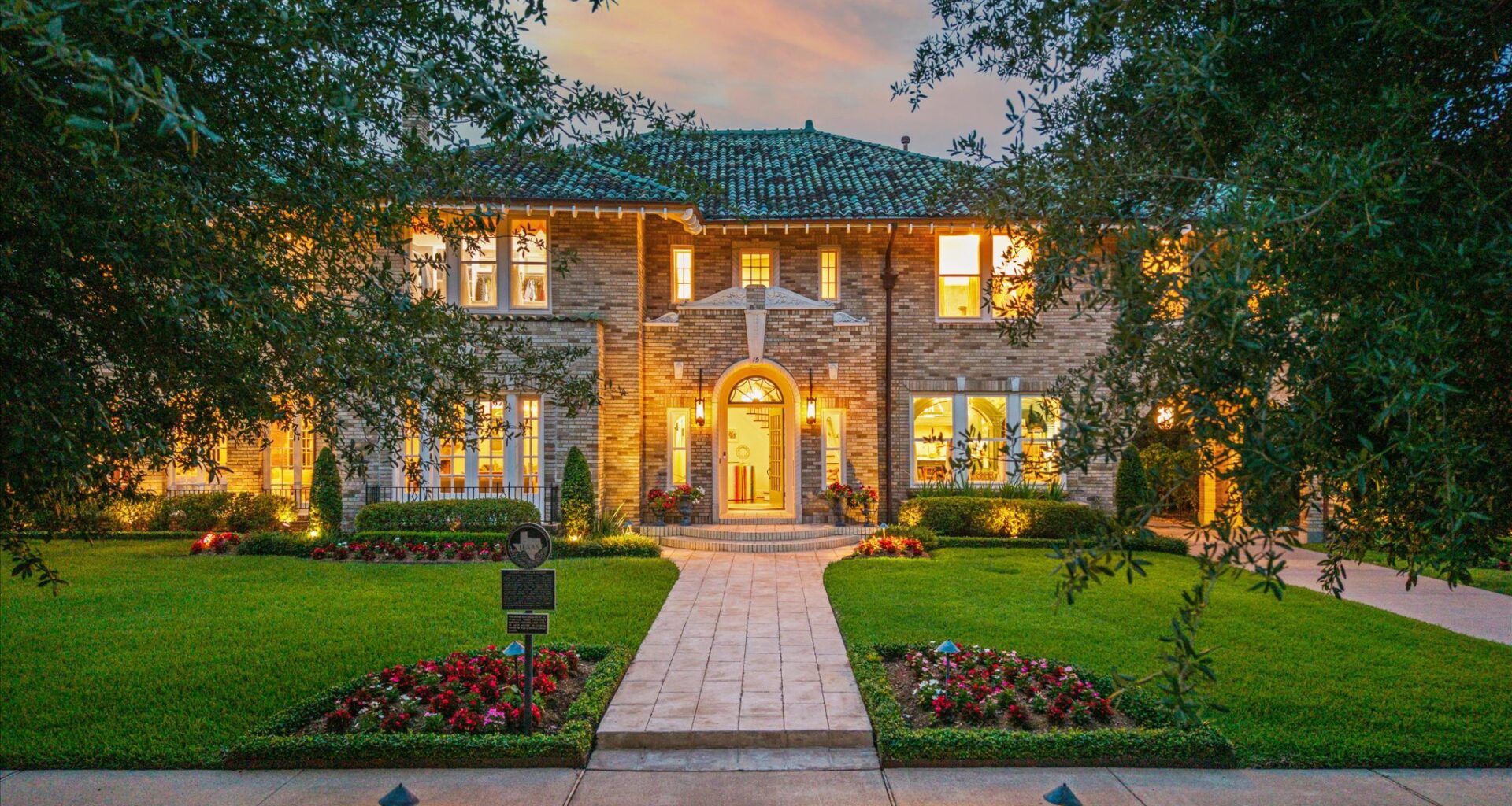
Long before River Oaks became Houston’s shorthand for old-money prestige, the city’s earliest power brokers were already building a private world behind gates just south of downtown.

That world still exists today inside Courtlandt Place—an ultra-private 18-home enclave established in 1906 as one of Houston’s first gated luxury neighborhoods, decades before River Oaks set the standard for high-end living.
Now, one of its rare surviving estates—the nearly century-old 15 Courtlandt Place—has returned to the market with a $4.6 million price tag, pulling renewed attention to one of Houston’s most quietly historic addresses.
Article continues below this ad
And the neighborhood’s legacy reads like a roster of early-20th-century Houston elite: oil men, lumber barons, cotton traders, bankers, attorneys, and civic leaders who helped shape the city’s rise.
Inside that world, today’s listing stands out not just for its age but for its pedigree.
15 Courtlandt Pl, Houston, Texas.
According to listing agent Dee Dee Guggenheim Howes, the home—known as the Johnelle Bryan House—is far more than another historic property hitting the market.
Article continues below this ad
“The Johnelle Bryan House represents a milestone in Houston’s design evolution,” Howes said, highlighting the work of architect Carlos Schoeppl. She described Schoeppl as “a native Texan and prominent architect best known for his impact in Florida, where he mastered both Mediterranean Revival elegance and early Miami Modern styles.”
Nearly a century later, that architectural foundation is still intact—and still defining the home’s identity.
Originally built in 1925, the estate has been carefully updated over time and most recently underwent a 2019 redesign that brings modern luxury into its historic structure.
Article continues below this ad
Howes said the renovation “masterfully updated the interiors, highlighting traditional scale and ultra-luxury finishes,” noting that “throughout the home, tailored built-ins and sophisticated materials strike a perfect balance between honoring historical roots and embracing a lavish modern lifestyle.”
15 Courtlandt Pl, Houston, Texas.
The effect is a home that still feels rooted in another era, but functions fully in this one—with grand formal spaces, marble finishes, a modern kitchen and living areas designed for contemporary use.
But the property’s transformation doesn’t stop at the front door.
Article continues below this ad
Outside, the estate opens into what Howes calls a curated landscape rather than a traditional backyard. “The meticulous grounds are elevated by an outdoor art installation by Jesús Bautista Moroles,” she said, referencing the Texas sculptor behind the Houston Police Officers’ Memorial. “The blending of the historic architecture and world-class art turns the pool area and lawns into a meditative oasis.”
15 Courtlandt Pl, Houston, Texas.
That combination of architecture, sculpture and landscape gives the property a feel more like a private estate gallery than a typical city home.
And it all sits within a neighborhood that once housed some of Houston’s most influential figures.
Article continues below this ad
Early residents included executives tied to companies like Texaco, along with banking leaders, judges and developers who helped steer Houston’s rapid growth. Among them were figures such as James Lockhart Autry, an attorney connected to early Texas energy development, and members of the W. T. Carter family, whose lumber empire and civic influence extended into city government and early aviation—including early efforts that helped pave the way for what is now William P. Hobby Airport.
Today, only 18 homes remain behind the gates of Courtlandt Place, preserving a rare pocket of Houston history that has largely survived the city’s constant reinvention.
In a city defined by change, that kind of permanence is becoming harder to find.
Article continues below this ad