
U.S. Sen. John Cornyn, R-Texas, speaks to the press, acknowledging he will face a run-off with Texas Attorney General Ken Paxton in the race for U.S. Senate after the Texas Republican primary election, March 3, 2026 at the Austin Marriott Downtown in Austin, Texas.
Sara Diggins/Austin American-Statesman
In 1998, the votes of 135,130 Texans were more than enough to set John Cornyn on his path to becoming a United States senator. But 28 years later, 910,382 votes would not be enough to keep him in office.

This story starts in 1998 because that was the year Cornyn went from being one of nine justices on the Texas Supreme Court to being the still-fledgling Texas Republican establishment’s preferred candidate for attorney general. It was also the year that Texas Republicans for the first time in more than a century saw within their grasp the chance to sweep every office on the statewide ballot.
Article continues below this ad
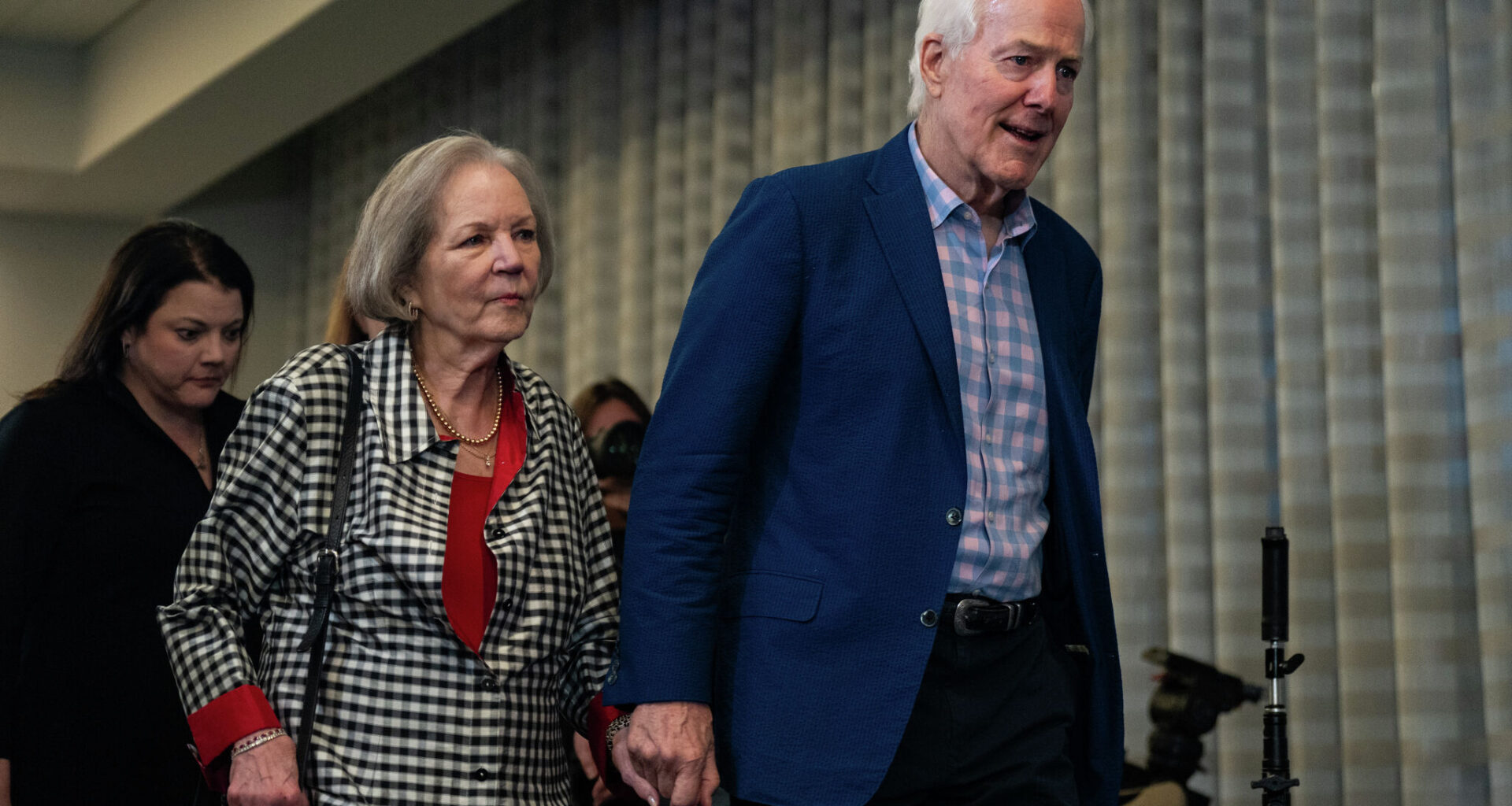
Sen. John Cornyn holds hands with his wife, Sandy Cornyn, before speaking to members of the press after losing the GOP nomination to Ken Paxton in Austin, Tuesday, May 26, 2026.
Mikala Compton/Austin American-Statesman
U.S. Sen. John Cornyn speaks at a campaign rally at Serrano’s on the first day of early voting in Austin on Tuesday, Feb. 17, 2026. Cornyn is seeking reelection and faces Texas Attorney General Ken Paxton and U.S. Rep. Wesley Hunt in the Republican primary for U.S. Senate.
Jay Janner/Austin American-Statesman
Cornyn’s presence on that GOP slate was considered vital to the Republicans’ chances of achieving that long elusive goal. And achieve it they did, which meant that the race that mattered as much as the general election in November was the 1998 Republican primary runoff. A grand total of 233,348 Republicans cast votes in the race for the only executive branch statewide office on the ballot, and 59% of them marked their ballots for Cornyn.
Four years later, when Sen. Phil Gramm announced that he would retire after three terms, Cornyn was again the establishment’s favorite. Nearly eight in 10 Republicans backed him in the primary, and he defeated his Democratic opponent by a comfortable 12 percentage points.
Cornyn’s rise began with Texas GOP dominance
Cornyn, the last of that victorious class of 1998 to still hold office, was defeated on Tuesday by Texas Attorney General Ken Paxton — and by a far different Republican electorate than the one that embraced him and candidates like him more than a generation ago. Back then, hewing to issues important to the business-minded, fiscally conservative cohort sometimes known as “country-club Republicans” was the key to electoral success as the old Democratic Party steered hard to the left.
Article continues below this ad
Then still in his mid-40s, the white-haired lawyer with a patrician bearing seemed like a Republican candidate straight out of central casting. In his 1998 race, Cornyn attached his fortunes to fantastically popular Gov. George W. Bush. And Karl Rove, the operative who would be nicknamed “Bush’s brain” after he masterminded the governor’s ascension to the presidency in 2000, guided Cornyn’s campaign.
READ MORE: James ‘Tala-freak-o’: Paxton takes page out of Trump playbook as Senate race takes shape
Bush remained popular, especially in his home state, in the 2002 cycle, when the attacks of Sept. 11, 2001, were fresh in the minds of voters. Cornyn’s allegiance to the president was never questioned on the campaign trail. In fact, it was never questioned during the final six years of Bush’s presidency as Cornyn forged his career as a Senate insider who would become and remain part of the chamber’s Republican leadership long after his Texas benefactor returned to private life.
Article continues below this ad
U.S. Sen. John Cornyn greets supporters at a campaign rally at Serrano’s on the first day of early voting in Austin on Tuesday, Feb. 17, 2026. Cornyn is seeking reelection and faces Texas Attorney General Ken Paxton and U.S. Rep. Wesley Hunt in the Republican primary for U.S. Senate.
Jay Janner/Austin American-Statesman
Voters back home rewarded his service, which early on was in the shadow of Texas’ senior senator, Kay Bailey Hutchison. Later, Cornyn would be seen as a calming presence in the Senate when the more showy Ted Cruz moved up after Hutchison retired.
Along the way, winning statewide races would become the rule, not the exception, for Texas Republicans. Turnout in the GOP primary would grow far beyond the anemic few hundred thousand of the late 1990s and balloon past 1 million. It also became increasingly conservative and less country club.
But Cornyn, whose campaign and governing style would remain remarkably consistent, kept winning with each reelection campaign as successful and uneventful as the last.
Article continues below this ad
U.S. Sen. John Cornyn and his wife, Sandy, arrive at the Carver Branch Library to vote on the first day of early voting in Austin on Tuesday, Feb. 17, 2026. Cornyn is seeking reelection and faces Texas Attorney General Ken Paxton and U.S. Rep. Wesley Hunt in the Republican primary for U.S. Senate.
Jay Janner/Austin American-Statesman
The Trump-era GOP catches up to Cornyn
By 2026, being a Senate insider was no longer an asset with base Republican voters. Being slow to board the Trump train, and even suggesting that the party should look for Trump alternatives ahead of the 2024 cycle, became unforgivable sins.
Article continues below this ad
Still, on primary night back in March, Cornyn stunned the pundit class by finishing ahead of Paxton in the first round of voting. But not far enough ahead. All told, nearly 2.2 million voters cast ballots in the Republican primary. About 42% of them were for Cornyn. But to avoid the runoff and advance to November, he would have needed nearly 200,000 more votes than he got.
Reports that Trump might endorse Cornyn in the runoff, to avoid further fracturing the Texas GOP and saving the countless millions the campaign would cost, buoyed the senator’s spirits. Just as he did in those early campaigns so long ago, Cornyn sought to attach himself to his president. He was photographed reading “The Art of the Deal,” Trump’s pre-presidency autobiography. He filed a bill to name a still-to-be-completed multistate highway the Trump Interstate.
But modern Republican voters weren’t buying it. Neither, as it turned out, was Trump. One week before the election, the president endorsed Paxton. Judging by the margin of the challenger’s victory, Cornyn’s defeat had been preordained.
Article continues below this ad
When he suggested in 2023 that “Trump’s time has passed him by,” the 74-year-old Cornyn was partially right. Time had passed someone by. But it would not be Trump’s — it would be his own.