
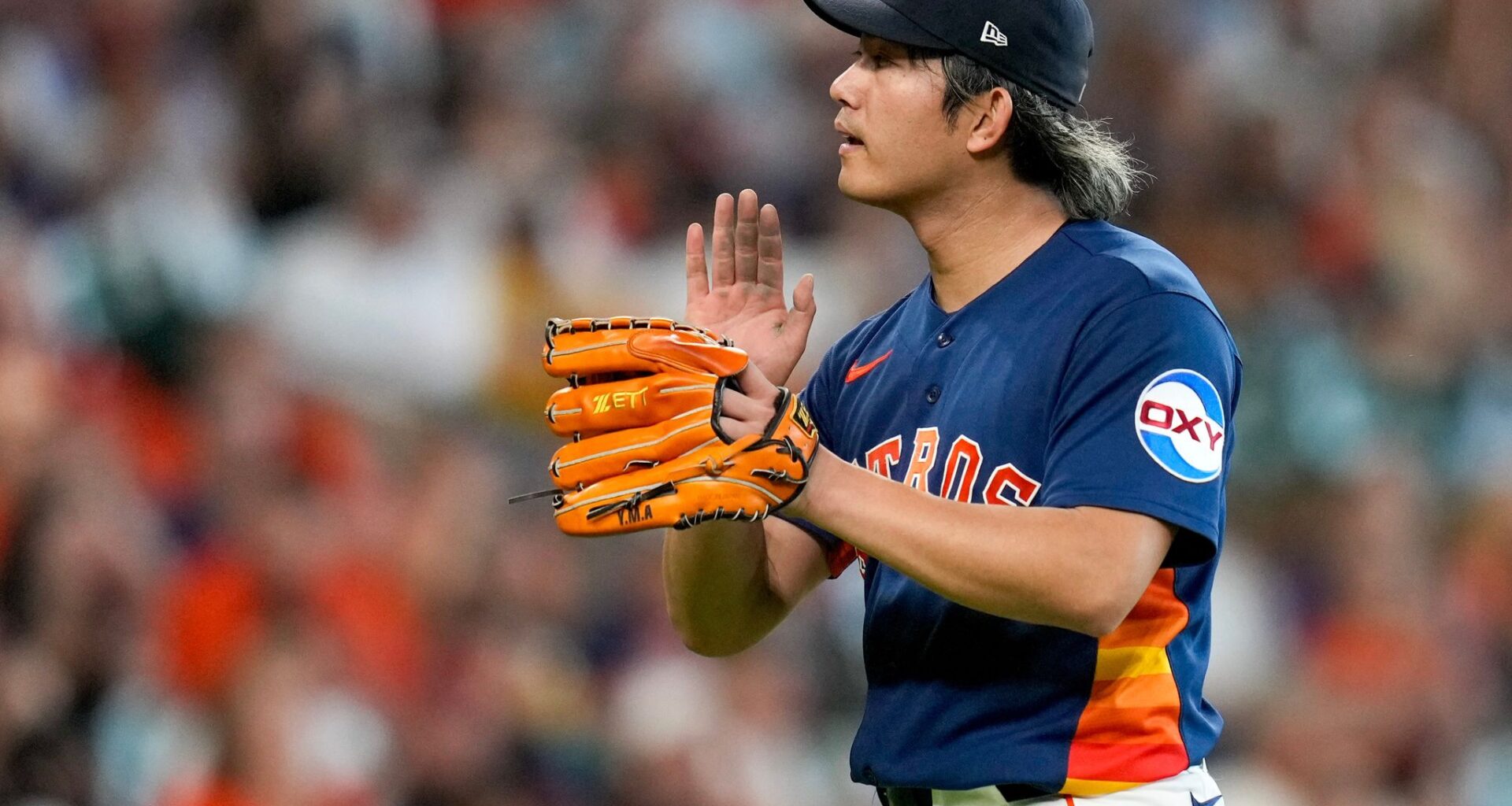
Houston Astros starting pitcher Tatsuya Imai reacts after the final out of the sixth inning of a baseball game against the Milwaukee Brewers, Sunday, May 31, 2026, in Houston. (AP Photo/Eric Christian Smith)
Eric Christian Smith/Associated Press
After inducing a lineout with his 110th pitch of a laborious afternoon, Tatsuya Imai trudged back to the Houston Astros dugout with a message for his manager.
“He was like, ‘I got more in there, I could go back out there for another inning,’” said Joe Espada.
Math made that an easy decision. No pitcher has thrown more than 114 pitches in an MLB outing this season. Imai’s total over six innings of two-run ball against the Milwaukee Brewers on Sunday equaled the third-highest and rendered his eagerness moot.
Article continues below this ad
“But it was really good how there’s more confidence,” Espada said. “There’s a different presence about him when he knows OK, things are starting to go my way. And that’s very important for him, just where he started and where he’s at now.”
Imai’s introduction to a league and lifestyle has been a longer acclimation than many in Houston hoped. Expectations and economics honed the scrutiny of his early struggles with both, yet Sunday marked just his seventh start in a move to Major League Baseball.
That his first few — and ensuing time on the injured list for “arm fatigue” — added to the Astros’ initial pitching turmoil is inarguable. Imai took the mound Sunday with a 6.17 ERA, one aspect of a Houston staff that still owned the majors’ second-highest team ERA.
Yet both parties have offered some signs of stabilizing. The Astros compiled a 3.66 ERA as a team while going 15-14 in May, after posting a 6.08 ERA through April. Imai’s last three outings have yielded a 2.70 ERA, as well as peripheral indications of progress.
Article continues below this ad
Both trajectories beg context. Houston is 27-34 following its 2-0 loss Sunday to Jacob Misiorowski and the Brewers. Imai followed a rain-shortened start at Minnesota with six hitless innings against a short-handed Texas lineup in which Astros coaches acknowledged his execution was not as sharp.
His outing in the combined no-hitter of the Rangers still reinforced an idea — Imai can be effective with his repertoire when he is around the strike zone. Preaching it, as the Astros’ coaches have done, is one thing, but attaining such results may produce another level of confidence.
Sunday, Imai faced a lineup tailored to exploit tentativeness. No offense in baseball is chasing out of the strike zone at a lower rate than the Brewers’ this season, per Baseball Savant. Just two have walked at a higher clip, requiring opposing pitchers to attack the zone.
Imai did with both his fastball and slider Sunday, throwing 59% of his pitches for strikes. He issued two walks over six innings, despite throwing first-pitch strikes to just seven of 23 hitters. Milwaukee totaled three hits against him, one a two-run home run by Jake Bauers on an elevated slider.
Article continues below this ad
“For today’s outing, I was able to find a position where I’m really comfortable, and then even with high intent I was very confident with being able to put it in the zone,” Imai said through an interpreter. “So I was very confident about that.”
Imai clarified that he felt better with his position coming set on the mound, before starting his delivery, and able to repeat it consistently Sunday. That in turn allowed him to “ramp up” his intent as his outing went on and maintain command, he said.
“I have to put my body weight on my left heel and I was struggling before,” Imai said. “But for today’s outing I was able to do it most of the time and be comfortable and be able to attack the zone.”
Houston Astros starting pitcher Tatsuya Imai delivers against the Milwaukee Brewers during the fourth inning of a baseball game, Sunday, May 31, 2026, in Houston. (AP Photo/Eric Christian Smith)
Eric Christian Smith/Associated Press
In Imai’s final three innings, his average fastball velocity was higher than in his first three. He recorded each of nine fastest pitches Sunday in the fifth or sixth inning. Just one was a called ball; the rest were either strikes, fouled away or put into play for outs.
Article continues below this ad
Like many aspects of this transition, Imai’s fastball has been a work in progress. He admitted in spring training a hesitance to fully let the pitch go at times while adjusting to the different MLB baseball and pitcher’s mound. He threw his fastball in-zone just 42.9% of the time in his first three starts.
In his first start back from the injured list, Imai threw his fastball with a two-seam grip, which he’s used only sporadically since. In his outing at Texas, Imai sprayed fastballs to left-handed hitters while walking three of the first four batters he faced.
He did the same with his first pitch of the game Sunday to Christian Yelich. But Imai then appeared to make a quicker adjustment. His second fastball missed just inside. His next two landed in the zone. He threw 58% of his fastballs in-zone to a lineup with six left-handed hitters.
Imai held a Brewers team averaging the sixth-most runs per game in the majors to two, which scored when Bauers lofted a slider 347 feet into the Crawford Boxes. He did not allow a hit after that, holding his own against Misiorowski, who stymied Houston’s lineup for seven scoreless innings.
Article continues below this ad
In doing so, Imai delivered perhaps his most promising Astros start to date, underscored by his being afforded the chance to finish the sixth inning. Bauers worked a nine-pitch at-bat with two outs, amid which Imai threw a 97.6 mph fastball, his hardest pitch of the day. Bauers lined his last to left fielder Taylor Trammell. Imai later affirmed he has “a tank even after 100 pitches.”
“We know that he’s thrown that many pitches in his career (in Japan),” Espada said. “But the fact that he did it against a really good offensive team, and came out on a positive note, that was very encouraging.”