
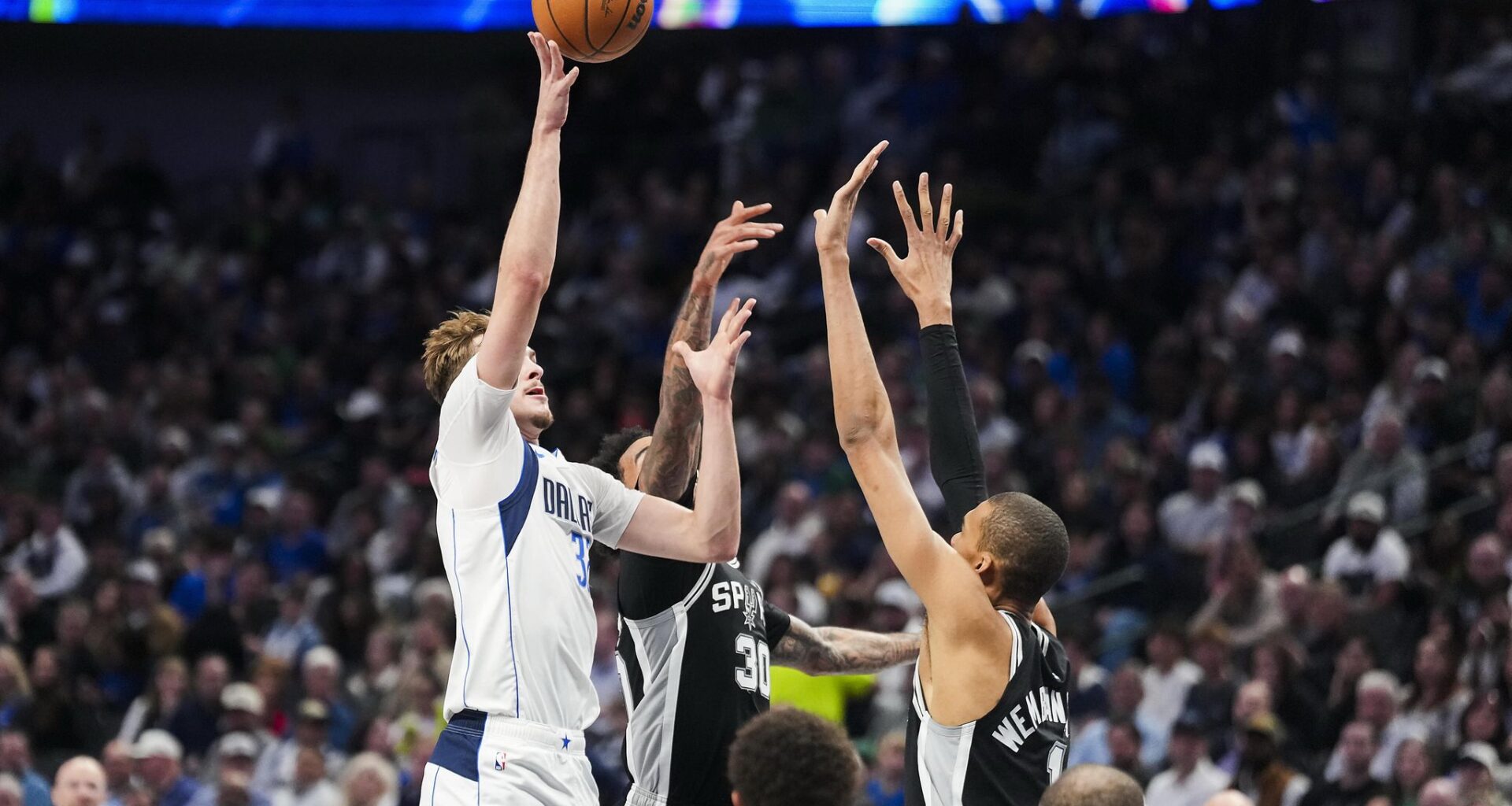
Dallas Mavericks forward Cooper Flagg (32) scores over San Antonio Spurs forward Victor Wembanyama (1) and forward Julian Champagnie (30) during the second half of an NBA basketball game at American Airlines Center on Thursday, Feb. 5, 2026, in Dallas.
Smiley N. Pool/Staff Photographer
Imagine you are one of 13 general managers in the West, watching the conference finals, trying to figure out how in the world you intend to compete with the Spurs and the Thunder for the next five years.

Now imagine you are the newest of those general managers, one taking over a 26-win team that has a massively talented teenager at one guard and a 34-year-old former superstar coming off injury at the other guard. And not much else. And no draft picks to speak of, following this year’s draft, for the next five years.
Does the word “frightening” come to mind?
Article continues below this ad
“I would say eager to join the party, you know. Driven to join the party.’’
Mike Schmitz is the 36-year-old general manager of the Dallas Mavericks, hired in mid-May by new President Masai Ujiri to be the day-to-day eyes-and-ears of an organization that is — for the moment — not in the same league with San Antonio and Oklahoma City. Not in talent (don’t have nearly enough), not in coaching (don’t have one), not in support staff (the medical and training group that was dismantled during Nico Harrison’s reign is being rebuilt), not in home-court advantage (the Mavs are moving in five years … somewhere).
On top of that, after making their picks in three weeks — they currently have 9-30-48 and Schmitz likes to say “9-30-48” like it gives him comfort, for reasons we will get into — they don’t own any of their first-round picks again until 2031. You want more? The league just changed the rules regarding the lottery in hopes of eliminating tanking. That’s going to reduce the number of trade partners a team might have if fewer teams are out there looking to play for the future.
Article continues below this ad
The new rule just gave at least two teams a decided advantage moving forward. Those teams are the Oklahoma City Thunder and the San Antonio Spurs.
In the Thunder’s case, general manager Sam Presti has accumulated a stockpile of draft picks over the next several seasons. That’s just to bolster a team that won the 2025 championship, lost Game 7 to San Antonio after leading the league in wins this season and has a two-time MVP squared away, ready for more. Now that it’s almost a roll of the dice to see which teams land the top picks, the Thunder’s stockpile is even more valuable than it was a week ago.
Dallas Mavericks general manager Mike Schmitz.
Courtesy of the Dallas Mavericks
The Spurs are the team that dethroned the Thunder. In the games in which De’Aaron Fox didn’t play, the ages in their starting lineup went: Devin Vassell, 25; Julian Champagnie, 24; Victor Wembanyama, 22; Stephon Castle, 21, Dylan Harper, 20. It was the youngest starting five in conference finals history.
Article continues below this ad
Oh, and one other thing. The manner in which the Spurs built their team is no longer legal. At their core, they have Wemby, first overall pick in 2023 and quite possibly the latest version of Wilt, Russell and Kareem rolled into one, along with Castle, the fourth pick in 2024 and Harper, second behind Cooper Flagg in 2022. The new lottery rules prevent a team from getting top five picks in three consecutive seasons. Assuming the NBA stands by this change when the rules are re-examined in 2029, the Spurs will be the last team allowed to load up in this manner.
Nothing but smiles from Schmitz, though.
“To be able to see this [series] and Game 7, it motivates you, honestly,’’ Schmitz said. “So we do this to win, to win for a long time and that’s why we’re here.’’
Schmitz is here because he is really, really good at studying and evaluating draft picks. Did it for Draft Express a decade ago. Worked his way to ESPN where he served as their top NBA draft analyst for a few years.
(I always figured the Mavs would listen to someone talking on ESPN, I just thought it might be someone else).
Article continues below this ad
Was good enough that Portland hired him and he made assistant GM at 31, one year after his target date. Made GM in Dallas at 35, right on schedule for another ambitious target date he had set. Now it’s up to Ujiri and Schmitz to figure out how to use his evaluating tools because — again — not much in the way of valuable picks after this season.
But for now there is the June 23-24 draft and a chance to supplement Flagg.
“My job is to take all the inputs and make the right decision,’’ Schmitz said. “That’s information on the [changing] landscape, that’s intel on a player, that’s video breakdowns, that’s the analytics, that’s what our health and performance people are saying, and it’s my job to have clarity on all those factors. To have 9-30-48, I mean coming from Portland we had no picks, right, so to go from that to having three now in the draft is really exciting, and just having tools to get better is all you can ask for.’’
There’s a lot to take in, plenty of tape to study and players to interview, not to mention one day maybe getting a head coach. Then again, that party Schmitz wants to crash doesn’t hand out invitations. Geographically speaking, Oklahoma City and San Antonio are just up and down the road from here. In an NBA that has just rendered the West’s two best teams even more powerful, they are a world apart from Dallas.