
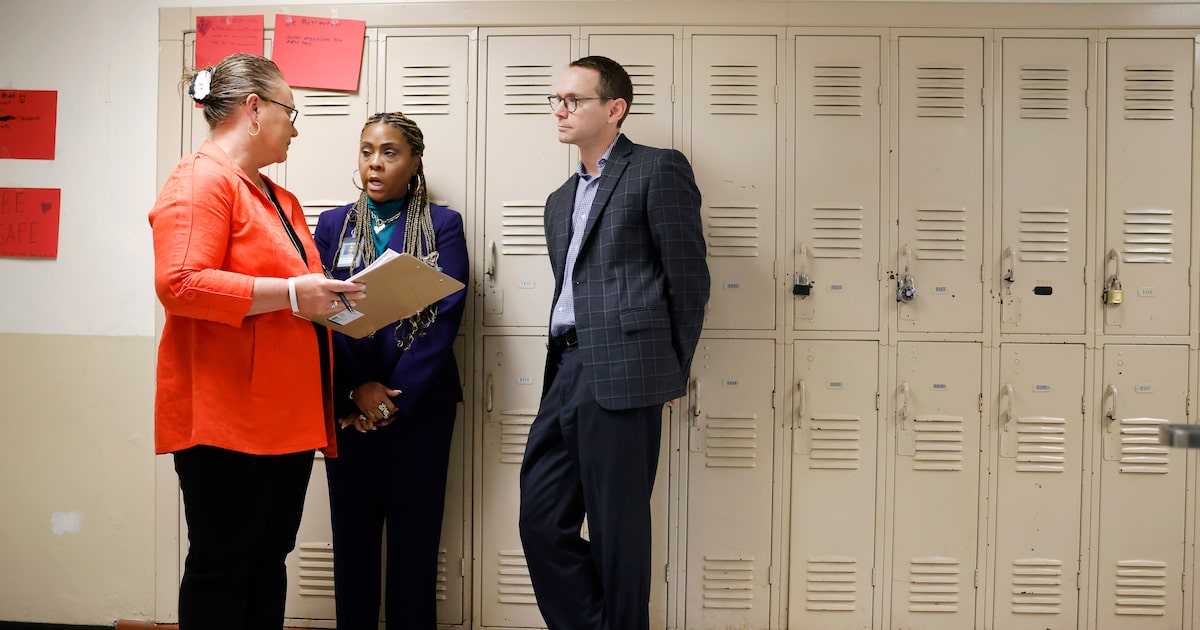
Fort Worth Independent School District, which enrolls almost 70,000 students, has struggled academically for years. Last month, Texas Education Commissioner Mike Morath intervened. He announced that the Texas Education Agency would appoint a board of managers and a conservator to govern the district. The state could also replace the current superintendent.
While jarring, the state action is neither surprising nor unwarranted. Fort Worth ISD needed a chance to break with its past and officially rededicate itself to student achievement. The takeover allows that.
And the dramatic action has a good chance of success because so many district stakeholders have publicly acknowledged its problems and begun trying to correct them. Superintendent Karen Molinar, who was promoted into that position in February, has been honest about its instructional deficits. She identified lagging literacy as a top academic concern and has worked energetically to provide the resources needed to improve student performance in that area.
Key civic and political leaders, including Fort Worth Mayor Mattie Parker, have exhorted the district to raise expectations and outcomes. Parents and nonprofits have organized to help families understand data about how students, and schools, are stumbling. While the takeover has critics, and many teachers and parents may be wary, we are optimistic. This is an opportunity to accelerate transformation so that every student benefits from high quality instruction as soon as possible.
Opinion
How Fort Worth ISD fell behind
News stories presaging the takeover tended to focus on a single school, the Leadership Academy at Forest Oak 6th Grade campus. It received unacceptable academic ratings for five consecutive years. Once a school hits that threshold, the education commissioner must either close the campus or take over the district. (Forest Oak actually hit that trigger after the 2022-23 academic year, but those ratings were only released in April of this year because of litigation.)
But the problem was much bigger than one school. Underperformance had become the norm for Fort Worth ISD. In 2022-23, more than half of its schools earned D’s or F’s, Morath noted in his letter to district leadership. Only one-third of students meet grade-level expectations across all grades and subjects, he wrote, which is significantly below the state average and also below student performance in Dallas and Houston. The district couldn’t blame the problem on COVID-19 learning loss; only 35% of Fort Worth ISD students met grade level the year before the pandemic struck.
Despite the grim state ratings, it has been difficult for parents to understand how dire the situation is, or how their own children are performing. Most parents assume the report card their son or daughter brings home accurately reflects their child’s knowledge and skills. That isn’t always true.
Fort Worth ISD parent Trenace Dorsey-Hollins recalls that her daughter’s first-grade report card made it appear that she had regressed academically since kindergarten. The teacher told Hollis-Dorsey not to worry because she gave every student the same grade for the first six weeks. Then she could show their growth over the next six weeks.
Dissatisfied with that explanation, Dorsey-Hollins kept asking questions and talking to other parents. She founded a nonprofit, Parent Shield, which organized summer clinics that surveyed parents about their children’s performance and had independent reading teachers assess their children’s skills.
Almost 70% of parents relied on report cards to gauge their children’s progress and a similar majority thought their children were reading on grade level or weren’t sure. The reading “check-ups,” however, showed that about 64% of children read below grade level.
The assumption that report cards accurately describe student achievement is widespread. In a 2024 survey of 150 Tarrant County parents, 86% said their child brought home mostly B’s or better on report cards. Eighty-four percent thought their child read at grade level.
In fact, just over half of Tarrant County public school children read at grade level and only 43% were at grade level in math. That’s why statewide assessments, such as the STAAR test, are so important. They are aligned with state standards and provide a snapshot of how children, schools and districts perform against one another — and against the standards.
“Assessments are not popular nationally, but they’re necessary,” said Robin Berkley, who directs the George W. Bush Presidential Center’s education program. “They give school administrators, policy makers and parents incredibly important information. It’s the only apples-to-apples comparison we have.”
The path forward for Fort Worth schools
The state’s next steps in Fort Worth will be community meetings, recruiting and evaluating candidates for the new board of managers, appointing a conservator, and soliciting applications for superintendent. The new leadership should be selected by early next year.
District takeovers in Texas rarely produce high-achieving districts. Shepherd ISD in Deep East Texas had 28% of students performing at grade level in 2019, when the state intervened. It has 31% at grade level this year. Houston’s results are more encouraging. In two years, the percentage of students meeting grade level rose from 41% to 49%, which translates to thousands more students on track.
A successful turn-around will require consistently high-quality instruction, which requires frequent evaluation and coaching. It will require high-quality instructional materials. Fort Worth recently selected the Bluebonnet Learning reading curriculum, which is considered effective, although its religious overtones add unnecessary controversy to its use. The district must lean even more into rewarding the best teachers with higher pay, and putting the best teachers in front of the most challenged kids.
And the new team needs to sell the product. Teachers and campus administrators may be worn out, cynical or worried. They need to understand why this intervention, why now, and how irreplaceable they are to helping students expect and achieve more.
Former DISD Superintendent Michael Hinojosa understands the stress that comes from implementing systemic change. He led Dallas schools before and after former Superintendent Mike Miles, a knowledgeable and effective but unyielding reformer who now leads Houston ISD.
One key to success is the new team’s tone.
“Nobody wants to be fixed, but everybody wants success,” Hinojosa said. “Be empathetic but not sympathetic. Listen to people, hear them, but don’t get dissuaded from what the future can look like.”