
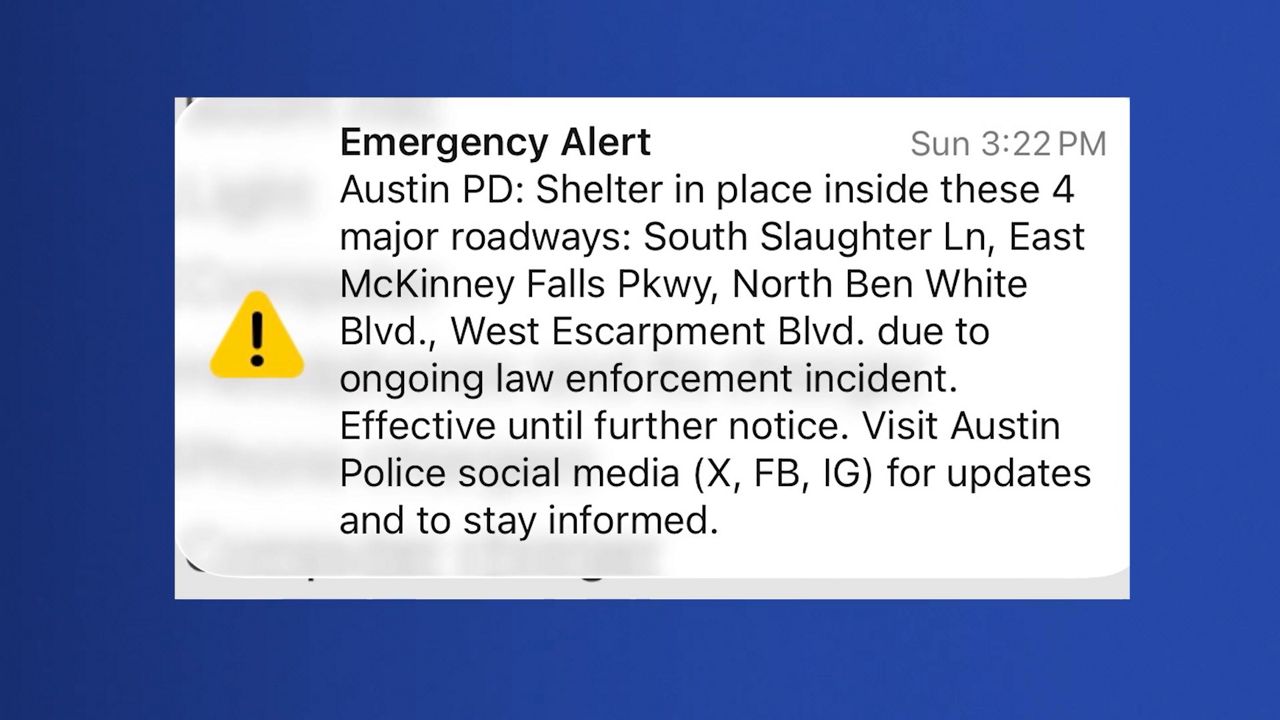
AUSTIN, Texas — On May 17, the Austin Police Department (APD) began investigating at least a dozen “random” shootings, which left four injured.
The incident triggered the City of Austin to send out a shelter-in-place message using its emergency alert system. The message included the area to avoid, which were four roadways: South Slaughter Lane, East McKinney Falls Parkway, North Ben White Boulevard and West Escarpment Boulevard.
“Someone was trying to tell me a day or two ago, and I don’t even know what that means,” said Isaac Robles, an Austin resident.
Spectrum News asked the director of Austin Emergency Management, Jim Redick, about the brief message. He said there’s a limited number of characters they can use, and the alert pushed people to social media for continuous updates.
“You’re right, shelter-in-place can be pretty confusing,” said Redick. “And to your point…depending on the incident, if it’s a hazmat incident, shelter-in-place means a lot more than just you staying where you are.”
Austin uses the Integrated Public Alert and Warning System (IPAWS). It’s a federally regulated system that allows jurisdictions to contact people via cellphone towers, television and radio without requiring people to subscribe to a service. IPAWS uses wireless emergency alerts to contact cellphones within a geofenced area. The city is tasked with not only making sure the message is clear but also making sure people are getting the message.
“If you have an Apple phone, way down at the bottom is government alerts area, and that’s Amber alerts, emergency alerts, public safety alerts and text alerts. And if you have any of those turned off, then you’re not going to get IPAWS warnings,” said David Wiechmann, public information and marketing program manager at Austin Emergency Management.
Wiechmann said some people never got the message at all. According to a report from the Homeland Security Operational Analysis Center, Texas is leading the nation in the number of people not signed up for any type of emergency alerts, with the state having a rate of opt outs five times higher than that of Vermont, the state with the lowest rate of opt outs.
“Our message is, if we can’t contact you, we can’t alert you. And so whether it’s this type of incident or a wildfire and we need to evacuate, folks, we need to make sure folks can receive that message,” said Redick.
Redick said the biggest lesson the team has learned so far is that a lot of people are choosing to opt out of emergency alerts.
“It’s critical because we don’t know what disaster is going to happen next. And we don’t know how much lead time we may get, because a lot of times disasters are no, no-notice incidents. And we’re going to send a blast message to send people information to take protective action,” said Redick.