
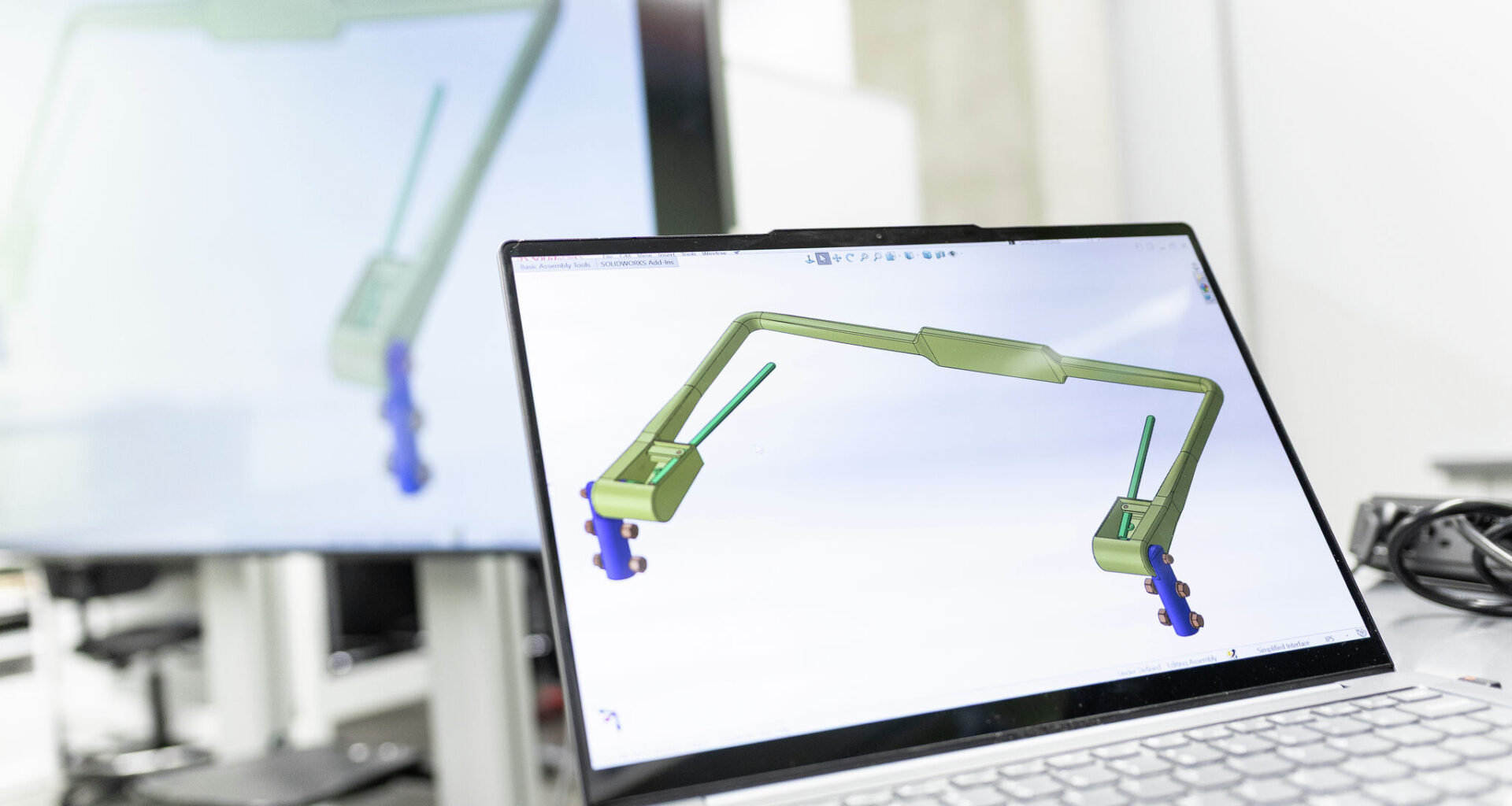
A group of UTD engineering students tackled a redesign of a tool cart handle for NASA’s Micro-g Neutral Buoyancy Experiment Design Teams. The team will present it at the Johnson Space Center in early June.
james coreas/University of Texas at Dallas
On Earth, a tool cart handle is simple, mundane even. On the moon, it becomes complicated. On the moon, that “simple” handle now has to withstand up to 200 pounds of force, extreme temperatures, lunar gravity and glass shards — all while being less than five pounds.

A group of engineering students at the University of Texas at Dallas tackled those challenges when trying to redesign the tool cart handle for NASA’s Micro-g Neutral Buoyancy Experiment Design Teams. After more than 10 months of designing and prototyping, the team was one of six selected from across the country to present their final prototype to NASA at the Johnson Space Center this week.
“How often do people get to say, ‘NASA liked what we’re doing?’” said David Von Paumgartten, the team’s testing and safety lead. “Is there any bigger compliment you can get as an engineer?”
Article continues below this ad
UTD joins five other teams from West Virginia University, University of Illinois Urbana-Champaign, Embry-Riddle Aeronautic University, Colorado School of Mines, and Grand Valley State University. This year marks the fourth UTD team selected for the competition in the last four years.
NASA’s Micro-g Neutral Buoyancy Experiment Design Teams project challenges college students to solve a real-world problem the agency is facing. NASA began the program in 2015 as a way to encourage students to engage with a current challenge the agency faces, as well as give them experience working with NASA engineers. This year, students had the option of designing a tool cart handle or a tool dock in anticipation of the 2028 Artemis IV mission, when astronauts are expected to land on the moon.
“Getting the chance to be a part of something as historic as the Artemis missions is really exciting,” said Ben Hudson, the team’s outreach director.
The UTD students working on the NASA design team project are (front row, from left) mechanical engineering junior Adisan Hammel, mechanical engineering senior Nat Sullivan and computer engineering senior John Phelan; (back row, from left), mechanical engineering juniors Jakob Aleman, David von Paumgartten and Ben Hudson.
james coreas/University of Texas at Dallas
Six teams, including the UTD team, advanced for the tool cart handle challenge, while 10 teams advanced in the tool dock challenge. Now, the teams will put their prototypes through a series of tests over the next several days at NASA’s Johnson Space Center in Houston, where NASA engineers will evaluate how well the prototypes withstand lunar gravity and regolith — glass shards found on the moon.
Article continues below this ad
Related: Tuition freeze to continue, Abbott reminds Texas universities
In addition to handling extreme temperatures, the handle also has to be ergonomic. For astronauts in bulky, pressurized suits with limited finger mobility, gripping a tool cart handle for hours can be fatiguing in lunar gravity.
“Why are we making the job harder for the astronaut?” von Paumgartten said. “Why don’t we just make something that makes their lives easier, especially when they’re already on [the moon] for us doing all this work?”
To solve this problem, the team used a design based on a dog clutch mechanism to create a handle that primarily relies on the astronaut moving their thumb, rather than their entire hand.
“What this does is allow the astronauts to manipulate and adjust our handle using as little hand flexion as possible, making it very non-fatiguing, ergonomic, and reliable,” Hudson said.
Article continues below this ad
Over the course of 10 months, team lead Nat Sullivan estimated they went through about 12 to 15 different prototypes, with dozens of smaller tweaks between each one. At its most intense, team members put in 20-40 hours per week. Adisan Hammel, the project’s computer assisted design lead, said it felt like a part-time job.
Nat Sullivan (from left), Adisan Hammel and David von Paumgartten work on the UTD team’s tool cart handle design. The team will present its design at the Johnson Space Center this week.
james coreas/University of Texas at Dallas
“I haven’t had the chance to work with anybody this motivated outside of this group, so it’s really been something special,” Sullivan said.
Von Paumgartten said the most rewarding aspect of the project for him was being able to inspire his little cousins, who lovingly call him a “space cowboy.” Coming from a low-income household as a first-generation college student, working on this team has meant “everything” to him.
For Hudson, it was exciting to work with NASA so early on in his career, especially to solve an issue that astronauts are facing in real life.
Article continues below this ad
“It’s one thing to learn formulas that you can use to see how much stress a part can carry,” Hudson said. “It’s something else, getting to apply it in a very real-world application, where your work is going to be looked over and checked by professional engineers working for NASA.”
The DMN Education Lab deepens the coverage and conversation about urgent education issues critical to the future of North Texas.
The DMN Education Lab is a community-funded journalism initiative, with support from Bobby and Lottye Lyle, Communities Foundation of Texas, The Dallas Foundation, Dallas Regional Chamber, Deedie Rose, Garrett and Cecilia Boone, Judy and Jim Gibbs, The Meadows Foundation, The Murrell Foundation, Ron Steinhart, Solutions Journalism Network, Southern Methodist University, Sydney Smith Hicks, and the University of Texas at Dallas. The Dallas Morning News retains full editorial control of the Education Lab’s journalism.