
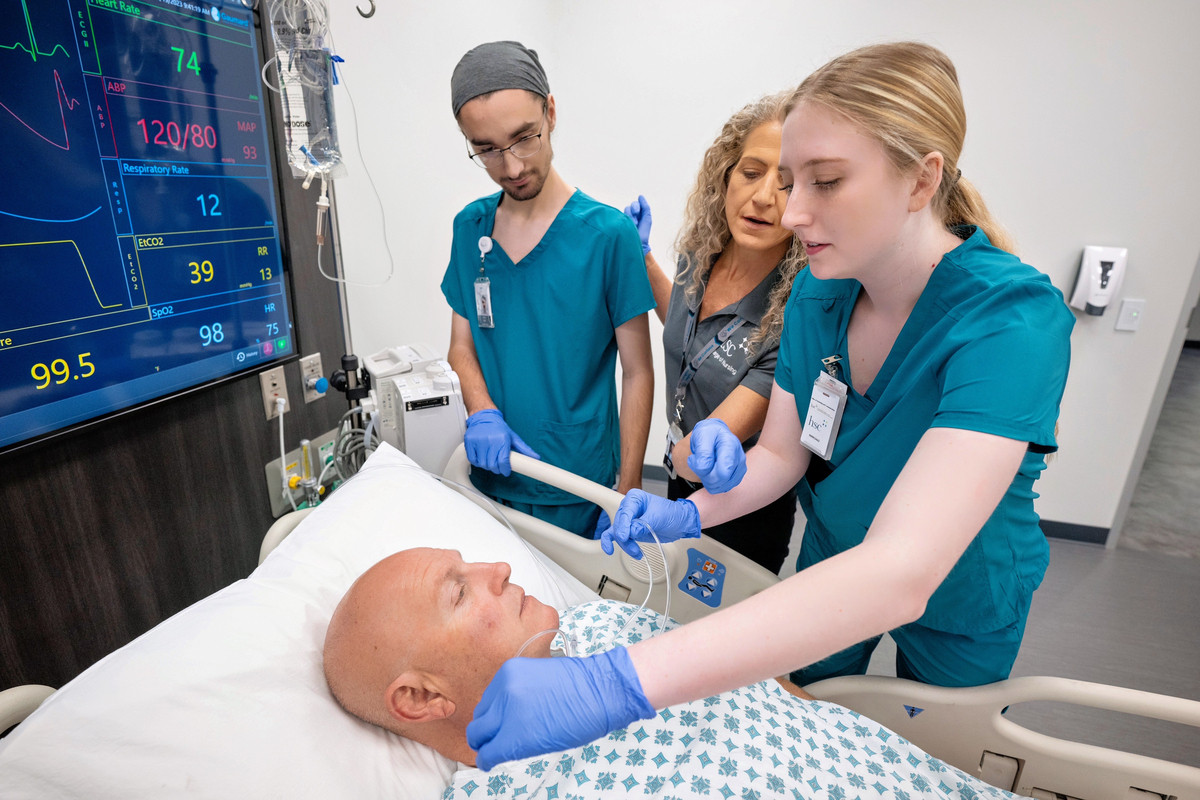
How many people in the hospital system die because of “medical errors”?
The definitive answer is elusive because calculations are opaque. The definition is also opaque — “medical errors” can be consistent with everything from surgical and diagnostic errors to equipment failures and hospital-acquired infections.
But general calculations indicate 22,000 to nearly 100,000 people die in hospital systems annually due to medical error, according to studies from the National Institutes of Health and National Academy of Medicine.
That’s the equivalent of something like two large planes crashing every day, said Dr. Frank Filipetto, a current faculty member and the former dean of the Texas College of Osteopathic Medicine at UNT Health Fort Worth.
“One jetliner crashes, and you hear it as the top news story for the next month. Why are we not talking about this?” Filipetto said.
Loosely defined, medical error refers to mistakes made by healthcare professionals that affect patient care. “Medical error” is not listed as a cause of death in hospital statistics, but experts estimate that if it was, it would be the third leading cause of death nationwide.
Causes flagged by experts that lead to medical error include high workload, understaffing, communication issues and organizational deficiencies.
Few medical schools have looked to address the issue. But since launching the Certified Professional in Patient Safety course in 2019, UNT Health has become a leader in the healthcare industry for looking to address systemic causes of medical error, said Patricia A. McGaffigan, senior adviser for patient safety at the Institute for Healthcare Improvement.
“TCOM is absolutely the crown jewel in this work, and they are setting an incredible standard that I hope many other organizations will aspire to have,” McGaffigan said.
The two-week intensive course, which includes self-assessments, interactive activities and regular coursework, was created utilizing guidance from the Institute for Healthcare Improvement, an international nonprofit dedicated to improving the equity and quality of healthcare.
UNT Health is one of a handful of medical schools that work with the institute to certify students. And even fewer require the course, as UNT Health does. Through the course and consequent certification, students learn the touchpoints that can lead to medical error — including hospital culture, safety risks and performance measurements.
Internationally, over 8,000 people have the Certified Professional in Patient Safety credential. About 1,400 of them are TCOM grads, Filipetto said.
When he was TCOM dean, it was important for Filipetto to equip future medical professionals with tools to improve the industry. Oftentimes, medical error is wrongly attributed to individual physician mistakes, he said, when the issues are mostly systemic.
“Someone like myself, who went to medical school 30 years (ago), as well as any other faculty in most medical schools, knows nothing about patient safety,” Filipetto said. “They don’t know anything about safety science, so they don’t truly understand how impactful this is.”
Fear of reprisal for pointing out errors from others with more experience should not be a barrier to fixing a problem, said Dr. David Mason, assistant dean of osteopathic clinical education at TCOM.
“It’s about changing the culture,” he added. “We have to empower all of our workers in the medical field to be able to protect our patients, because it’s just too widespread. There’s too many people still getting hurt in the medical world.”
The focus on patient safety is not exclusive to a two-week intensive. McGaffigan noted TCOM made a conscientious effort to promote patient safety throughout the educational system.
And the results show. Several former students reached out to faculty noting examples of how patient safety education helped positively affect their medical system, Mason said.
Current students also note the professional impact. While on rotation at a rural clinic in Collin County’s Anna, Kristen Miguel, a third-year TCOM student, noticed the facility often lost power and internet access — and had no structured backup plan.
Through her education, she was able to implement an organized analog system the clinic could fall back on if power was lost for an extended amount of time.
For Miguel, the experience was empowering.
“It changes the way that you interact with other physicians, with nurses, other staff and even the primary stakeholders in each facility,” she said. “I think, ultimately, the rest of the staff sees that you are really trying to identify things that could improve. Learning how to implement it and learning how to work together is incredibly unifying.”
The value of having UNT Health lead the way in patient safety, especially considering the school’s role in helping support rural communities where medical error is more consequential, is indispensable, McGaffigan said.
“What we’re creating are cadres of new physicians and healthcare leaders who are able to be proactive about identifying risk, anticipate what could go wrong, and think about the system’s impact and their role in being able to create and lead change,” McGaffigan said.
Ismael M. Belkoura is the nonprofit editor for the Fort Worth Report. His position is supported by a grant from North Texas Community Foundation. Contact him at ismael.belkoura@fortworthreport.org.
At the Fort Worth Report, news decisions are made independently of our board members and financial supporters. Read more about our editorial independence policy here.
This <a target=”_blank” href=”https://fortworthreport.org/2026/06/01/unt-health-fort-worth-continues-work-as-crown-jewel-of-patient-safety-education/”>article</a> first appeared on <a target=”_blank” href=”https://fortworthreport.org”>Fort Worth Report</a> and is republished here under a <a target=”_blank” href=”https://creativecommons.org/licenses/by-nd/4.0/”>Creative Commons Attribution-NoDerivatives 4.0 International License</a>.<img src=”https://i0.wp.com/fortworthreport.org/wp-content/uploads/2021/04/cropped-favicon.png?resize=150%2C150&ssl=1″ style=”width:1em;height:1em;margin-left:10px;”>
<img id=”republication-tracker-tool-source” src=”https://fortworthreport.org/?republication-pixel=true&post=584451&ga4=2820184429″ style=”width:1px;height:1px;”><script> PARSELY = { autotrack: false, onload: function() { PARSELY.beacon.trackPageView({ url: “https://fortworthreport.org/2026/06/01/unt-health-fort-worth-continues-work-as-crown-jewel-of-patient-safety-education/”, urlref: window.location.href }); } } </script> <script id=”parsely-cfg” src=”//cdn.parsely.com/keys/fortworthreport.org/p.js”></script>