
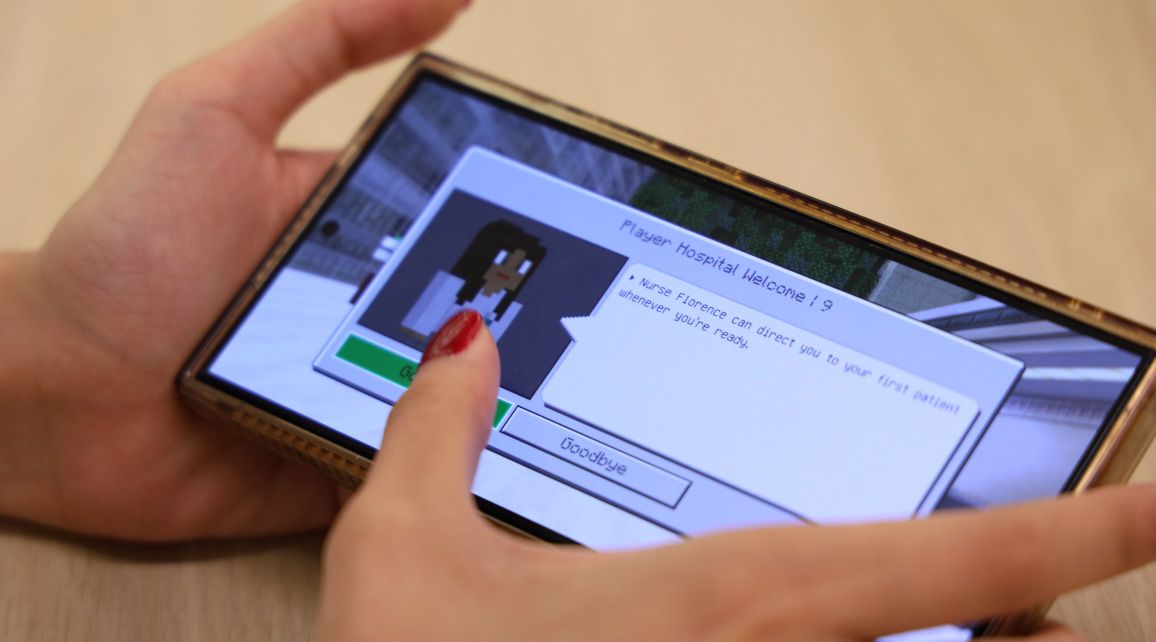
TEXAS — Students in a University of Texas at Dallas course are learning medical reasoning in an unlikely place: Minecraft.
The course, Experiential Medical Reasoning, places pre-med students inside a virtual hospital built within the popular video game. There, students interview fictional patients, order tests, review charts and practice making diagnoses. These are experiences educators say can be difficult to provide in traditional classroom settings.
Dr. Eric Kildebeck, co-director of the Center for Engineering Innovation at UT Dallas, said the course grew out of a broader effort to make learning more engaging and interactive.
“We started at UT Dallas with Polycraft World almost a decade ago,” Kildebeck said. “If you look at students learning through traditional lectures and textbooks, it’s a fairly passive process. And we wanted to make learning more active.”
The course uses a virtual hospital modeled in part after Parkland Hospital in Dallas. Kildebeck said the exterior resembles the real facility, while the interior was designed specifically for gameplay and navigation.
“The key part of the replica, beyond looking like Parkland from the outside, is to have an accurate replica of the experience of actually being in a hospital,” he said.
Students progress through different healthcare roles, beginning with laboratory work before advancing to positions that require them to interview patients, order tests and make diagnoses.
Kildebeck said the virtual environment allows students to gain experiences they would not normally have access to because of privacy, safety and legal restrictions.
“If you blow up and die in a video game, a lot of video games are built around that,” Kildebeck said. “You just respawn and try again.”
For Sahar Bavandi, a student who has completed the course, the concept initially seemed unusual.
“When I first saw the title of the course, it didn’t make sense to me,” she said.
After working through the game, however, she said the experience helped connect classroom concepts to real-world situations.
“The main goal of being a pre-med is to get clinical exposure,” Bavandi said. “To make sure you actually know what you’re getting yourself into.”
Rather than relying solely on memorization, Bavandi said the course emphasizes decision-making and problem-solving.
“It’s more about critical reasoning,” she said.
The Minecraft environment and course activities were developed with assistance from IvyBee, an educational technology company that spun out of research conducted at UT Dallas.
Joey Steininger, a puzzle master at IvyBee, said the company helped build the hospital environment, quests and interactive learning activities used throughout the course.
“We’ve built the Minecraft setting, the Minecraft quests,” Steininger said. “We’ve worked with Dr. Kildebeck to get all of the content into the game.”
Steininger said the long-term goal is to create learning experiences that are more engaging than traditional educational materials.
“The dream is to build a game that can compete with these awesome games that are on PlayStation and Xbox and Steam,” he said, “where kids want to go in and play the game, but then at the end of it, all of a sudden they know everything they need to know.”
University leaders say the program reflects a growing emphasis on experiential learning, which focuses on applying knowledge rather than simply acquiring it.
“In academia, we’re really good at teaching you what you need to know before you go out in the real world,” said Dr. Adam Woods, dean of the School of Behavioral and Brain Sciences. “The missing piece is experiential learning. You never truly know something until you’ve done it.”
Educators involved with the program say they see potential applications beyond medicine, including helping students explore careers before committing years of study to a specific field.
“What if we could help them figure out sooner what they actually want to do?” Woods said.
For Bavandi, the experience has already had an impact. She’s preparing for the MCAT after graduating in May.
“This course really helped me build my confidence,” she said.