

During the Super Bowl this past February, the Amazon-owned security company Ring ran a high-profile commercial that depicted a network of its doorbell cameras helping to locate lost dogs by utilizing footage from across the city. Backlash was prompt and fierce. The negative reaction even made The New York Times, as critics cited concerns about when the cameras are active and how the recorded data is used. If you can’t win over public trust by championing missing pets, it’s time to do some serious soul-searching.
The fears seem well founded, and not just because the company’s parent entity knows more about people than their own grandmothers, or that it controls around a third of the internet via its cloud services. Ring had also planned a partnership with Flock Safety, a company that uses AI cameras and works closely with law enforcement to deliver the data they collect. But that collaboration has been axed amid fallout from the Super Bowl ad.
Community conversations in Austin have mirrored that national scrutiny in recent months, as pushback has had a chilling effect on the city’s plans to implement AI cameras on roads and in parks. Some council members have even insisted on greater transparency and regulation around new technology. But is this temporary halt just delaying a future that sometimes feels unavoidable?
Marina Roberts facilitates a coalition called No ALPRs (automated license plate readers), which advocates for the removal of AI cameras in the Austin area. She says the organization’s name is a bit of a misnomer as it has expanded its focus to include a range of cutting-edge video tech.
“The primary objection of the majority of our coalition members to these cameras is that they are feeding tributaries of data into the surveillance apparatus being used by ICE to disappear our immigrant neighbors,” she says.
Flock Safety, the same company that was set to partner with Ring, has previously contracted with the City of Austin on ALPRs that monitor roads and help police track stolen cars or serve arrest warrants linked to drivers. However, widespread deportation initiatives have stoked fears that the technology is disproportionately being used to target undocumented immigrants.
In response to public outcry, city officials removed Flock cameras across Austin, but the victory was short-lived. A few months later, DPS employees added new ALPRs to roadways within the capital city that are maintained by the state. The move continues a years-long tug-of-war between state and local leaders around contentious issues like the bag ban, mandated sick leave policies, or even regulating ride-share companies. When it can, the state likes to flex its muscle and squash whatever progressive-leaning policies Austin enacts.
In a separate but related instance, the city has tested a service that uses mobile cameras placed in communal areas like parks and parking lots. Operated by LiveView Technologies, the surveillance systems were in effect during a three-year pilot program, between 2022 and 2025, and data from the city shows that the units significantly decreased vehicle burglaries and criminal activity in targeted areas. But as awareness about AI cameras and political distrust has increased, Austin’s tolerance for the tech has waned.
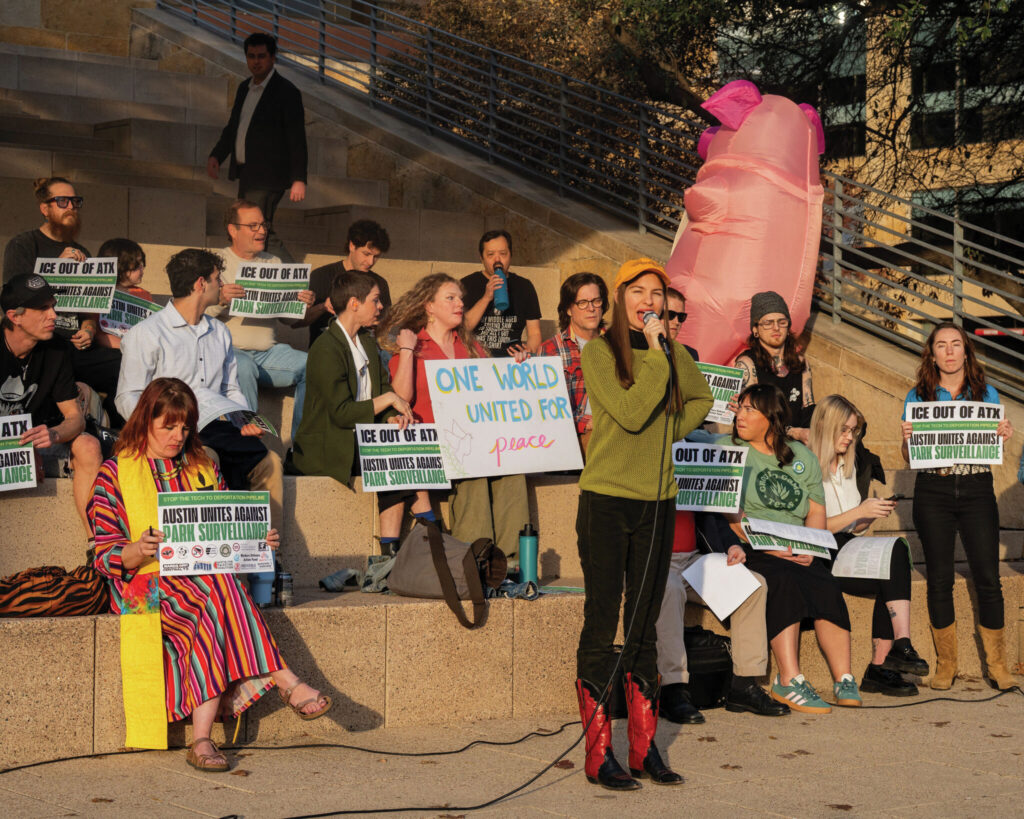 Sophia Mirto, president of Hands Off Central Texas, speaks in front of Austin City Hall. Photo by Mikala Compton.
On an unseasonably warm day in early February, just five days before the Super Bowl, a group of demonstrators clutching protest signs congregated on the hulking limestone steps in front of Austin City Hall. They’d turned up to object to a new contract with Live View Technologies that Austin leaders were scheduled to consider. But even before the press conference and protest began in earnest, news broke that the agenda item in question had been scuttled—a rare moment of immediate results for local activists.
“It felt really good to see in real time that our advocacy is working,” says Sophia Mirto, president of Hands Off Central Texas, which works with No ALPRs and focuses on political organizing around civil rights issues.
Two days later, activists got more good news, when the Austin City Council passed the TRUST Act (Transparent and Responsible Use of Surveillance Technology Act), which tasked the city manager with developing a framework that guides what technology is used in the capital city and how it’s allowed to operate. It’s unclear if it will assuage the concerns of citizens like Roberts, who says she’s “cautiously hopeful… but there’s a great deal of emphasis on the caution.”
In the wake of a string of shootings in May, the conversation about surveillance cameras bubbled up in public conversations and news reports. Some Austinites wondered if such equipment might have helped capture the teenagers who wreaked havoc on the city and its surrounding suburbs. Proponents of widespread surveillance often recite some version of a popular refrain: If you don’t have anything to hide, what’s the problem? But innocence isn’t always a cure-all.
In 2023, 61-year-old Harvey Murphy Jr. was arrested by Houston police for the robbery of a Sunglass Hut in the River Oaks Shopping Center after he was falsely identified using facial recognition technology from a private security camera. Murphy was eventually released after evidence proved he was living in California at the time—but not before he spent more than 10 days in jail, during which time he says he was sexually assaulted. Murphy is suing Sunglass Hut’s parent company, EssilorLuxottica, but the case has been bouncing around in court for more than a year.
The incident raises an important issue facing citizens across the country. Even if governmental bodies ensure safeguards with AI cameras or eschew the technology altogether, it doesn’t prevent private entities from implementing such equipment. And at some point, that data could be used in a variety of ways, including being sold to third parties or given to law enforcement. It begs the question: Is our framework of lawmaking equipped to handle such a rapidly evolving tech environment?
For Roberts, the situation comes full circle to another private company that recently made headlines. “That’s the injustice of all of this,” she explains. “When you put a Ring doorbell camera on your house or you download an app on your phone that has a location tracker that uses AI, your informed consent was circumvented.”
As she sees it, ostensibly benign instances like this build an invisible apparatus that doesn’t even require direct use to surveil wide swaths of the population. The Orwellian reality of the situation is that you’re likely monitored by such technology on a regular basis without ever even knowing it.
Advanced technology is ushering in a whole new version of reality.
40
The number of Flock cameras removed by the City of Austin.
59%
Percentage of Austinites who describe AI as a “blessing and a curse,” per Austin AI Alliance.
1 million+
Number of ChatGPT users amassed by the service within five days of launch.
80%
Percentage of Americans who believe we should prioritize safety around AI, even if it slows development, per Gallup.
$1.3 trillion
Expected size of the AI market by 2030, according to Forbes.