
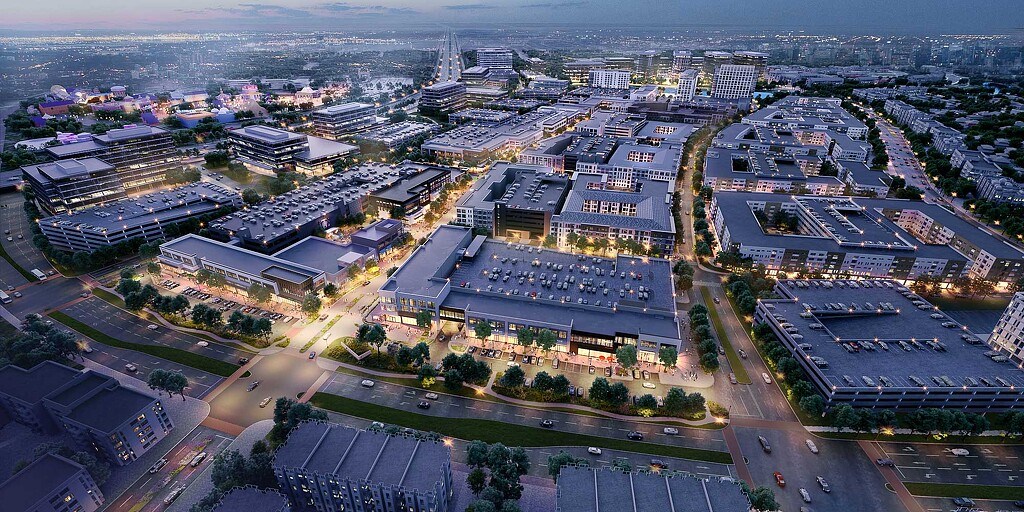
On August 3, 2001, the last enclosed mall built in Texas opened its doors to an estimated 250,000 visitors. The mall seemed like it would be a sure-fire hit, bolstered by big-name department stores like Neiman Marcus, Dillard’s and Lord & Taylor.
Just 39 days later, the events of 9/11 reshaped the economy and consumer behavior, slowing retail growth and exacerbating the challenges facing malls nationwide.
Slowly but surely, spending across the country began to recover, but The Shops at Willow Bend never found its footing. Its struggles came to symbolize something larger: not a mall that missed its moment, but the moment when the American mall itself began to change.
In Collin County, that shift is playing out in real time. From the quiet closure of Collin Creek Mall to the ongoing reinvention of Stonebriar Centre, from the walkable streets of Legacy West to the sweeping redevelopment of Willow Bend, the places where people once came simply to shop are being rebuilt as something far greater.
Collin Creek Mall
Long before lifestyle districts and massive mixed-use developments began reshaping North Texas, much of Collin County gathered at its very first mall. When Collin Creek Mall opened in Plano on July 29, 1981, it marked a turning point for a rapidly changing region. Just a decade earlier, much of Collin County still felt rural, but growth fueled by the expansion of U.S. 75 was transforming Plano into one of North Texas’s fastest-growing suburbs. As the city’s population surged throughout the 1970s, retailers followed the steady wave of new residents moving north from Dallas.
Collin Creek, developed by Federated Department Stores, was designed to serve shoppers across a wide trade area stretching along U.S. 75. With stores like Sanger Harris, Sears and Dillard’s, the mall introduced a retail format that defined suburban life for a generation. Teenagers gathered after school, and families planned weekend outings around it. At a time when suburban downtowns were limited and entertainment options were even fewer, enclosed malls became reliable social centers as much as retail destinations.
The model worked for years. Through the 1980s and early 1990s, as Collin County’s population climbed, Collin Creek stood at the center of Plano’s commercial identity. But retail continued moving north. New developments opened farther along the growth corridor, each larger and more modern than the last. By the early 2000s, competition from newer destinations, including Stonebriar Centre in Frisco and Allen Premium Outlets, began to erode the mall’s dominance. Stores closed, foot traffic declined and ownership changed repeatedly as operators searched for ways to adapt a property built for an earlier version of shopping habits.
“The primary reasons regional malls struggled were the rapid development of strip centers that dispersed the retail environment, along with the creation of a robust online shopping experience,” says Rob Romo, vice president at Centurion American Development Group, the current owner of Collin Creek Mall. “In short, it was no longer convenient to go to the mall to shop.”
Still, the site retained one enduring advantage: its place within the community. Nearly every Plano resident had memories tied to the mall, and its location remained valuable even as the traditional mall format faced mounting pressure.
In July 2019, after nearly four decades in operation, Collin Creek Mall closed its doors. A farewell celebration drew thousands for one final gathering, complete with 1980s music and nostalgia that reflected the mall’s heyday. “Today is not the closing of Collin Creek Mall; it’s the beginning of Plano 4.0,” then-Mayor Harry LaRosiliere said during the event. “It’s the era of renovation, rejuvenation and innovation.”

Rendering: Centurion American Development Group
Soon after, the property was acquired by Centurion American, the North Texas-based real estate development firm known for large-scale residential and mixed-use communities across the region. Rather than attempting to revive the traditional mall, the company envisioned something fundamentally different.
“Centurion has maintained a consistent vision throughout the development process,” Romo says. “A true live-work-play environment for on-campus residents as well as other Plano residents.”
The former mall site is currently being transformed through a $1 billion redevelopment into a pedestrian-oriented district organized around open streets, parks and public gathering spaces instead of enclosed corridors.
When complete, the project is expected to include roughly 2,300 apartments, 500 single-family homes and 300 senior living units, alongside 1.5 million square feet of office space designed to bring a daily workforce back to the area. A 200-room hotel, restaurants and neighborhood-scale retail aim to anchor activity throughout the day and evening. Public space sits at the center of the redesign, with more than nine acres of parks, 1.6 miles of trails and restored access to Spring Creek. Portions of the original mall are being preserved, blending familiar elements with a walkable layout.
“The central core portion of the mall, minus the large retail boxes, was the only viable portion of the project moving forward,” Romo says, noting the nationwide shift away from traditional malls.
The development is structured along a main east-west axis connecting Sunrise Park and Sunset Park through a grand paseo linking offices, residences and retail. Rather than relying on destination shopping alone, the new Collin Creek emphasizes daily use and repeat visitation.
“We are prioritizing tenants and experiences that support frequent visitation and everyday convenience rather than traditional destination-only retail,” Romo says. “Residents provide morning and evening patronage, while office tenants create lunchtime activity.”
When Collin Creek first opened, community life gathered under one roof, shaped by a time when shopping was a reason for people to come together. Today, the site plans to open outward, trading enclosed corridors for streets, parks and shared spaces designed for lingering as much as buying, while continuing its long role as a place where neighbors meet.
But retail evolution rarely moves in straight lines. Even as some malls began showing signs of strain, the enclosed mall itself was entering a new phase of ambition. Just a few miles north, North Texas was preparing to build one of its most significant shopping destinations yet.
Stonebriar Centre
As aging malls like Collin Creek are being reimagined today, the turn of the millennium told a very different story about the future of retail in Collin County. At the time, developers were not moving away from enclosed malls. They were building them bigger, better, positioning them as regional destinations capable of anchoring growth for decades.
When Stonebriar Centre opened in Frisco on August 4, 2000, it mirrored the confidence of an expanding region and a retail industry convinced that the mall model still had a long future ahead.
The project was envisioned years earlier, when Frisco was still a relatively small town of just over 6,000 residents in 1990. By the time Stonebriar opened, the city’s population had surged to 33,714, a sign of the explosive northward migration reshaping Collin County. Growth only accelerated in the following decade, with Frisco surpassing 116,000 residents by 2010. Recognizing the economic potential of a major regional mall, city leaders fought to secure the development, offering tax incentives and infrastructure improvements to keep the project within city limits amid competition from neighboring Plano. The effort paid off, placing Frisco at the center of one of the most significant retail investments in North Texas at the time.
Unlike earlier community malls designed primarily for nearby residents, Stonebriar Centre was conceived as a super-regional destination. Located at the intersection of major transportation corridors and surrounded by rapidly developing suburbs, the mall was built to attract shoppers from across North Texas rather than a single city. The goal was to combine traditional department store anchors with entertainment, dining and experiential retail intended to keep visitors onsite for hours rather than quick shopping trips.
At the time, the scale felt almost surreal.
“In ’98-’99, there was just nothing but cattle pasture,” recalls Randy Holcombe, vice president of leasing and retail at Brookfield Properties, the global real estate firm that acquired the mall in 2018. “It looked like a spaceship when we dropped it out here in the middle of the pasture.”
Stonebriar opened its doors fully leased. The center brought in nationally recognized brands and a wide mix of specialty retailers, but its appeal extended beyond storefronts. A large theater, family-friendly attractions and an expanding lineup of restaurants signaled an evolution already underway within the mall industry. Developers increasingly understood that shopping alone was no longer enough; malls were becoming places designed around experience and leisure as much as retail.

Photo: Brookfield Properties
According to Holcombe, successful regional malls have always depended on understanding their core audience. “In every market, there’s a dominant super-regional shopping center,” he says. “Stonebriar has been one of those.”
Even practical considerations played a role in the mall’s early success. “There’s still value to being a climate-controlled environment,” Holcombe says. “When we opened on August 4th of 2000, the temperature was literally 104 degrees.”
Stonebriar quickly became more than just another commercial project. The mall helped establish Frisco as a regional destination at a moment when development was accelerating along the Dallas North Tollway and State Highway 121 corridors. New homes, offices and entertainment venues followed, expanding a development pattern that had begun decades earlier in Plano but was now unfolding on a far larger scale.
Today, Stonebriar Centre spans more than 1.7 million square feet. Under Brookfield’s stewardship, the strategy has focused on continual reinvention rather than demolition.
“My entire 40-year career, one thing has stayed consistent,” Holcombe says. “People love to interact with one another. They love the social experience of getting out and being together.”
That philosophy has guided ongoing updates to the tenant mix, bringing in brands such as Zara, Uniqlo, Mango, Alo Yoga and Evereve — retailers chosen specifically to match the evolving demographics of Collin County’s fast-growing population. “We merchandise to our customer,” Holcombe explains. “We know who our customer is, and that customer base has only multiplied dramatically over the years.”
Experiential additions have also helped the mall adapt, including the adjacent hotel and attractions like KidZania. These offerings once again prove Stonebriar’s role as more than a shopping destination. The goal, Holcombe says, is one simple question: “How do we continue to satisfy their desires and really create the experience that they want to shop in?”
At the time of its opening, the strategy appeared unquestionably successful — and it has remained so. Foot traffic stays strong, national retailers continue to seek space in the center, and the enclosed mall format still proves effective for this kind of suburban retail destination.
Yet even as Stonebriar endured, subtle shifts in consumer expectations were beginning to emerge. Shoppers increasingly sought places that blended retail with dining, entertainment and everyday life, setting the stage for the next evolution of retail environments that would soon reshape Collin County once again.
Legacy West & Fields West
When the Williams Sonoma Home Store opened at The Shops at Legacy in 2009, then-Mayor Harry LaRosiliere leaned across the soon-to-be-cut ribbon and joked to developer Fehmi Karahan, “How great would it be if you built up the other side?” Karahan looked across the highway at the empty cornfield surrounding JCPenney’s Plano headquarters and knew one thing: if he didn’t do it, someone else would.
For Karahan, there’s nothing like a little intuition. By 2011, JCPenney sought proposals to develop the 240 acres around its headquarters, land it had owned since relocating from New York in 1987. Three years later, the company partnered with Karahan Companies, KDC and Columbus Realty Partners to bring a $2 billion mixed-use vision to life with offices, apartments, a luxury hotel and a retail district.
The lesson from malls like Collin Creek was clear: enclosed malls had thrived for decades but eventually faced pressures from strip centers, online shopping and changing consumer habits. Karahan recognized that the next generation of retail had to be open, walkable and integrated into daily life. He decided to build a new kind of destination, one that didn’t just sell products but created an entire ecosystem.
“We started at a time when mixed-use developments were not widely accepted in the U.S. People were saying, ‘This guy is crazy, out of his mind trying to do that,’” Karahan told Local Profile in 2018. “But we did it; we proved everybody wrong.”
Legacy West officially opened on June 2, 2017, spanning 38 acres along tree-lined Windrose Avenue, which Karahan affectionately calls “our Rodeo Drive.” The 415,000 square feet of retail and restaurant space features current tenants like Tiffany and Co., Coach, Tesla and West Elm. Dining includes Del Frisco’s Double Eagle, True Food Kitchen and Tommy Bahama, alongside the three-story Legacy Hall food hall with more than two dozen stalls and a brewery. “I have not chosen a restaurant or signed a lease if I did not believe they would be successful,” Karahan said at the time. That remains true.

Photo: Visit Plano
Karahan knew that people would brave the heat for a “Rodeo Drive” experience with misting systems and patios, but they wouldn’t brave a parking lot just to walk into a department store. Legacy West’s design addressed that insight. By combining walkable streets, curated experiences and a daily workforce, it solved the limitations that had challenged Collin Creek and Willow Bend, proving that the future of retail was about lifestyle, not just transactions.
Legacy West also anchored a corporate presence. Nearby, offices for JCPenney, FedEx, Boeing, NTT Data, JPMorgan Chase and Liberty Mutual, along with Toyota’s 100-acre North American headquarters, create a daily workforce that sustains the retail and hospitality ecosystem. The Renaissance Dallas at Plano Legacy West Hotel supports the area with 303 rooms in a 15-story tower.
But Karahan’s vision for Collin County’s evolving retail scene didn’t stop there. On Frisco’s northern edge, he is now building Fields, a 2,500-acre master-planned community that will blend modern living with local heritage. “I expect Fields to have a similar impact in Frisco as The Shops at Legacy and Legacy West had in Plano, but at an even greater scale,” Karahan says. “With the type of amenities offered within Fields, it is the perfect place for corporate relocations, thousands of job opportunities and raising a family. The list goes on and on.”
Fields West, the 55-acre retail and entertainment component of the Fields development, mirrors Legacy West’s formula on an even larger stage. At completion, it will feature 350,000 square feet of retail, restaurant and entertainment space, 325,000 square feet of offices, 1,200 multifamily units and 375 hotel rooms.
“People do not want to drive to go shopping, to eat, to play. They want to walk down the street with their families,” Karahan says.
Projected to generate more than $400 million annually in sales, Fields West is designed to create a self-sustaining ecosystem for residents — continuing the evolution of North Texas retail and the very same mixed-use development Karahan helped pioneer.
The Shops at Willow Bend
Not every ambitious project hits its mark. And sometimes things must fall for something greater to emerge.
At the northwest corner of the Dallas North Tollway and West Park Boulevard, The Shops at Willow Bend once represented the future. When the Taubman Centers unveiled the ambitious $200 million development in 2001 — roughly $356 million in today’s dollars — it was designed as an ultra-upscale destination for a rapidly growing Collin County. Developers envisioned a luxury retail hub unlike anything the region had seen, so carefully curated that they even attempted to purchase and demolish a two-year-old Home Depot across the street, arguing the big-box store conflicted with the mall’s high-end vision.
At the time, the strategy made sense. Prestonwood Town Center in Far North Dallas was faltering after a stalled renovation, and Valley View Center had begun its slow decline. Willow Bend promised something new: a refined shopping experience anchored by Neiman Marcus and Lord & Taylor, both relocating from Prestonwood, sparing Plano shoppers the drive to NorthPark Center or Galleria Dallas.
And for a moment, it worked. The architecture was elegant, the interiors bright and polished, the atmosphere intentionally calm. It was a mall designed less for crowds than for prestige. But almost immediately, circumstances shifted.
The Shops at Willow Bend opened just weeks before the events of Sept. 11, 2001, reshaped consumer behavior nationwide. At the same time, competition had already arrived. One year earlier, Stonebriar Centre opened in Frisco, staking its claim as the must-visit mall for shoppers across northern Collin County and even as far as cities like Little Elm and Denton. With a large mix of stores and a dynamic atmosphere, it quickly became the go-to destination, leaving Willow Bend to fight for attention against both Stonebriar and the well-established southern alternatives.
As the years passed, new retail concepts continued to emerge. The Shops at Legacy, and later Legacy West, embraced walkability, dining and experience-driven environments that reflected changing consumer expectations. Willow Bend, by contrast, remained rooted in the enclosed mall model — quieter, more restrained and increasingly out of step with the direction retail was heading.
Willow Bend was the last enclosed mall built in Texas and among the last of its kind in the country. It was a time capsule of a pre-9/11 retail philosophy arriving just as the industry began to change.
Ownership changes followed again and again, with new visions emerging each time. In 2014, Chicago-based Starwood Retail Partners acquired the mall as part of a $1.4 billion portfolio deal and announced a $100 million redevelopment aimed at modernizing the property with restaurants, office space and an open-air plaza. Though the idea was there, by 2020, loan defaults halted construction, lenders seized control and operations transferred. Occupancy fell below 70%, roughly where the mall had begun two decades earlier.

Photo: Visit Plano
In 2022, Dallas-based developer Centennial purchased the property with a new vision. Centennial began reimagining it entirely. In February 2024, the Plano City Council approved redevelopment plans that called for demolishing roughly 500,000 square feet of enclosed space by the end of the year and transforming the site into a mixed-use district known as The Bend.
The proposal replaces inward-facing corridors with walkable streets, green space and outward-facing retail, alongside 965 residential units, an 18-story hotel and a seven-story office building, while preserving portions of the existing structure. In particular, introducing residents to the site is expected to boost both foot traffic and retailer success.
“Bringing in a residential consumer to the site has been proven to be a benefit to the vibrancy and success of the retailers — whether that be cafes, restaurants, fitness centers or shops,” says Michael Platt, executive vice president of mixed-use development at Centennial.
By combining everyday destinations, the development creates a self-reinforcing ecosystem, directly addressing the challenges that once held Willow Bend back. Today’s strategy focuses on right-sizing retail and surrounding it with uses that create daily activity: housing, hospitality, entertainment and public gathering spaces.
“I think initially this mall came out of the gate as a very high-end mall,” Platt says. “There were multiple luxury department stores alongside more moderate anchors.” The mix, he explains, ultimately proved difficult to sustain as shopping habits evolved and traditional retail footprints shrank.
Demolition is expected to begin within the next year, with redevelopment unfolding in phases while portions of the property remain open. Even the site’s future possibilities extend beyond retail. City leaders have begun exploring Willow Bend as a potential location for the Dallas Stars’ new hockey arena, a sign of how these spaces are evolving into multi-purpose, community-focused destinations.
As Collin Creek rises again, as The Bend begins its next chapter, as Fields West takes shape, one thing is unmistakable: these aren’t malls being rebuilt. They are communities being created.
Places where people don’t just come to shop but to spend time, build routines and feel connected to where they are. North Texas is shaping spaces where life unfolds alongside commerce. The malls are no longer defined by what people buy. They are defined by why people come and what keeps them returning time and time again.
This article originally appeared in Local Profile Magazine. Read more here.
Don’t miss anything Local. Sign up for our free newsletter.