
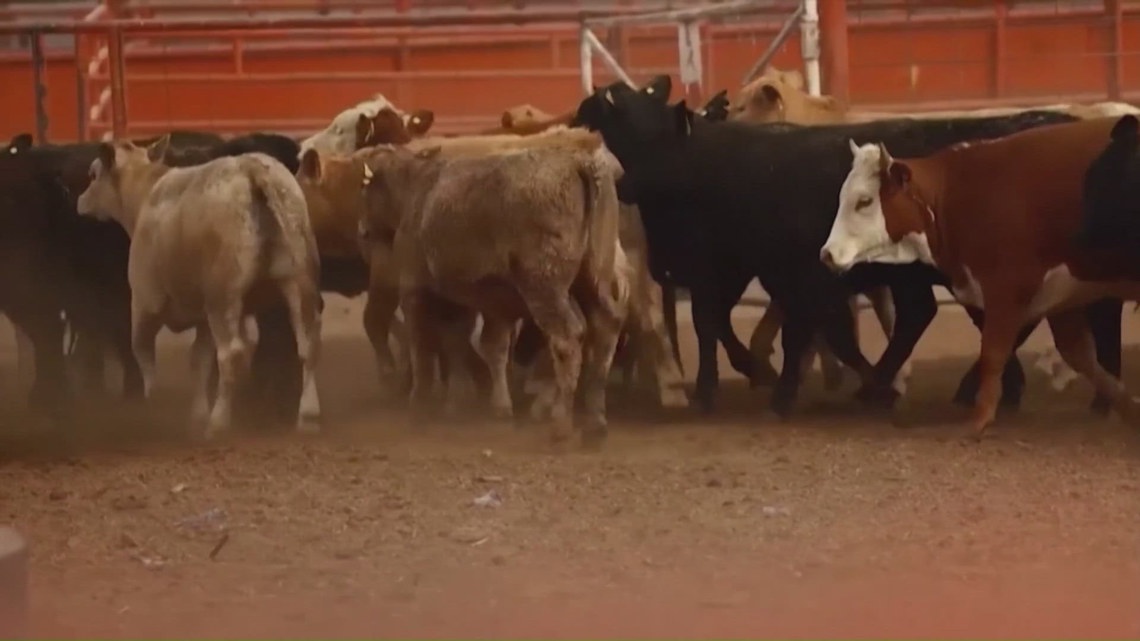
The flesh-eating fly larvae, which have been detected in Mexico, were declared eradicated from Texas in the 1960s.
AUSTIN, Texas — An invader that could severely damage the state’s cattle industry is on Texas’ doorstep and is inching closer to the U.S.-Mexico border.
The maggot, known as the New World screwworm, can infect and infest the tissue or flesh of warm-blooded animals like cattle, deer, pets and even humans. It’s the larval form of a fly that nests in the wounds of warm-blooded animals and slowly eats them alive.

This story continues below.
More in State
New World screwworm now 25 miles from Texas-Mexico border
New screwworm cases identified closer to Texas border
According to the U.S. Department of Agriculture (USDA), authorities in Mexico confirmed 11 new cases of New World screwworm within 100 miles of the U.S.-Mexico border at the end of last month. The closest confirmed case is roughly 25 miles from the border in a 5-year-old goat in Coahuila, Mexico.
As of Monday, there were roughly 1,800 active cases in Mexico, bringing the total to more than 26,700 since November 2024.
To date, the New World Screwworm has not been detected in Texas or the U.S. Still, it is concerning for the cattle and livestock industry, as the pest continues to move north, from a few hundred miles from the border earlier this year to just over two dozen miles now.
“It’s been a slow, steady march over the last few months. It’s crept up all the way to just 25 miles away, and in realistic terms, that really marks a point where the state and the federal agencies have to deploy their final response teams,” Texas Farm Bureau Associate Director Tracy Tomascik said.
U.S. Agriculture Secretary Brooke Rollins said they plan to provide briefings every other weekday, in part because of misinformation that has circulated online in recent days, including from a Texas state representative claiming there was a screwworm case 1 mile from the border. Rollins said they want to ramp up communication so everyone knows the actual situation.
The pests are primarily found in South America and the Caribbean but have been migrating northward over the past several months.
“Limited movement of people, livestock, wildlife and commerce through that region slowed the northward spread of pests and diseases and helped keep the New World screwworm largely contained in South America,” Rollins said. “That security bulwark began to crumble during the previous administration, as cartels in South and Central America became entangled in the agricultural industry. They ramped up livestock trafficking with no concern for New World screwworm infestation.”
Since then, Rollins said Mexico has failed to lock down cattle movement in infected zones and to tend its fly traps daily.
“We do have a USDA team on the ground in Mexico trying to alleviate that,” Rollins said. “We have since last year, but it continues to be a problem.”
Screwworms can devastate livestock herds. The invasive parasites became a significant problem in the U.S. in the 1950s.
State leaders fear it could devastate the Texas cattle industry, so state agencies and the federal government are both working to address the issue.
There are several efforts underway to fight the screwworm, including novel traps and modular sterile fly units. Officials are working on deploying sterile flies to prevent the parasites from reproducing. The USDA is releasing 100 million sterile insects per week in Mexico. They are targeting the releases around locations of new cases.
“We move those flies by plane and drop them. We had massive challenges last year getting those planes up in the air in Mexico for a lot of reasons, and have certainly been battling that,” Rollins said. “The last number of months, we have been able to move our planes, but there was a long stretch there where we were not able to consistently land our planes.”
All of the cases within 100 miles are within the sterile fly dispersal area.
The USDA and the Texas Animal Health Commission (TAHC) are expanding existing ground release sites for the distribution of sterile flies in South Texas near the Texas-Coahuila border. TAHC said it is bolstering its personnel in South Texas to increase outreach and provide additional awareness and resources to locals.
“These operations are focused on outreach,” Dr. Bud Dinges, executive director of TAHC, said. “Personnel are not responding to detection of New World swarms in Texas or the United States.”
The USDA continues to release sterile flies in South Texas as part of efforts to mitigate an incursion of the pest into Texas. Officials are also moving currently placed surveillance traps to reflect the changes in sterile fly dispersal.
“Science-based assessments to determine dispersal locations continue to be evaluated,” Dinges said. “The USDA continues to utilize aerial dispersal of sterile New World screwworm flies in South Texas counties. Aerial dispersal grids continue to shift to maximize the impact of sterile flies currently available to mitigate and incursion of new wild New World screwworm flies in the United States.”
Currently, 8,000 traps are located near the border. More than 58,000 suspicious fly samples and 19,000 wildlife specimens have been submitted for official identification, and none have been detected as the species.
“The scale and technological prowess of our response to New World screwworm has been unprecedented,” Rollins said. “We have done everything we can possibly do on our side of the border to keep it out, and we have worked so hard to slow the spread.”
In February, the U.S. completed a new facility in Edinburg that will give the USDA the option to release sterile flies to combat screwworms if necessary. The facility will be capable of deploying up to 300 million insects each week along the U.S.-Mexico border and into Texas.
The sterile males can be released into the wild, where they will mate with female screwworm flies. Because the sterilized males cannot fertilize eggs, no larvae hatch, effectively reducing the population over time.
The USDA has a five-prong approach to the screwworm. The agency is also hiring more mounted patrol officers, known as “tick riders,” to focus on surveillance along the border. It also has detector dogs at the ports of entry.
“The most recent, detections 20, 30, 50, 70 miles from the border, many of them are cats, dogs, sheep, goats, so making sure that even though we’re not moving livestock through the border ports right now, we have detector dogs on the border at all the entrances to check all of and everything that’s coming across the border,” Rollins said.
Producers have been using fly prevention measures, such as insect growth regulators in mineral supplements, dewormers like ivermectin, which is poured over the cattle, and Dectomax, which is injected.
In the 1970s, the screwworm devastated Texas, causing just over $330 million in damage. When you adjust that for inflation and current cattle prices, the estimate is that an outbreak here in Texas would approach $2 billion in livestock-related losses and $10.6 billion in national economic damage. Economists say a screwworm outbreak, should it spread to the U.S., would likely lead to higher prices for beef products at the grocery store.
After researchers learned about the flies’ mating habits, a technique to sterilize the flies was introduced to the U.S. in 1955. In 1960, Texas and New Mexico became involved in the sterilization process, which led to a South Texas plant producing around 200 million sterile flies a week. Four years later, screwworms were eradicated from Texas. By 1966, officials said the screwworms had been eradicated from the U.S.
“The last time this devastated our industry, 1960s America did not have the resources we have today. The New World screwworm crisis farmers and ranchers experienced back then will not repeat itself today,” Rollins said. “Unlike then, USDA is leading a robust, detailed and technologically advanced response paired with our plan of action. Going forward, we will minimize the impact of this pest on our livestock and wildlife.”
Tomascik said preparations over the last 12 to 18 months have put the country in a much better position than it was in decades ago.
“We’re confident that with some critical components, cooperation, vigilance and communication with the farmers, ranchers, the wildlife managers, the landowners in South Texas along the border, that if we get a hold and get confirmation early on with a sterile fly case in Texas, that we’ll be able to snuff that thing out and for the betterment of everyone,” Tomascik said.
Authorities stressed the risk to public health in the U.S. is extremely low.
“A screwworm is not contagious. It does not spread directly from animals to people or from person to person, and the screwworm does not pose a food safety risk,” Dudley Hoskins, the U.S. under secretary of agriculture for marketing and regulatory programs said. “It spreads only when a screwworm fly lays eggs in a wound – not through meat, poultry or dairy products.”
Currently, U.S. ports remain closed to imports of cattle, bison and horses from Mexico.
Texas officials hope to prevent a widespread outbreak, as it could devastate ranching operations, local wildlife and jobs in the region, as well as America’s food supply.
“This parasitic fly, the larva, impacts the livestock and directly impacts the ability for our livestock to produce efficiently, and that means that it has not only an impact on the production, but the families and the economies at the local, statewide level that depend on those,” Tomascik said. “We’re talking about a very small amount of livestock in comparison to the whole of the United States. So, we don’t expect a huge impact from an infestation on consumer prices of goods. What we will see is, from a farm and ranch standpoint, the volatility in livestock markets will be very harmful to those producers that, to no fault of their own, are subject to market movements.”
If it spreads to the U.S., screwworm could cause an estimated $2.1 billion loss to cattle and a $9 billion loss to the hunting/wildlife industries in Texas.
“The vast majority of the time, we’ll get one or two cases in the United States, and if that happens and we’re going to be able to respond efficiently, quickly and dramatically reduce the potential impact for any of that,” Tomascik said.
Authorities are asking animal owners, especially those along the border, to keep a close eye on their animals for wounds and suspicious larvae.
“You’ve got to increase that time spent with them,” Tomascik said. “That comes at a cost. But the return on that investment for minimizing the impact of this type of foreign animal pest is substantial, so it’s worth it.”
If you suspect your animal may be infested with New World screwworm, notify the Texas Animal Health Commission or your local veterinarian immediately.
“Quick notification leads to quick detection and quick response to stop this pest from spreading. Animal owners should treat and cover any wounds as soon as possible, so having an existing veterinary client-patient relationship will be essential if your animal does have an infestation, or just to advise on prevention methods,” Dinges said.
If there is a case on American soil, there are detailed protocols and procedures already in place, which could include quarantines and movement restrictions to limit the spread, along with additional trapping and surveillance in the immediate area and the release of sterile New World screwworm flies to eliminate any reproducing New World screwworm populations.
“It remains possible that numerous growers will never reach Texas,” Dinges said. “However, given the expanding New World screwworm fly population in Mexico and the severe threat it poses to Texas livestock and wildlife industries, we now must prepare and act as if it will.”