
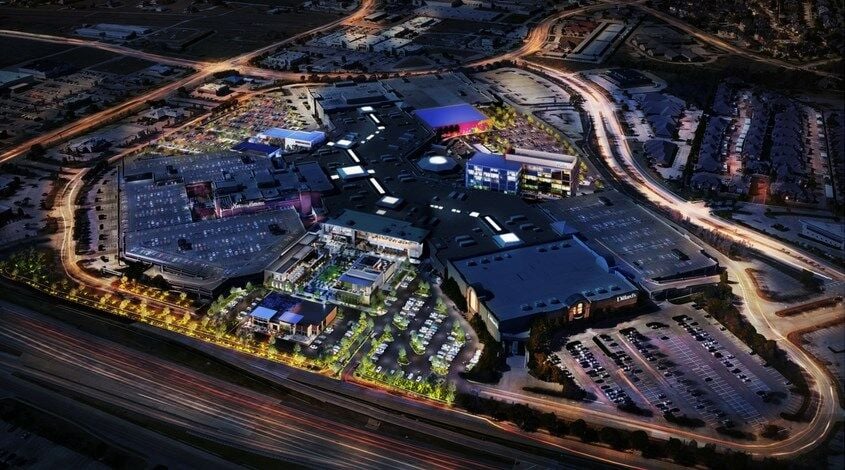
This has been quite a week already for Dallas sports franchises announcing arena plans without quite committing to them: On Monday, the Mavericks owners declared that they had “entered into option agreements” to maybe purchase 104 acres at the former Valley View Mall site in north Dallas to use for a new arena. (The total price hasn’t been made public, but 20 acres of it would cost $50 million. The Mavs owners are putting down about $200,000 a month to hold the option open.) The project would also — if the team owners go through with the purchase, and then build it — possibly include “a vibrant mixed-use destination anchored by a state-of-the-art arena, along with restaurants, entertainment options, public green spaces and family-friendly experiences.”
Just 24 hours later, Stars owner Tom Gaglardi announced that he, too, was absolutely thinking about the possibility of considering moving to the site of a shopping mall, maybe, this one in the eastern suburb of Plano:
Tuesday, the Stars announced that it submitted a signed, non-binding letter of intent for a proposed sports and entertainment district at The Shops at Willow Bend.
The team said that the proposed mixed-use development, being advanced jointly with Levin Holdings & Cawley Partners and Centennial, could include sports, entertainment, retail, dining and public gathering spaces “anchored by a future Dallas Stars arena.”
“This project would present a once-in-a-lifetime opportunity for our franchise,” said Tom Gaglardi, the Dallas Stars’ owner, governor and chairman. “We eagerly await the vote by the Plano City Council and look forward to continuing the conversation to be part of the redevelopment of The Shops at Willow Bend.”
Neither an option agreement nor a nonbinding letter of intent — sorry, a signed nonbinding letter of intent — is a promise to do anything, of course. First, Gaglardi needs the Plano council to approve some niceties like, what exactly would those be?
According to the letter of intent, the city is expected to contribute up to $700 million in funding toward the project from TIRZ revenue and other available funds. Development costs for the arena are expected to be around $1 billion.
Ah, $700 million, a small detail! A TIRZ is Texas’ version of tax increment financing, where any rise in property taxes on a site is kicked back to pay off the bonds that built the project getting taxed, a kind of fiscal perpetual motion machine that it takes either advanced economics or the wisdom of Oscar Madison to see through as still being public money. In fact, the TIF district the city of Plano is considering would cover more than 900 acres; the city would also own the arena, while the Stars would get every lick of arena revenue. (Whether the team would pay any rent is yet to be negotiated.) The $700 million, according to an agreement the Plano council is set to vote on Monday night, only includes “public infrastructure,” while “interest on debt” is listed as TBD, making it unclear if this is $700 million worth of public bonds or $700 million in tax revenues over time plus interest or what.
(For those just tuning in for the first time: The Mavs and Stars currently both play in an arena that is just 25 years old, but which both team owners have decried as obsolete. Sports marketer Craig Sloan of Playfly Sports explained this as “it seems like the life cycle of a stadium or arena is moving towards 20 to 25 years,” which isn’t really an explanation, though economist Rod Fort’s suggestion, also from 2001, that “I don’t see anything wrong, from an owner’s perspective, with the idea of a new stadium every year” might be.)
On the Mavs side, meanwhile, the team’s casino-operator owners, who have previously expressed interest in building a combined arena and casino complex in Dallas, notwithstanding that casinos aren’t yet legal in Texas, now insist that they’re thinking of nothing of the sort:
In a statement to The Dallas Morning News on Tuesday, Welts reemphasized the absence of gaming elements from the team’s plans for a new entertainment district, including a new arena, corporate headquarters, practice facility, hotel, retail and dining.
Asked if those plans will change in the future, Welts said, “No, our plans will stay consistent with no casino component.”
Nobody is saying how much public money would go into a Mavs arena district, though the Valley View site already sits in a TIF district, which could provide a chunk of Dallas city property tax money to start things off. Assuming that all these options are actually actualized, which is just as TBD as any potential public costs. First step: Monday’s vote in Plano, then we’ll see where the remaining chips fall.