
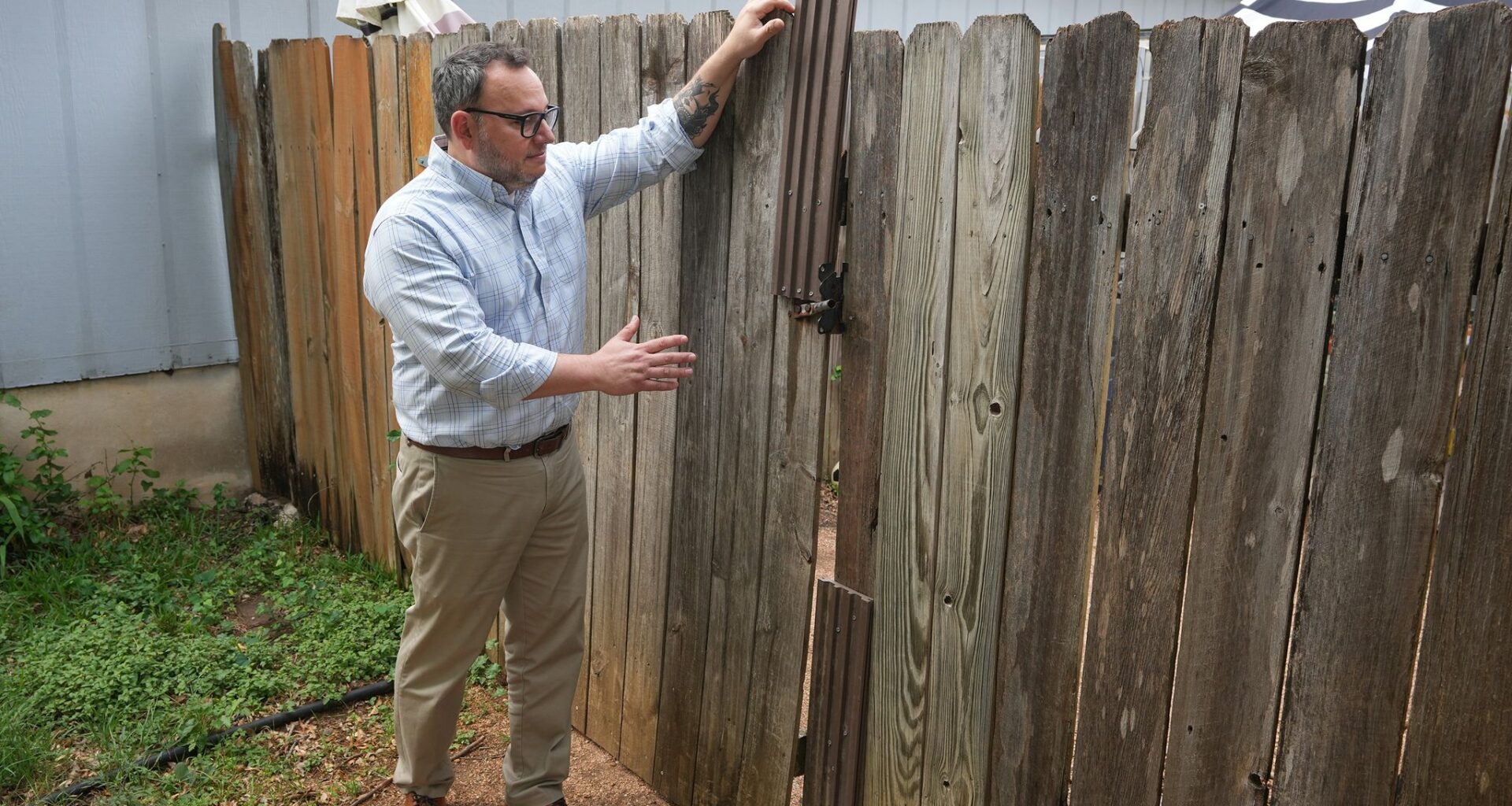
Bryan Rubio shows a broken gate at a house he owns in Austin. Rubio said Austin police broke the gate while planning to apprehend a suspect at a nearby home in September 2025, causing about $750 in damage. The busted gate is fortified with leftover pieces of decking.
Jay Janner/Austin American-Statesman
A city’s public safety response often begins with a 911 call. But it doesn’t end when the police drive away — especially for residents left with splintered doorways or busted gates that make their homes less secure.

For years, Austin officials refused to pay for repairs when a good-faith police response left people with damaged homes. But this week, City Hall announced a commendable new plan to reimburse residents when “the property holder had no fault in causing the damage.”
Article continues below this ad
The approach outlined in a memo posted Wednesday by City Manager T.C. Broadnax signals an important effort to bring city policies in line with community values when innocent people are harmed:
You break it, you fix it.
“This process is based on the recognition that, although the City might not be legally liable for damage to an individual’s real property, principles of accountability and justice, fiscal responsibility, and trust between the City and individuals may require restitution for property damage,” Broadnax wrote.
That is a welcome shift in the outlook at City Hall. It comes after the American-Statesman’s three-part “Damaged for Good” series showed how Austin’s Law Department reflexively denied all 135 claims for police-related property damage over the past six years — even when officers mistakenly busted into the wrong apartment, kicked in neighbors’ gates or left vulnerable residents without a locking door.
Article continues below this ad
Among recent residential claims containing dollar amounts, the median bill was $1,071 — the kind of emergency expense nearly 60% of Americans can’t afford.
This was not a policing problem. It was a policy failure. The Law Department’s old claims review process focused on avoiding liability instead of ensuring residents’ safety after the emergency passed.
“If someone bashed in my door or ran over my fence, I would not be happy about that, and no one else would, either,” said City Council Member Ryan Alter, who urged the city manager to revisit the claims process. “That fundamental sense of fairness that didn’t seem to be met by our previous process, I think galvanized not only myself but others to say we could do this a little differently.”
Policy hinges on how vulnerable residents are treated
Without admitting fault or accepting liability, the new claims process is geared toward “addressing valid impacts … and building trust with the public,” Broadnax wrote.
Article continues below this ad
A team in the Law Department will review residents’ claims, which must include information about the incident and an estimate or invoice for the repair. Reimbursement will be provided for people who own or lease the damaged property and meet the criteria of “no-fault claimants.”
Clearly, the city should not pay for damage when police bust into a suspect’s home to make an arrest. The new policy states reimbursement is only for those who “did not engage in, facilitate, or consent to the event leading to City action.”
How that standard is applied will be crucial.
The policy clearly covers the rare cases when officers kick in the wrong door, or when bystanders’ gates are toppled while police chase a suspect.
Article continues below this ad
It should also apply to the most vulnerable people at the center of 911 calls: those suffering a medical emergency or mental health crisis, and those experiencing family or domestic violence. Those residents are facing a threat to their safety; they should not be treated as if they invited it.
If the new claims review process views them with suspicion — second-guessing whether their health care decisions or relationship choices “facilitated” the need for police response — City Hall will repeat the mistake of focusing on blame instead of security. It will substitute one failed policy for another.
Broadnax’s memo also notes it is the city’s goal to resolve issues “in a timely and consistent manner.” The best way to do that is to adopt deadlines for reviewing claims and providing reimbursements, recognizing residents are paying out of pocket until the city makes them whole.
Austin policy could be a model
Perhaps the most important element of the new policy is what was sorely missing before: discretion.
Article continues below this ad
Previously, the Law Department uniformly applied the Texas Tort Claims Act, which largely absolves local governments from liability for property damages. Yet that rigid standard produced wildly unfair outcomes by failing to differentiate between victims, suspects and bystanders.
The new process provides sensible criteria for decisions that must be handled case by case. That is the right posture from a public safety and a financial perspective.
Consider the cost of the old policy: Rather than reach a prompt settlement with Glen and Mindy Shield, who suffered $23,000 in damage after Austin police and Department of Public Safety SWAT mistakenly blew off their front door in 2023, the city refused to pay. The Shields sued. By this spring, the city had spent $146,000 on attorneys’ fees, and the council raised the litigation budget to $609,500 — spending that, we noted, represented a mathematical and moral failure.
Nor can governments assume they are legally immune from paying for such damage. Two weeks ago, the 5th U.S. Circuit Court of Appeals ruled the city of McKinney must reimburse Vicki Baker about $60,000, plus interest, for the 2020 damage caused by police trying to apprehend a fugitive barricaded in her home. The courts found the Texas Constitution requires governments to provide compensation when damaging or destroying an innocent person’s property.
Article continues below this ad
McKinney spent nearly $320,000 in legal bills on that case, according to records obtained and posted by the McKinney Citizen to Citizen watchdog blog.
In McKinney as well as Austin, the money poured into costly legal battles would have been better spent treating residents fairly upfront: paying for repairs and securing broken doors.
Austin’s new claims review process provides a responsible path forward. It has the potential to be a model for other Texas cities grappling with the same dilemma.
Article continues below this ad
And if administered with compassion toward the most vulnerable people needing emergency response, the process can ensure Austin lives up to its public safety mission, leaving residents more secure after the emergency has passed.