
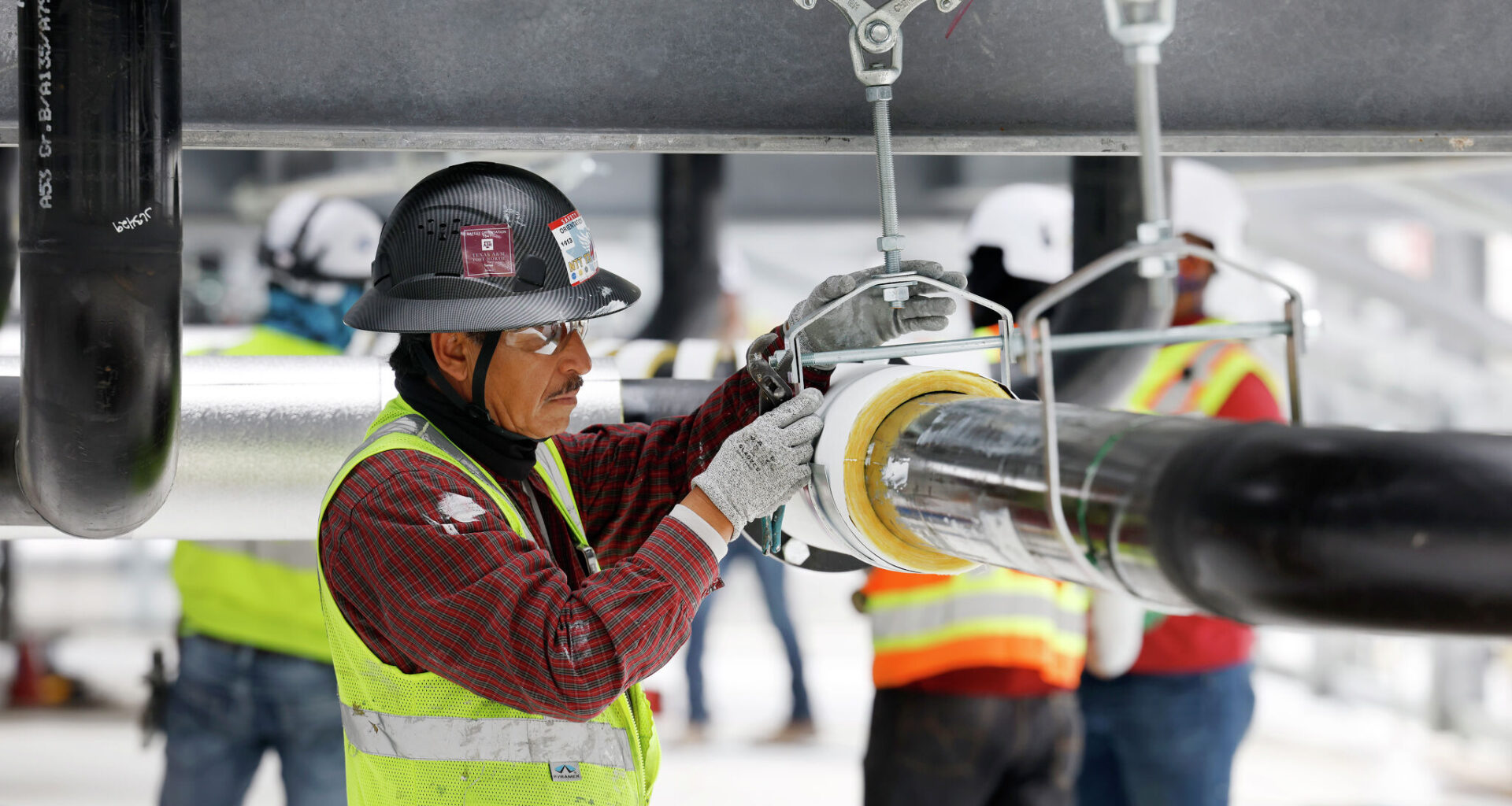
Construction workers build out the rooftop chillers and water lines feeding them atop Dallas TX4, which is under construction at the NTT Data center campus in Garland, Texas, March 4, 2026. It will take 40 of those water-filled chillers to cool the fourth data center built on the property.
Tom Fox/Dallas Morning News
Google will spend $10 million on water projects in Texas communities where it plans to build data centers, the company announced Wednesday — a first-of-its-kind investment that comes amid growing backlash to the resource-intensive projects.
The company also said it will replenish more water than its data centers consume by 2030, and report usage numbers publicly as part of an effort to craft a “blueprint” for responsible water management. Google has emerged as one of the biggest data center developers in the state, with plans to invest $40 billion over the coming years.
READ MORE: See where data centers are planned or operating near you
Article continues below this ad
Critics said the initiative is a good start, but isn’t aggressive enough to address concerns that data centers will deplete the state’s already stressed rivers and aquifers and strain the electric grid. Top Republican lawmakers are studying the issue ahead of the next session, and some local communities are trying to halt the projects altogether.
“$10 million doesn’t buy much of anything,” said Perry Fowler, the executive director of the Texas Water Infrastructure Network, a construction trade coalition. “It may help one little town with their system, but if you’re talking about any significant investment in infrastructure, that’s a drop in the bucket.”
Data center developers have flocked to Texas in the past year, lured by cheap land, few regulations and a path to low-cost energy. Hundreds of computing centers, with servers that power artificial intelligence, are planned or already under construction across the state.
RELATED: Data centers need water. Could Texas oil companies help?
Article continues below this ad
The state has struggled to anticipate data centers’ future water use, but the projections that do exist predict a dramatic shift. A recent report from the University of Texas calculated that on the high end, demand could balloon to 22 times data centers’ estimated current water use by 2040, or 9% of the state’s total consumption.
‘People are rightfully concerned’
Google has made Texas the center of its data center development nationwide. Last fall, CEO Sundar Pichai said the company would invest $40 billion in AI data centers and related workforce training across Texas through 2027.
The company already has two data centers currently operating in Texas and at least six other centers in the works, according to announcements from Google and data from Cleanview, a company that tracks data center projects. Those centers are mostly planned on sites around Dallas-Fort Worth, although one has been proposed in Gray County, west of Amarillo, which primarily relies on groundwater from the stressed Ogallala Aquifer.
According to Google’s 2025 annual report, its data center in Midlothian, Texas, consumed 182.3 million gallons of water in 2024 – about the amount in 276 Olympic-sized swimming pools.
Article continues below this ad
While data centers’ total hydrologic impacts include everything from the water used during energy production to facility sewage lines, most concerns are focused on the massive volumes of water often needed to cool the facilities.
The most water-intensive strategy – and also the cheapest – involves large-scale evaporation.
MORE COVERAGE: Most Houston-area residents use AI but oppose data centers being built near them
On Wednesday, Google committed to avoiding the practice in its centers currently in development in Texas, saying it would instead use air-cooling systems that require a fraction of the water.
The company has yet to announce how the $10 million water fund will be distributed.
Article continues below this ad
Ben Townsend, Google’s head of infrastructure and sustainability, said the company will work with local nonprofits and water stewardship agencies to identify projects. He said Google has already invested in water projects across the state, including efforts focused on irrigation efficiency in the Panhandle; longleaf pine forest restoration in East Texas; and water rights leases to increase streamflow in the San Saba River. (The company declined to share how much it has spent to-date.)
Townsend said the opposition to data centers is often warranted: “There are… no-name companies showing up and saying, ‘I want a bunch of water, I’m not gonna tell you why, and I’m not gonna tell how much I use,’” he said. “And people are rightfully concerned, especially in a state with the type of water scarcity that Texas has.”
But he’s optimistic that communities will be able to demand similar commitments from other companies. “My hope is that they’re empowered with this sort of checklist or blueprint of what best-in-class water management looks like,” Townsend said.
Apartments sit across the street from Dallas TX4, the fourth and final new data center building under construction at the NTT Data center campus in Garland, Texas, March 4, 2026. A row of diesel powered back-up generators in the foreground are being prepared to go online.
Tom Fox/Dallas Morning News
‘Every drop counts’
GOP leaders have largely supported the state’s data center boom, even as Texans in conservative rural areas are increasingly opposed to new development.
Article continues below this ad
Unlike cities, county governments don’t have the power to block development. In May, Texas Agriculture Commissioner Sid Miller called for a temporary moratorium on new data centers, citing impacts on the electric grid, water supplies, agricultural land, and rural communities.
Brendan Steinhauser, a Texas GOP strategist who founded the Alliance for Secure AI Action, said a range of concerns have fed the groundswell of local opposition to data centers and that Google’s new water promises are unlikely to turn the tide.
“That’s good that they’re doing that. But I don’t think it’s enough,” he said.
The issue is likely to be front and center in the coming legislative session.
Both Lt. Gov. Dan Patrick, who leads the Senate, and House Speaker Dustin Burrows have directed lawmakers to study the water and energy demands of data centers before they convene in 2027.
Earlier this year, the Texas Water Development Board, which oversees water planning for the state, released a draft water plan that estimated $174 billion would need to be invested in water infrastructure and supply over the coming 50 years to keep up with demand.
But that draft report doesn’t calculate projected water demand from data centers.
The computing facilities have never been required to share their water use with the state, and – prompted by the Texas Legislature – the state’s Public Utility Commission asked them for details for the first time via a voluntary survey this spring. The results should help the water board draft data center water-use projections, which are expected by next year, said Matt Nelson, the board’s deputy executive administrator for planning.
Townsend said Google has responded to the survey, which he called a “sensible” request to help state water leaders “plan for a resilient future.”
But he said the company currently only publicly shares the data centers’ direct water use, as it is still assessing how much they consume as a byproduct of the energy required to power facilities.
Environmental Defense Fund’s Vanessa Puig-Williams applauded Google’s commitment to replenishing water supply, but urged a more “aggressive” investment.
“In these very arid regions, every drop counts,” Puig-Williams said.