
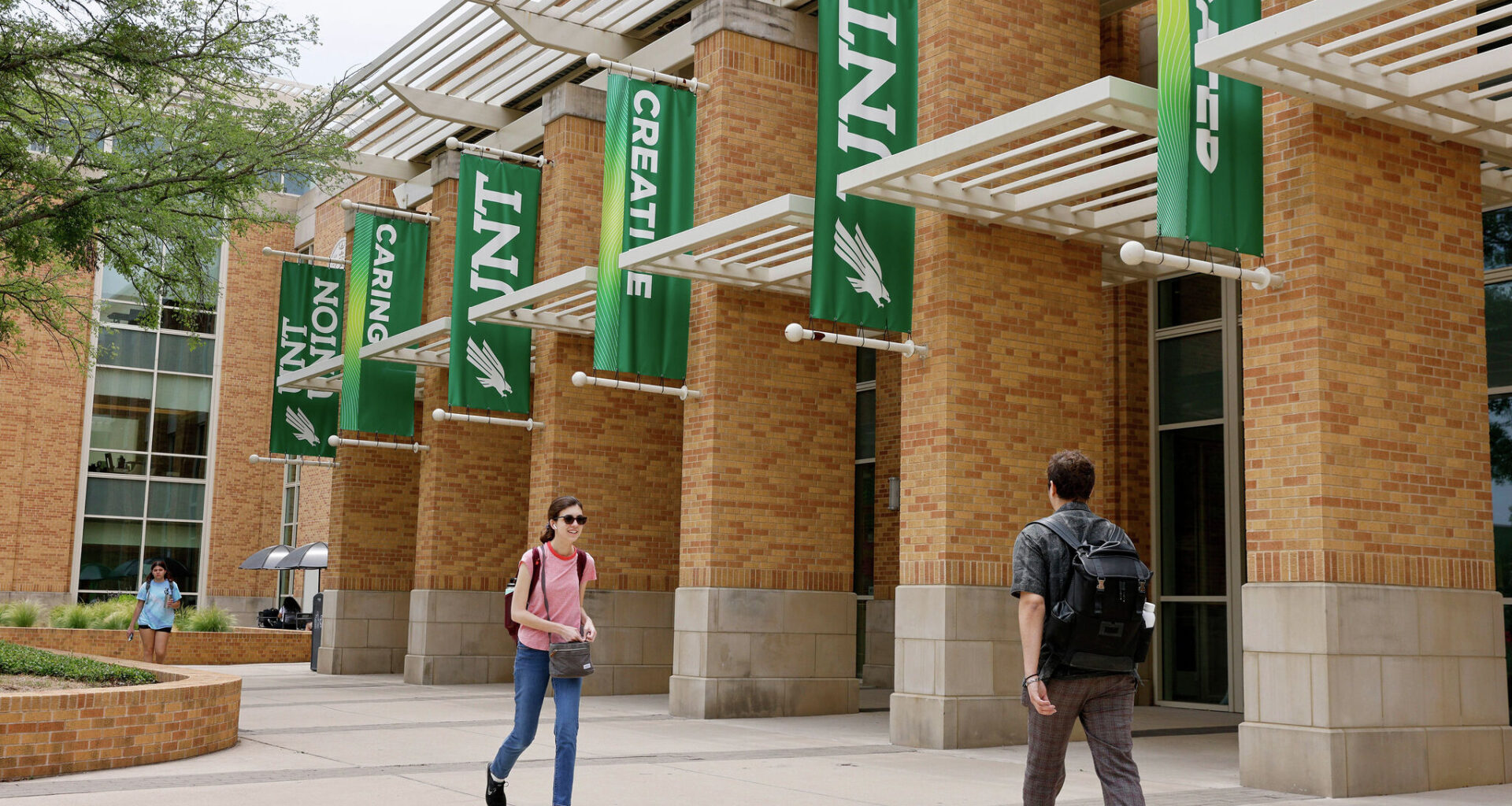
Texas was the first state to extend in-state tuition to undocumented students when former Gov. Rick Perry signed the bipartisan measure into law in 2001. Pictured here is the campus of the University of North Texas in Denton.
ElÃas Valverde II/TNS
Students and former students from left to right, Alejandra Villasenor, Maria Yolisma Garcia, Diana De Los Reyes, Jesus Ochoa, Carlos Estrada, and Daniel Candelaria wait to testify against a repeal of the so-called “Texas Dream Act” of 2001, in Austin, Texas, Monday, April 6, 2015. (AP Photo/Austin American-Statesman, Rodolfo Gonzalez)
AP
Latino Center for Leadership Development founder Jorge Baldor, left, and executive director of the center, Miguel Solis, were in Austin Jan. 14 for a news conference regarding the preservation of House Bill 1403, the Texas Dream Act.
Maria Yolisma Garcia, 20, of Dallas, center, rallies in support of the HB1403, the Texas DREAM Act, at a demonstration at the Capitol in Austin, Texas, on Wednesday Jan. 14, 2015. More than 50 people, a coalition of businesses, affected students, supporters, and lawmakers, rallied to preserve the 2001 in-state tuition law. (AP Photo/Austin American-Statesman, Jay Janner) AUSTIN CHRONICLE OUT, COMMUNITY IMPACT OUT, INTERNET AND TV MUST CREDIT PHOTOGRAPHER AND STATESMAN.COM, MAGS OUT
Jay Janner – AP
A federal appeals court will hear oral arguments Thursday about whether a community college and student activists can sue to restore the Texas Dream Act, which gave in-state tuition to undocumented students.

Last summer, the U.S. Department of Justice sued Texas over the 2001 law, arguing the act violates federal immigration law. State Attorney General Ken Paxton quickly agreed, and in a matter of hours, 24 years of in-state tuition for undocumented students came to an end.
The Dream Act allowed undocumented students to receive in-state tuition at public colleges and universities as long as they had lived in Texas for at least three years and signed an affidavit saying they would apply for legal status as soon as possible.
Article continues below this ad
With undocumented students now required to pay much higher out-of-state tuition rates, the end of the Dream Act could put college education out of reach for many, as undocumented students do not qualify for federal financial aid. There were about 73,000 undocumented students in Texas, according to a June 2025 report by the American Immigration Council.
A week after U.S. District Judge Reed O’Connor struck down the Dream Act, an activist group of undocumented students called Students for Affordable Tuition filed to intervene in the suit. They argued that due to the rushed timeline, the most important stakeholders in the case — undocumented students — were not given a chance to weigh in.
“Laws that have been on the books for over a quarter century should not be eliminated in an afternoon,” said Thomas Saenz, president and general counsel of the Mexican American Legal Defense Educational Fund, which represents Students for Affordable Tuition.
Austin Community College, along with University of North Texas student Oscar Silva, joined the effort shortly after.
Article continues below this ad
As a result of the Dream Act ending, some members of the coalition could face up to an 810% increase in higher education costs, according to court documents. Several members of Students for Affordable Tuition were able to afford college through the Dream Act, but will now be forced to either drop out of their programs or significantly scale back their courseload.
O’Connor denied the students’ bid to intervene in August 2025, saying their challenge was legally “futile.” Now, a higher court, the Fifth Circuit Court of Appeals, will weigh the same question after hearing oral arguments. Each side will have 30 minutes to present their arguments to a panel of judges in the New Orleans courtroom. The court will decide whether the students can intervene, a ruling that could be appealed to the U.S. Supreme Court. It is unclear exactly when the court will rule.
If the court rules in the students favor, the case would go back to the district court, where Students for Affordable Tuition and other parties would have a “full opportunity” to weigh in on the Dream Act.
That is how the case should have been handled to begin with, Saenz said.
The U.S. Department of Justice and state attorney general’s office did not respond to a request for comment.
Article continues below this ad
In its effort to strike down the Dream Act, the United States cited a 1998 federal law that prevents undocumented students from receiving benefits, like in-state tuition, unless those same benefits are given to all U.S. citizens, including out-of-state residents. Consequently, the Trump administration argued, Texas has been violating federal law with the act.
“Under federal law, schools cannot provide benefits to illegal aliens that they do not provide to U.S. citizens,” former U.S. Attorney General Pam Bondi said. “The Justice Department will relentlessly fight to vindicate federal law and ensure that U.S. citizens are not treated like second-class citizens anywhere in the country.”
Advocates for the Dream Act argue it has increased access to education for a large sector of Texas’ population, growing the workforce and helping the state’s economy. The law passed the Texas Legislature in 2001 on a bipartisan vote, and it has withstood several state lawmakers’ attempts to dismantle it, including in the most recent legislative session.
Texas was the first state to grant undocumented students in-state tuition, and at least 22 states now have similar provisions. The U.S. successfully sued Oklahoma last year to strike down its law giving undocumented students in-state tuition, and Florida’s state Legislature repealed its version of the law last year as well.
Article continues below this ad
The DMN Education Lab deepens the coverage and conversation about urgent education issues critical to the future of North Texas.
The DMN Education Lab is a community-funded journalism initiative, with support from Bobby and Lottye Lyle, Communities Foundation of Texas, The Dallas Foundation, Dallas Regional Chamber, Deedie Rose, Garrett and Cecilia Boone, Judy and Jim Gibbs, The Meadows Foundation, The Murrell Foundation, Ron Steinhart, Solutions Journalism Network, Southern Methodist University, Sydney Smith Hicks, and the University of Texas at Dallas. The Dallas Morning News retains full editorial control of the Education Lab’s journalism.