
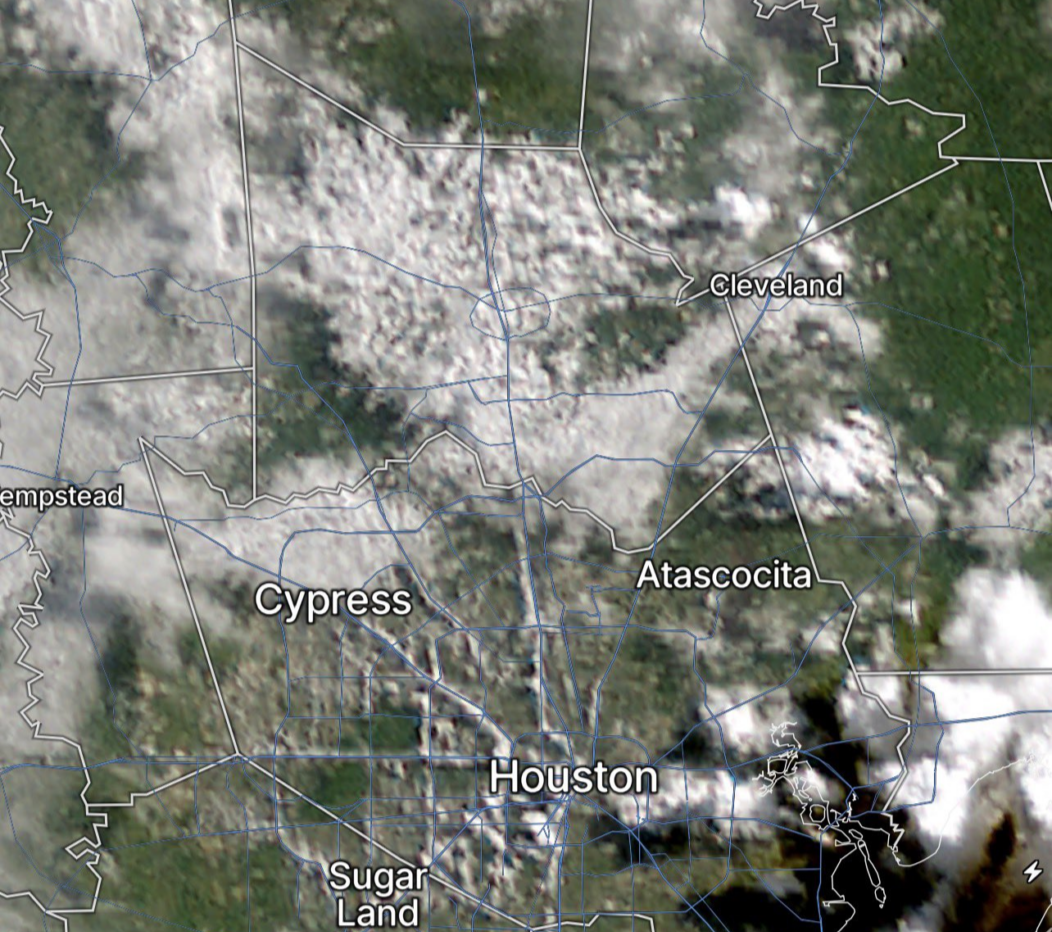
Houston’s weather and its roadways have done some pretty unpredictable things, but perhaps no one guessed that together, they would create their own clouds.
That’s exactly what appeared to happen Tuesday morning, when storm chaser Ethan Mok shared satellite images taken between roughly 7 a.m. and 8 a.m. The image quickly drew attention from meteorologists, including Space City Weather meteorologist Eric Berger.
“In them, remarkably, clouds lined up directly over most of the freeways in the greater Houston region,” Berger wrote. “Quite clearly these interstates, particularly the Katy Freeway with its more than two dozen lanes, were inducing their own micro-climate.”
Understandably, the sight leaves behind more questions than answers—some that even Berger admits he cannot fully explain.
“I’m not sure precisely what is happening here, but it must be a combination of several factors,” he wrote. “Winds on Tuesday morning were very light, allowing heat from the concrete surfaces (which were warmer than the surrounding air) to rise almost straight up. In addition, particulates from vehicle exhaust provided nuclei for water vapor to condense around, creating seeds for clouds.”
As for exactly why the clouds appeared so neatly aligned with Houston’s freeway system, that remains somewhat of a mystery.
“We don’t, frankly, understand exactly why it happened on Tuesday morning, or whether this is a particularly common feature,” Berger wrote. “I have never seen a manifestation like this, however.”
What the images do reinforce, however, is a growing area of weather research: how cities can influence the atmosphere around them. A recent Texas A&M University study found urban areas like Houston can sometimes strengthen certain thunderstorms by altering heat, moisture and airflow patterns around cities. Researchers stressed that not every storm behaves the same way, but the findings highlighted how large urban environments can influence local weather in ways scientists are still working to fully understand.
“Cities don’t just change the landscape, they change the weather,” Dr. John Nielsen‑Gammon, a Texas A&M University atmospheric scientist and the study’s co-author, said in a statement.
“Asking whether cities get more or less rain is the wrong question,” he added. “The right question is which storms are affected, because that’s what determines the risk people actually face on the ground.”
In other words, Houston’s traffic may not be causing the rain, but Tuesday’s unusual cloud formation suggests the city’s sprawling concrete footprint might be leaving a bigger mark on the skies above than many people realize.