
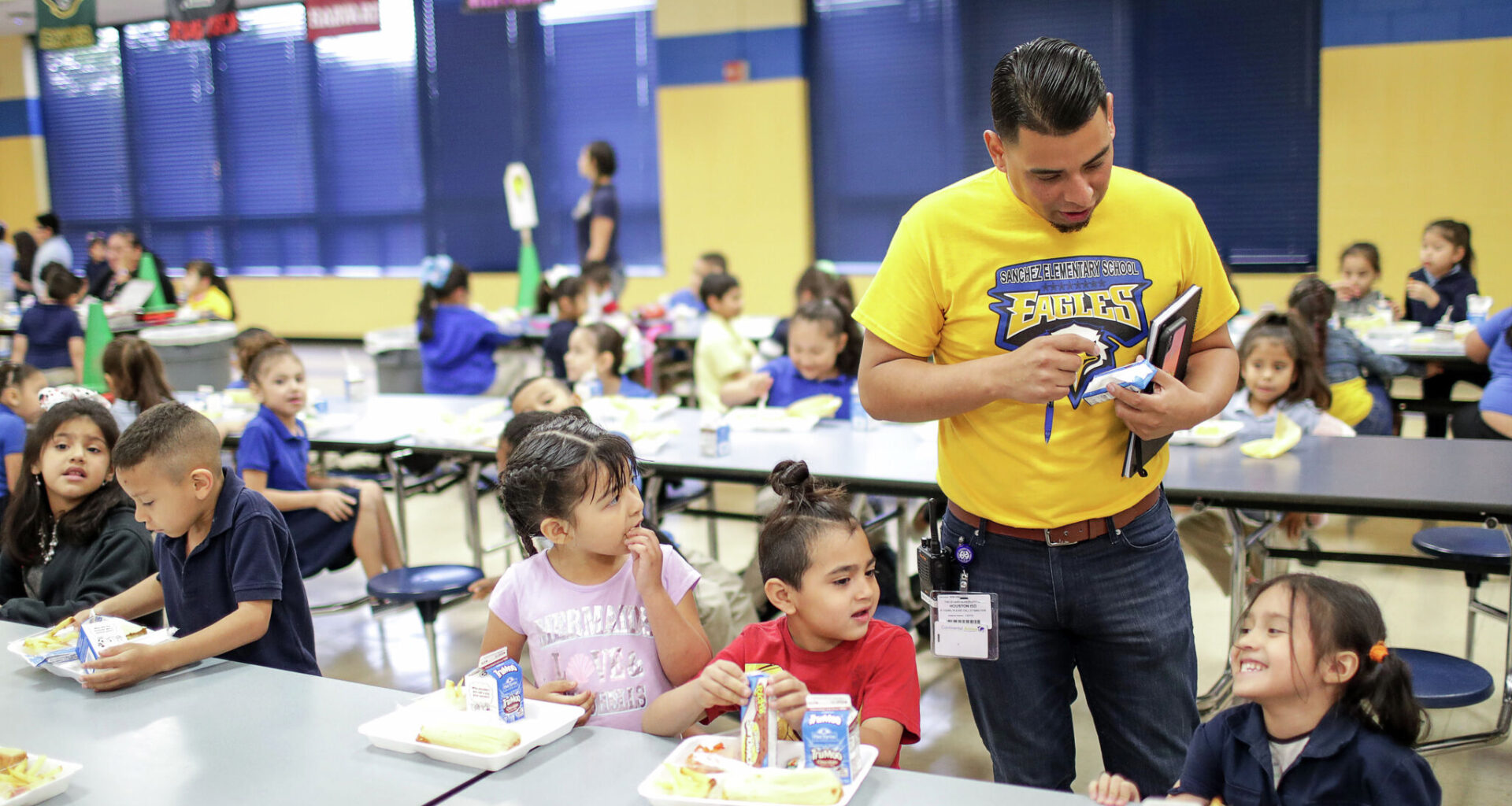
A resource coordinator at Sanchez Elementary in Houston talks to first-graders as they eat school lunch in 2019.
Jon Shapley/Staff photographer
The shy redhead girl who sat quietly in the back of my elementary school class carried a tiny punch card. She tucked it carefully out of sight.
At end of the lunch line, with a tray loaded with spaghetti or whatever the day offered, she surrendered the card to the cafeteria worker to be punched for her free lunch. I didn’t understand it then, but the particular shame of being made to prove your poverty in a crowded cafeteria with a line of 9-year-olds behind you is a weight no child should carry.
Hunger is hard enough. Kids are cruel.
Article continues below this ad
Now, possibly thousands of Houston children are about to feel the same weight of hunger and shame as Houston ISD removes 33 schools from the Community Eligibility Provision, a federal program that allows the nation’s highest-poverty schools and districts to provide free breakfast and lunch to every student enrolled. No questions.
SAME TIME, LAST YEAR: How Trump’s SNAP cuts would take food off 700,000 Texans’ tables to fund tax breaks for the rich
The decision has nothing to do whether children are hungry in schools. When Chronicle reporters asked why it was made, HISD said in an email that the change was not a “discretionary decision” by the district, rather the campuses did not meet federal guidelines to participate in the program. A free breakfast will still be provided to children at those schools.
Nearly 80% of HISD’s estimated 183,000 students are considered economically disadvantaged, qualifying them for free or reduced-price lunch.
Article continues below this ad
This has everything to do with a cost-cutting bureaucratic indifference that will pile paperwork on schools and struggling families, add meal charges some families simply cannot afford and inflict humiliation on the poor kid with the punch card.
It is a troubling step backward for students and families already struggling with rising food and grocery costs.
The move follows sweeping changes to federal food assistance under the Trump administration, which drove a 14% drop in the number of Texans participating in nutrition programs. In 2024, Texas turned down $350 million in federal aid for summer food assistance the provides children with free meals. Then last year, Gov. Greg Abbott vetoed a budget line item that would have brought in an estimated $450 million in federal dollars to fund a summer food program for low-income children.
Nationally, some 21.2 million students receive free school lunches and 16 million get free breakfasts daily through the National School Lunch Program. Most funding comes from the U.S. Department of Agriculture. State and local dollars fill the gaps, when leaders choose to do so.
It is reasonable that families who can afford to pay for school meals should do so. But those who cannot should never have to choose between a child’s esteem and lunch.
Article continues below this ad
Parents at impacted schools will have to fill out paperwork to qualify for free or reduced-price meals, which could hit working families the hardest. Many eligible families, particularly those with language barriers or limited time, may not complete the application, leaving their children without access to meals for which they would otherwise qualify.
Children can’t learn if they are hungry.
They certainly can’t compete on standardized tests or read for comprehension on empty stomachs. Universal free lunches are not meant to be a handout. They represent commonsense public policy that doesn’t just prevent hunger, but also helps children do well in school.
Here in Texas, about one in five students lives in a food insecure household, according to Feeding Texas. In Houston, that figure climbs to two in five, nearly three times the national average, according to Kinder Institute for Urban Research at Rice University.
Among the schools losing the program are Houston’s Poe Elementary, Wharton Elementary, Lamar Elementary and Bellaire High School.
Article continues below this ad
The federal government has been providing students lunch since 1946, when President Harry S. Truman signed the National School Lunch Act, a measure to ensure school-age children in public and private schools didn’t go hungry.
The loss of automatic free meals will create a ripple effect on hunger, stigma and economic strain. The families who can least afford it will be hit the hardest.