
You see it almost every day. Somewhere in your travels around Austin, there’s inevitably a little lump of fur in the middle of the road. Usually it’s a squirrel. Sometimes something more exotic, like an armadillo or a skunk. These poor little things probably didn’t know what hit them.
Our question asker — who prefers to remain anonymous — found one just outside his house. A squished opossum in the bike lane. He called 311 and within a day, the body had disappeared. But that made him wonder: what happens to all those dead critters the city picks up?
To find out, I needed to start at the beginning. So one day, I rolled up to a street in South Austin to meet up with a crew that does the work of hauling off what’s left of these departed creatures.
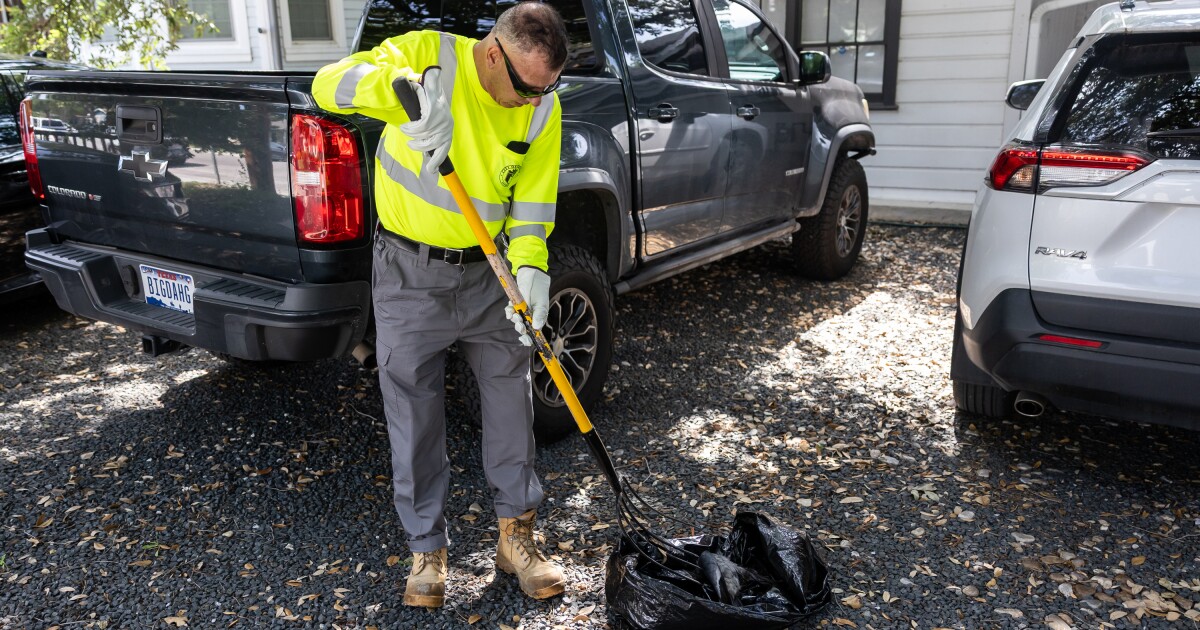
Marvin LeVaughn, 63, is a driver for Austin Resource Recovery, the city’s trash department. He is one of the people who collects dead animals that people report through 311.
“Most of the animals that we pick up are usually like opossums and raccoons, but we get quite a few cats,” Marvin said.
Last fiscal year, the department collected 2,780 dead animals from Austin’s streets.
The drivers carry microchip readers, so if they do find a cat or a dog, they can check for an ID chip, and the owners can be notified.
At his first stop of the day, he’s picking up a dead dog. The dog died at home and the owners made a sort of coffin for it: A cardboard box, duct taped over with those green, reusable H-E-B bags covering the top.
Marvin scoops up the box — it’s not too heavy, so it must be a small dog — and slides it gently into the back of his box truck.
“It gets sad sometimes, but, you know, I’m just glad to tidy them up and put them away properly and just not leave them out there on the roads or streets to rot,” he said
At the next stop, another driver, Dwight Leonard, is there to collect a dead squirrel that someone has helpfully but into a paper grocery bag. This is not typical. Dwight said most of the animals they collect are still on the road and depending on their condition, might require a pitchfork to get them loaded up in the truck.
“You see a lot of it,” he said. “You try not to think about what happened and just bag him and go.”
At another stop out east past U.S. Highway 183, Marvin is collecting another dead dog. The owner called to say they left it in their recycling cart on the side of the house. Marvin opens the lid and we peer inside. At the bottom, nestled among some empty cans and bottles, is the body of a pretty big dog. Its fur is black, but graying. It’s hard to tell exactly what it looks like because it’s wrapped up in plastic like a mummy.
Marvin goes back to the truck to get a big plastic bag to put the dog in. I’m left there for a minute with the dog.
Marvin is matter of fact about all this. I’m having a hard time.
I ask Marvin if he ever says a few words for the animals he collects.
“Maybe a little prayer or something inside my head,” he said. “Or sometimes I’ll talk to them if nobody’s around and say ‘I’m going to take good care of you and put you away proper.’”
He gets the dog bagged up and drags it back to the truck. The dog is too heavy to lift on his own, so Marvin wraps a cable attached to a winch around it. He slowly winds up the cable and the body is lifted up. Marvin swings the dog into the truck and unhooks the cable. He closes the doors and it’s on to the next stop.
In Northeast Austin, he’s responding to another call about a dead opossum in the road.
But we can’t find it. There’s what seems to be a diaper in the road, but no sign of an opossum.
This happens. Maybe the caller gave the wrong address, but more likely something else got to the opossum first: scavengers.
“Coyotes and foxes and stuff, they’re kind of nocturnal creatures — if they see something like that, a squirrel, a opossum — that’s a free meal for them,” Marvin said.
Empty-handed, Marvin heads to the next call. Before the day is out, he’ll collect several opossums and yet another dog. He usually picks up more than a dozen every day.
Then, it’s time for the last stop. This is where we answer the question.
Southeast of Austin, just outside city limits, there’s a Texas Disposal Systems landfill.
I’m not allowed to ride in with Marvin, so his supervisor gives me a ride. We wind through the mountains of trash that have been covered with dirt. Grass grows on many of them. Then we drive down into a valley — an active part of the landfill.
A giant pit of garbage — plastic bags, food packages, old furniture, drywall — everything you can think of is being dumped in this hole. Huge bulldozers move back and forth, grinding everything up, mixing it all together.
Marvin backs his truck up to the pile. He gets out and opens the back doors. The bed tilts up and the animals slide out.
They disappear into the abyss of garbage. The dogs and the opossums are one with the pile now.
As Marvin’s finishing up for the day, I ask him what he thinks about dumping the bodies in the landfill.
“I think it’s better for them to go out to a place like that than just be sitting left on the side of the road rotting and their bones there for years,” he said. “Eventually they fill all that in with dirt and green grass goes over the top of it. It’s just unmarked graves for those animals.”
And then he gets philosophical about it.
“I guess they go back into the Earth or whatever. You know, like they say ‘man is made from dust’ I guess animals are the same way and they turn back into dust after they’re long gone.”
Maybe Marvin is right. Maybe this is kindness for these forgotten creatures.