
Since we introduced “Jim Duncan’s Austin” on July 6, 2025, some of his most popular histories have recalled the city’s beloved bars, clubs and eateries. This week, we adapt four more of his chronicles of Tex-Mex restaurants. — Michael Barnes

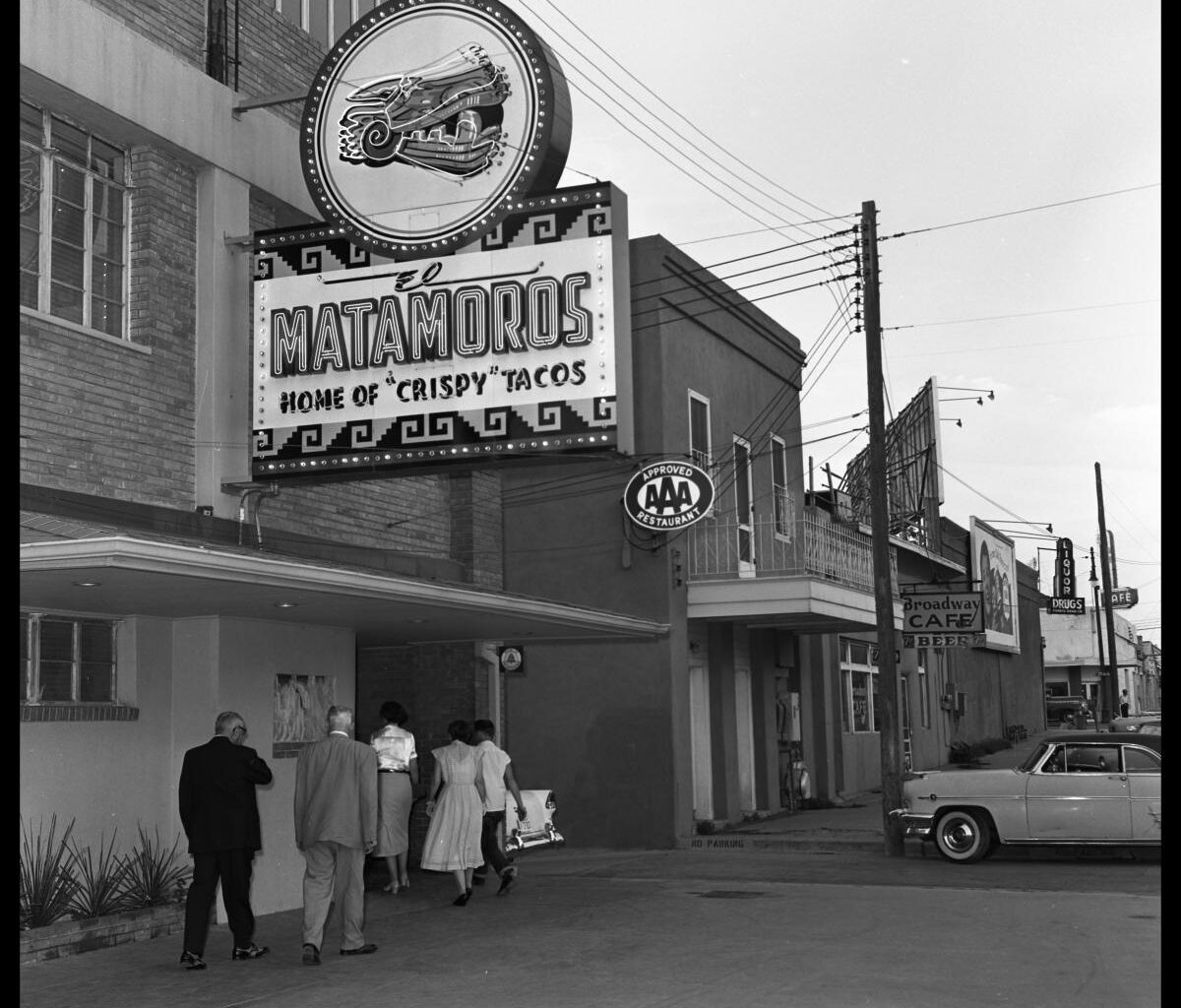
1947: El Matamoros / Monroe Lopez legacy
El Matamoros, Home of the “Crispy Tacos,” 504 East Ave. in 1957.
Neal Douglass/Austin History Center
Although his restaurants were long ago shuttered, the entrepreneurial legacy of Monroe Monseis Lopez continues to influence Austin’s restaurant industry. He was a restaurateur extraordinaire and is said to have been Austin’s first Tex-Mex millionaire.
Article continues below this ad
Lopez opened his first restaurant in 1947 in a four-room house at 504 East Ave., now Interstate 35. He named it El Matamoros, and it was universally known as “El Mat.” It was the first Mexican restaurant to offer crispy tacos, frosted beer mugs and an “all the Mexican food you can eat” special.
In 1952, he opened Monroe’s next door, where he was the first to offer Mexican food to go. Lopez also opened El Toro at 16th and Lavaca streets and acquired El Charro at 10th and Red River streets during the 1950s.
In 1980, he closed his four restaurants so that he could devote more time to his other business interests: a radio station and oil and gas exploration.
In 1986, Lopez returned to the restaurant scene, joining Ramon Lopez “Ray” Servantez in operating Casa Daniel at 11835 Jollyville Road.
Article continues below this ad
Lopez died in 1992. In 1996, Casa Daniel converted to Antonio’s Cantina. Today, it is the Pour House Pub.
1954: Maudie’s Café
Maudie’s Moonlight Margarita Run ends in a party at the Seaholm Power Plant with snacks and drinks from Maudie’s Tex-Mex. [Contributed by the Trail Foundation]
Austin 360
From biscuits to burritos, Maudie’s Café has served Austinites a full range of Southern delicacies for more than 70 years. For its first four decades, Maudie Oleta Wilson Hamilton and her husband, Albert, ran a homestyle restaurant at Exposition and Lake Austin boulevards. Her specialties were biscuits and gravy, Southern fried chicken and chicken and dumplings.
Article continues below this ad
The merits of Maudie’s were put to song in 1986 by local journalist Winston Bode: “Oh, in Austin on the banks of the Old Colorado, there’s a place they make the world’s best enchiladas. They’re cheesy and greasy and meaty at Maudie’s Café.”
It was popular with cedar choppers, who lived in the high western hills across the river.
When Maudie retired in 1993, she sold the property to Joseph Anthony Draker, who converted it into a Tex-Mex café. Maudie died in 1995. Roe and Pete Hernandez and Jorge Arredondo helped Draker do the menu turnaround.
Over the next two decades, Maudie’s Tex-Mex increased its chain of restaurants to six in Central Texas: Maudie’s (1994), Maudie’s Too (1997), North Lamar (2000), Milagro (2002), Hacienda (2003) and Hill Country (2010).
Article continues below this ad
Maudie’s sponsors an annual 5K called the Moonlight Margarita Run & Party, with proceeds going to the Butler Hike and Bike Trail Foundation.
It is the only Austin run that ends with dinner and margaritas. Draker says that Maudie’s and the trail are like yin and yang, “Yin the calories in and yang them out on the trail.”
1973: Casita Jorge’s / Enchiladas Y Mas
For four decades, Casita Jorge’s was one of Austin’s most popular Tex-Mex restaurant chains. Founded by George Corpus “Jorge” Arredondo in an old burger joint in East Austin in 1973, it was known for its cheese enchiladas, spicy salsa, tasty barbacoa and frozen margaritas.
Article continues below this ad
From 1973 to 2002, Arredondo opened and closed seven more restaurants, including those at 218 E. Sixth St., 2538 Elmont St., 1720 Lavaca St., 304 W. 15th St., 2205 Hancock Drive, 2700 W. Anderson Lane and 1620 N. Interstate 35 in San Marcos.
During that time, he also experienced several legal and fiscal hiccups in the form of lawsuits and foreclosures. Using his name and recipes, however, several of his family members continued to open Tex-Mex restaurants during the 1990s and 2000s.
In 1994, two of Jorge’s brothers-in-law, Roumaldo “Roe” Hernandez and Robert Martinez, opened Enchiladas Y Mas at 2804 N. Interstate 35. Soon after opening, they received the Austin Chronicle’s award for “Best Chorizo Migas.”
Needing more space, they moved to 1911 W. Anderson Lane in 1999, where they were able to double their number of tables and add a full-service bar.
Article continues below this ad
Today, EYM is the only direct descendant of Casita Jorge’s still operating.
1975: El Arroyo
Will Larsen, a property manager, pauses for a coffee and a breakfast taco at El Arroyo as the restaurant’s famous sign offers a bit of humor.
Jay Janner/Austin American-Statesman
El Arroyo is one of the few Austin restaurants better known for its wit and wisdom than for its food.
Article continues below this ad
Founded by Robert Lee Ogden and his wife, Mary, in 1975 at 1624 W. Fifth St., it was owned and operated by University of Texas business grad Joseph Clayton “Clay” McPhail and UT football legend Lowell Douglas “Doug” English from 1978 until 2012, and then by Ellis Brian Winstanley and his wife, Paige.
El Arroyo attracts diners not only with its Tex-Mex menu and margaritas but also with its world-famous changeable sign. With daily puns and musings that are funny, uplifting, snarky and timely, the sign has become a social media fixture. With more than 660,000 followers across all platforms — the marquee has taken on a life of its own. The restaurant also publishes picture books of the signs and gets recognition from celebrities.
In 2020, the cast of “Queer Eye” posed in front of the sign while in town filming the series. The first sign ever was “Warning: All traffic must exit — entering Tex-Mex zone.” Police made Ogden change it because so many people were slamming on their brakes and pulling in.
McPhail’s favorite sign was “El Arroyo: Conveniently located near most hospitals,” and Winstanley’s was “The Last Queso Stop Before a Bunch of Yoga Studios.”
Article continues below this ad
The restaurant is also called “The Ditch” because it was built on top of a drainage way, and it is the English translation for “Arroyo.”
Three more stories in this series
Article continues below this ad
Please send tips and questions to mbarnes@statesman.com.