
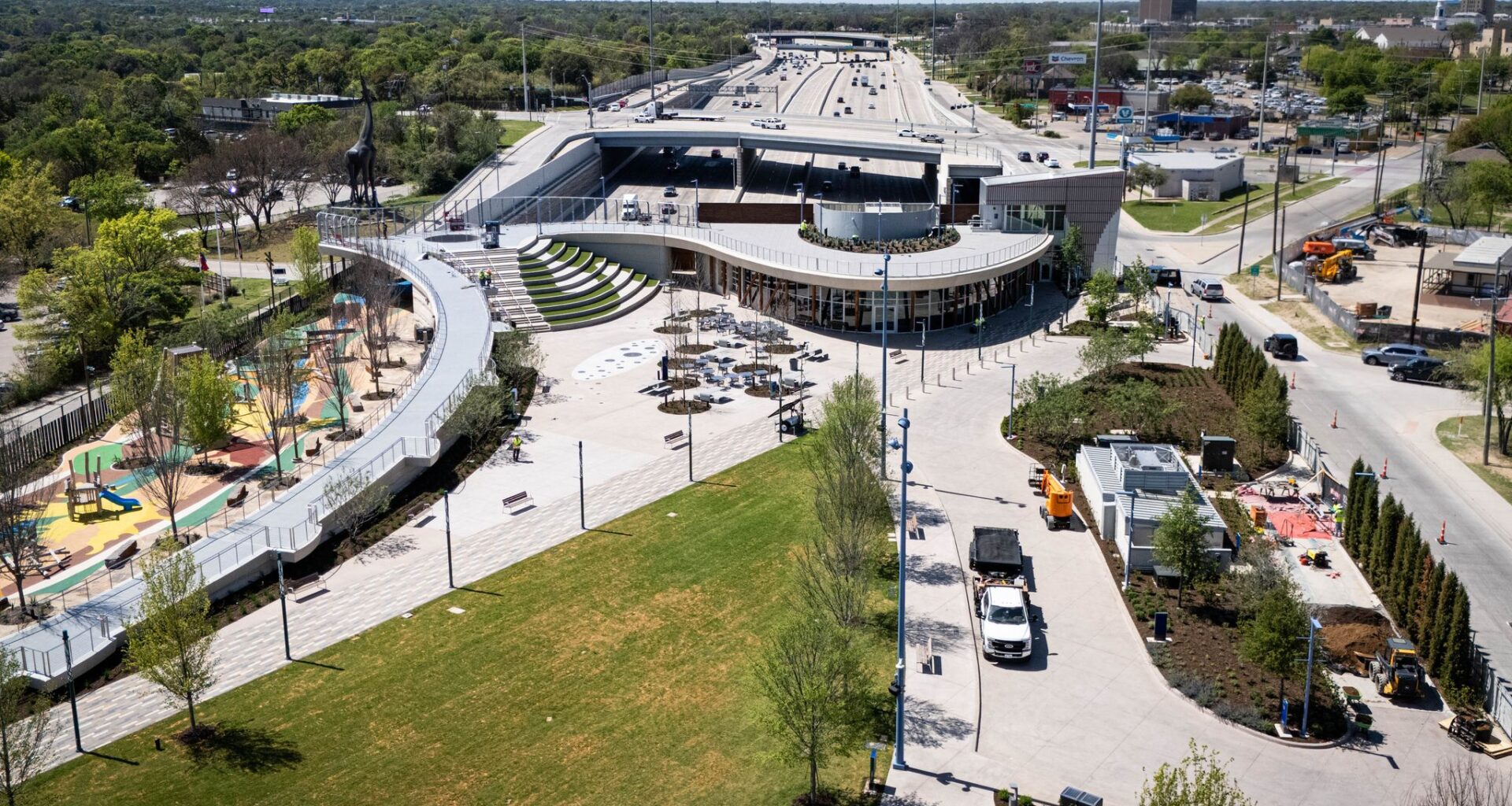
An aerial view of Halperin Park.
Angela Piazza/Staff Photographer
Last month’s opening of the first phase of Halperin Park, which decks over Interstate 35E in Oak Cliff, is worth celebrating for a host of reasons, not least for demonstrating that perpetually dysfunctional Dallas can, occasionally if imperfectly, get its act together, and achieve something for its residents.
The park, which is adjacent to the Dallas Zoo, sutures together communities divided in the late 1950s when the highway was driven through east Oak Cliff, separating predominantly Black communities, notably the historic Tenth Street district, from more affluent and predominantly white areas to the west.

The 3-acre first phase cost $112 million, with $15 million coming from the city. A second phase will expand the park to the south, adding 2.4 acres at a cost of roughly $170 million, of which $90 million has already been committed, mostly from federal and state agencies. Anticipated completion is sometime in the early 2030s, and expectation is that the park will host 1 million visitors annually.
Its design is a collaboration between landscape architecture firm SWA and Dallas architecture colossus HKS, and follows the maximalist formula established by Klyde Warren Park, packing a variety of amenities — an amphitheater, a performance bandshell, a multipurpose building, an elaborate playground, a promenade, a “sky bridge,” a water feature, a great lawn and extensive landscaping — into a narrow footprint, and then activating those spaces with an extensive catalog of events to ensure consistent traffic.
Performance bandshell at Halperin Park.
Angela Piazza/Dallas Morning News
Inside the multipurpose building at Halperin Park on Nov. 25, 2025, in Dallas. The space will house, community rooms, seating, food and beverage offerings and more.
Angela Piazza/Dallas Morning News
The amphitheater at Halperin Park, a new deck park in Oak Cliff, on Tuesday, March 24, 2026, in Dallas.
Angela Piazza/Dallas Morning News
“We’ve been really intentional about keeping it very heavily programmed, and programmed in a way that lifts up this local community,” says April Allen, the director of the Southern Gateway Public Green Foundation, the nonprofit entity established to build and maintain the park. Those activities have already included salsa lessons, reading groups, yoga and pilates instruction, and art classes for kids.
The park’s most dramatic feature is its bandshell, which looks like a giant Pringles potato chip propped up on stilts. Its undulating roof is composed of glulam (laminated sheets of timber compressed together with adhesive) and was fabricated in Germany and then assembled on site. It is a wonder, although somewhat marred by the presence of exposed piping for a sprinkler system that the city forced on the design during construction. Just why an open-air bandshell needs a fire suppression system at all is a good question, though it is certainly representative of the pointless bureaucratic interference that has become typical in Dallas.
Article continues below this ad
Across the park is a curving, glass-fronted multipurpose building capped by a roof terrace with dramatic views facing north, toward downtown. Its spare, open interior of roughly 6,000 square feet is flexible enough to accommodate a range of events, and perhaps someday be home to a cafe.
Most significantly, the structure is the first public building in Dallas to be constructed of mass timber, making it a welcome demonstration of sustainable design. The decision to use timber was driven by community feedback and by the material’s strength-to-weight ratio, critical when building on a suspended deck. “It worked both for function and aesthetics,” HKS principal Russell Crader said.
Another bit of material creativity is an artificial escarpment — inspired by the namesake cliffs of Oak Cliff and made of pre-cast concrete panels — that artfully encloses the park’s playground, so parents can allow their children to roam freely without worrying that they might wander off or get lost.
Running through the park and bisecting it diagonally is a promenade that will eventually be home to a “walk of fame” of notable Oak Cliff residents selected through a community nominating process. (The first names will be revealed in the fall.) That walkway reconstructs the original path of Twelfth Street before it was interrupted by the construction of the highway, bridging the neighborhoods that the road tore asunder.
Article continues below this ad
“We’ve healed a scar that was here for 70 years,” says Chuck McDaniel, who led the project for SWA before his retirement.
While the park’s designers have worked hard to repair pedestrian connectivity, the city has done little to reciprocate, leaving the park as something of a stranded island between the high-speed roads that parallel the highway on its east and west sides. The park’s “sky bridge,” which brings visitors from ground level up to the roof terrace above the multipurpose building, has a turnoff that abruptly ends, a fenced-off gangplank leading nowhere. It was supposed to connect over the adjacent road to the zoo, but the structure on the zoo side has not materialized.
More troubling, as this paper’s editorial page recently noted, is a near total lack of safe pedestrian crosswalks into the park. To visit is to be forced into a terrifying game of chance (think of the old arcade game Frogger) simply to get into the park.
“We have been highlighting this need since 2020,” says a frustrated Allen. In 2024, the park’s foundation arranged for 750,000 in TIF funding to build a crosswalk, but the city has yet to make it happen. A temporary solution has been promised, but even that has yet to materialize.
It is a disturbing way to treat what by all rights is one of the city’s new jewels, one that has drawn attention from across the country.
Article continues below this ad
“There are a lot of folks reaching out and asking us how we did this,” says Allen, who has had inquiries from Atlanta, Austin, El Paso and St. Paul, Minn.
“I think we really can be an example for many other cities that are looking to transform neighborhoods,” she said. “It’s less about a central business district economic play and more about how do we lift up these neighborhoods that have been impacted by infrastructure decisions of the past.”
Dallas, too, is considering a series of new deck parks, over I-30E and, after it is depressed into a trench, I-345. Has Allen heard from anyone from Dallas looking for advice?
“I have not,” she says.
Article continues below this ad
Maybe someone should stop by for a visit. Just be sure be careful crossing the street.