
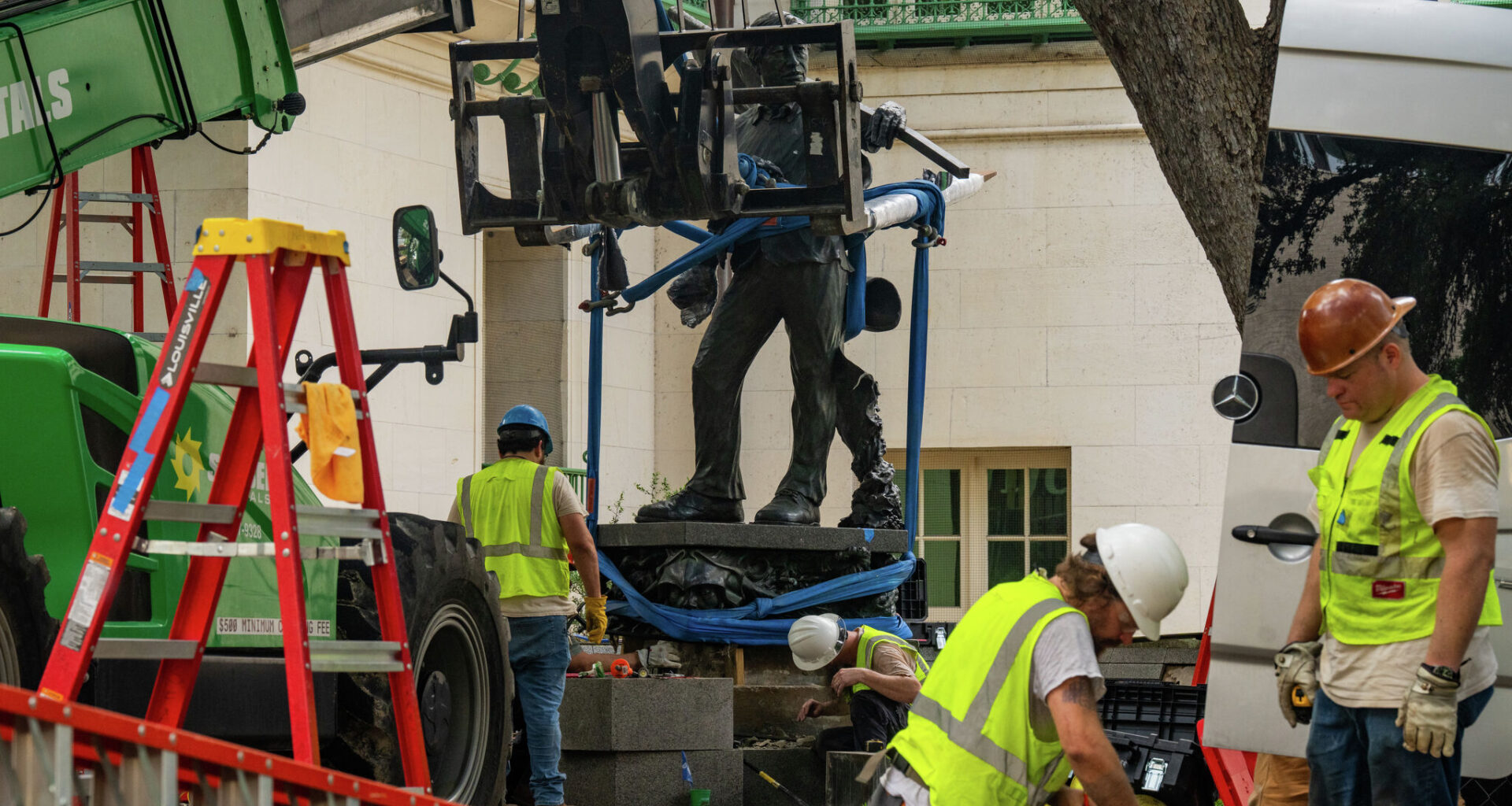
The University of Texas began to take down its Cesar Chavez statue Thursday morning without notifying the campus community, months after The New York Times reported allegations that the famed civil rights leader sexually abused girls.
The explosive report prompted calls to remove tributes to Chavez on government property, including at Austin City Council, which is considering renaming E Cesar Chavez Street. But others warned decision-makers to be cautious over quickly removing his name and discrediting the labor movement he represented.
The statue, located between Battle Hall and the West Mall Office Building, has been on UT’s campus for nearly 20 years. Artist Pablo Eduardo created the statue.
On Thursday, workers in hard hats with an orange Longhorn on them and construction vests with the UT logo oversaw the removal.
UT declined to comment on the fate of the statue after the New York Times report, but City Council Member Zo Qadri, who represents West Campus, told UT’s student newspaper The Daily Texan that he would support removing the statue.
Weeks after violent clashes at a protest in Charlottesville, Virginia where white supremacists protested the removal of a confederate statue, UT officials removed three statues of confederate leaders from the university’s South Mall in 2017. Just before the middle-of-the-night removal, then-president Greg Fenves emailed campus that the statues “run counter to the university’s core values” and would be removed.
Two years before that, UT also removed a statue of Jefferson Davis, who led the Confederacy during the Civil War, after a mass shooting in South Carolina at a Black church. Students had vandalized the statues and long called for their removal.
It was not immediately clear if UT consulted anyone before removing the statue and why the university waited to do so until now. A spokesperson for the university declined to comment on the statue’s removal.
Karma Chávez, the chair of UT’s Mexican American and Latino Studies department, which is being consolidated this summer into a new department, said she does not support statues that celebrate a person over a movement, but hopes UT consulted with community leaders before the removal. She was not consulted nor was the campus community aware before Thursday’s removal, she said.
“I certainly hope that UT at least consulted with Chicano community members about taking down the statue,” Chávez said. “Though I’m still chair of MALS and a scholar of social movements, I was not asked for my opinion.”