
Joe Gauthier has received funding from the National Science Foundation to study a
key element of producing hydrogen gas and improve STEM education.
CREATORS


Though hydrogen is becoming increasingly recognized as a promising energy source,
the U.S. Department of Energy attributes its lagging behind solar and wind to the
chasm in current capabilities for production and storage and what is required for
the future.
Joe Gauthier, an assistant professor of chemical engineering who has studied sustainable and renewable energy technologies since arriving at Texas Tech University in 2021, adds that hydrogen faces an uphill battle. They’re competing against a
fossil fuel industry whose distributors have had over a century to drive down prices
through engineering and economic development.
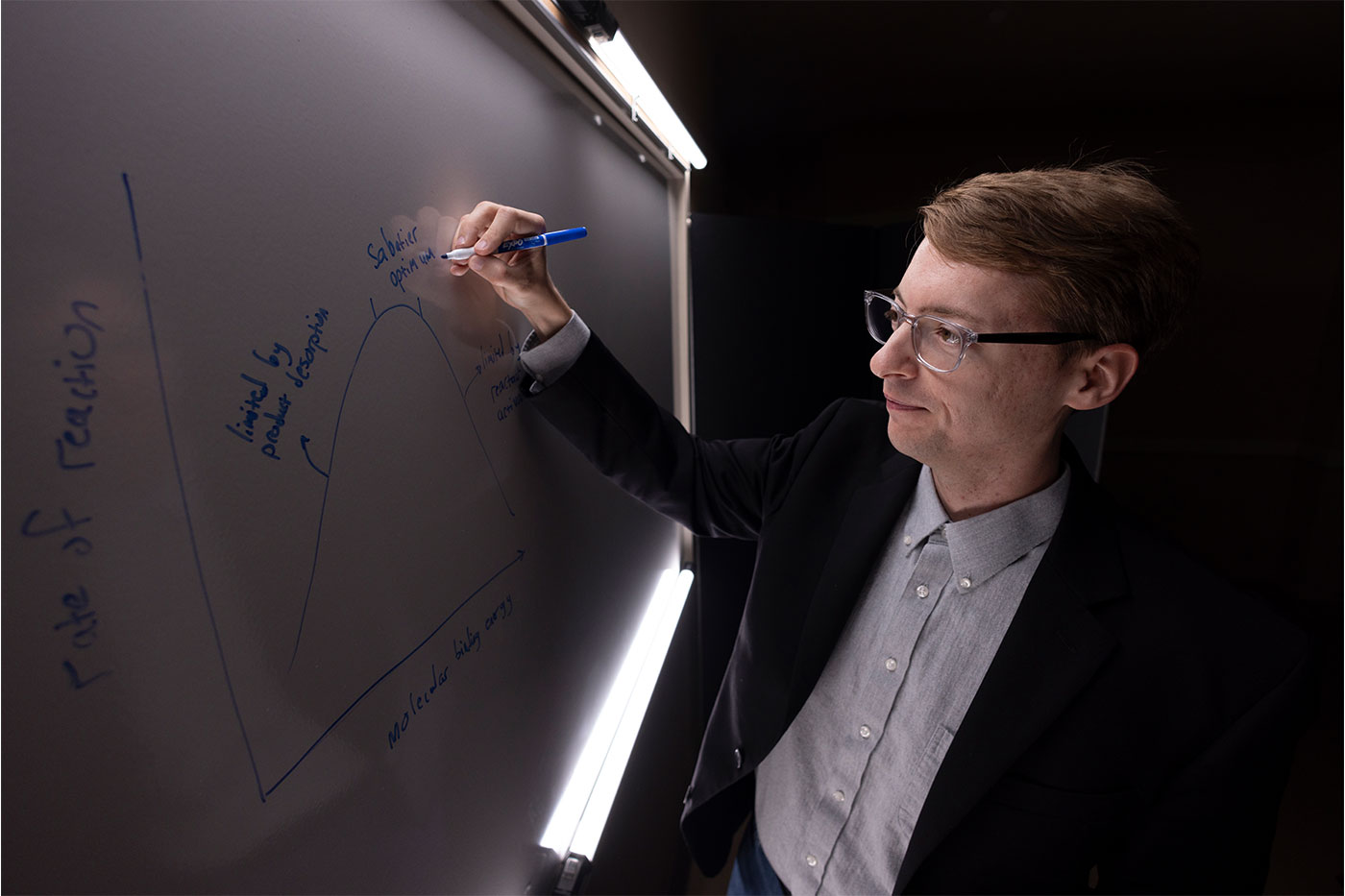 Joe Gauthier
“Unless we really make headway in making electricity much cheaper, it’s going to be
really challenging to make these technologies economically competitive,” he says.
To that end, Gauthier has received a grant totaling over $600,000 from the National
Science Foundation under the Faculty Early Career Development Program (CAREER). CAREER
provides funds supporting five years of research, aiming to help emerging instructors
and professionals in successfully combining research and education.
Gauthier’s project, titled “Engineering Earth-abundant and corrosion-resistant water
oxidation electrocatalysts,” looks toward improving the process of water splitting,
in which hydrogen is produced via electricity.
Motivated by long-term environmental and energy challenges, Gauthier has focused much of his work on sustainable technologies.
Since graduate school, Gauthier has specialized in catalysis, a method in which the
rate of a chemical reaction is increased with the introduction of an added substance,
or catalyst, that doesn’t dissolve during the process.
More specifically, Gauthier leads his own Computational Catalysis Research Lab, using computer simulations and numerous scientific processes to understand chemical
reactions and design improved materials for applications as catalysts.
A key method within the lab is electrocatalysis, which focuses on electrochemistry
and involves reactions on electrode surfaces. Electrodes are electric conductors that
carry currents into non-metallic parts of circuits.
In water splitting, the negative electrode (anode) receives the current and releases
hydrogen protons and electrons, producing oxygen gas in the process (water oxidation).
At the positive electrode (cathode), the protons and electrons recombine to make hydrogen
gas.
The growing interest in water splitting as a means of energy production has grown
significantly in parts of Europe and other regions investing heavily in alternative
energy technologies.
But what will galvanize the movement toward this approach on a larger scale is making
it economically viable, beyond government subsidization. That was the mindset behind
Gauthier’s proposals regarding the project.
There are several catalysts for producing hydrogen that are abundant in the Earth
and last a long time. The same cannot be said for the other, laborious side of the
reaction, which primarily uses iridium and other platinum-group metals.
“On the water oxidation side, the materials dissolve over time through mechanisms
that are really unclear,” Gauthier says. “That leads to increased costs, because even
the most expensive materials we can use still dissolve over time.”
For Gauthier, who always considers the economic aspects of sustainability, this project
presents him and his team with the opportunity to preserve energy and money for more
than water splitting. Other reactions, such as reducing nitrate to ammonia or carbon
dioxide to valuable fuels and chemicals, all of which rely on water oxidation as a
source of protons and electrons, could also stand to benefit.
Along with advancing water oxidation, Gauthier looks forward to progressing electric
catalysis to having the high-quality, benchmarked data other areas of catalysis research
rely on.
In thermally driven heterogeneous catalysis, where catalysts exist in a different
phase than the substances consumed during or produced after a chemical reaction, density
functional theory is used to simplify the calculations of a many-body equation.
The varying flavors, as he refers to them, of computer simulations used in his field
come with degrees of accuracy and cost. Gauthier describes the issue in electrocatalysis
as “the blind leading the blind,” when the results of a simulation cannot be predicted
based on an experiment format.
“A good chunk of this proposal, in addition to water and oxygen, is related to building
out those foundations so we can be more confident in what the simulations give us,”
he says.
In the same vein, the level of complexity still associated with electric catalysis
will pose challenges for the project.
“It’s possible that you put three Band-Aids on a wound and maybe it’s just not enough,”
Gauthier says. “Maybe there’s 10 other things that also need to be solved before we
can really be confident in the solutions. But every Band-Aid that you put on is a
step in the right direction.”
A factor that attracted him to Texas Tech was the school’s High Performance Computing Center, a major resource not available at many other institutions that provides consistent
access to both faculty and their student researchers without marginal cost.
Gauthier also highlights the potential for sustainable energy that exists in West
Texas and strong university leadership, but he has developed into an advocate and
an exemplary educator in his own right. He demonstrated this growth in his CAREER
proposal, including two planned education objectives intended to assist both undergraduate
and middle school students.
The first is a project-based elective course that will prepare students for graduate
studies in computational materials science by introducing them to topics in electrochemistry,
physics and more that aren’t elaborated on in much detail in undergraduate majors.
For the latter, Gauthier will collaborate with the STEM Center for Outreach, Research & Education and the Teaching, Learning, & Professional Development Center for outreach to middle school students across the Lubbock Independent School District.
These events will feature activity-based projects that expose students to alternative
energy sources, such as hydrogen fuel cells, to attract more students to careers in
science, technology, engineering and math.
“I want to make sure the path into computational research feels welcoming and achievable,
especially for folks who might not have a centralized compute facility down the street,”
Gauthier says. “The students we reach today are the ones who will push this science
forward tomorrow.”