
A gaggle of press armed with cameras and microphones formed outside Smokey Joe’s Bar-B-Que, in South Dallas, this week. Senate candidate James Talarico had invited us there to announce his plans for lowering beef prices to provide relief to Texas barbecue joints. Ending the war in Iran, suspending the federal diesel tax, and fully staffing the USDA were on his list of priorities, but his real reason for being there was the photo op inside.
Countering accusations of being vegan from his opponent Ken Paxton, who nicknamed him “Talafreako,” Talarico sat beneath a BBQ Freak sign with Smokey Joe’s owner, Kris Manning, to share an overflowing tray of smoked meat. He cleaned the meat off a spare rib with his teeth and ate brisket slices with his hands. Smoked sausage, brisket boudin, and Texas Twinkies beckoned while Talarico savored a South Dallas specialty called brakes. Sometimes spelled “breaks,” they are usually the end pieces of meat sliced on the chopping block, but at Smokey Joe’s, Manning smokes the raw trimmings from his rib racks and seasons them liberally with lemon pepper. They’re delicious.
Along with the omnivorous overtones, the message from Talarico was that the high price of beef is making the barbecue business unsustainable. (Paxton has his own plans to combat the issue.) His proposed solutions highlighted that everything is too damn expensive. When barbecue joints close, it’s the beef prices—or more specifically, the brisket prices—that are blamed, but grocery, fuel, and utility bills at home are whittling away at the profitability of every restaurant. The National Restaurant Association has collected data on customer traffic and found that operators reported a net decline during fourteen of the last fifteen months. Diners are staying at home more often.
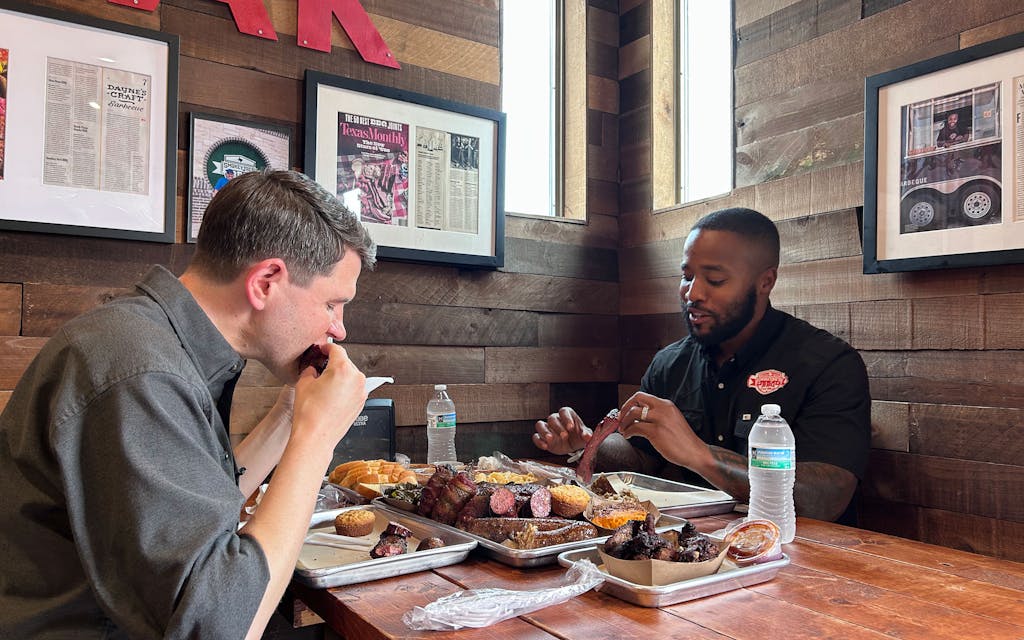 James Talarico enjoying barbecue with Smokey Joe’s owner, Kris Manning.Photograph by Daniel Vaughn
Rising beef prices and the threat they represent for struggling barbecue joints has been covered ad nauseam by national media of late. I talked with The Washington Post for a Memorial Day story that built on my reporting from January about some beloved Texas barbecue joints that have called it quits. Other outlets like The Independent, the New York Post, and Men’s Journal echoed that reporting, and the Today show visited Iron Works Barbecue, in Austin, over the weekend to tell a similar story. Evidently, barbecue stories sell when barbecue isn’t selling so well.
Brisket prices are a culprit, for sure, due to ridiculously high demand. If all the Texas-style barbecue joints opening across the country haven’t affected supply enough, major chains are getting in on the action too: Panda Express just unveiled its new Cantonese BBQ Brisket entrée. And beef prices are elevated across the board thanks to low cattle-herd counts and the Big Four meat companies—Cargill, JBS Foods, National Beef Packing Company, and Tyson Foods—controlling about 85 percent of the country’s beef supply. To add to the concern, this week brought news of the first detection of New World screwworm in the U.S. beef supply since a 1976 outbreak. There are a whole lot of market forces restaurant owners can’t control, but they can put a dent in demand. But what is Texas barbecue without brisket?
The hysteria over this single cut has clouded our understanding of Texas-barbecue history. It’s a cuisine born of necessity that has been relentlessly adaptable. Meat market–style barbecue was created by cooking cuts from whole lambs, goats, and cattle that didn’t sell in the raw-meat case. Barbecue stands in the big cities of the early twentieth century were built on the beef naval plate, which was chopped and served almost exclusively as sandwiches. When pitmaster Steve Kapchinskie started cooking as a young man at the century-old Martin’s Place, in Bryan, smoked T-bone steak sold just as well as brisket, and he remembers when the family began offering pork ribs back in the eighties. Texas barbecue’s menu is not set in stone.
When the norm for beef delivery switched from half carcasses to boxes of individual cuts in the late sixties, a few cuts became popular in barbecue because of their value. Joints like Clem Mikesk’s, in Temple, went with sirloin; Kreuz Market, in Lockhart, relied on the shoulder clod; Black’s BBQ, also in Lockhart (across the square and a couple blocks down from Kreuz), chose brisket as its default—all of them made their choices because of cost. Customer demand had all of them serving brisket eventually, but it was still a very inexpensive cut of beef until recently.
A few Texas pitmasters have looked to the past when expanding their offerings. I just had a platter of shoulder clod, brisket, and tri-tip at Moreno Barbecue, in Austin. Casey Lee’s BBQ, in Flatonia, just announced it would be serving brisket again this weekend after going without it in favor of tri-tip and beef cheeks for months. A couple friends and I shared a platter of beef cheeks, flat iron, brisket, and tri-tip at LeRoy and Lewis Barbecue, in Austin. “This might be the best bite of barbecue I’ve ever had,” one of them said, holding up a half-eaten slice of smoked tri-tip.
In Austin, smoked-beef sweetbreads were a standout in my recent review of Churchrow Tejas BBQ, and Space Kat Barbecue abandons brisket entirely for smoked tri-tip. The meaty, beef back ribs were a treat at Burnt Bean Co., in Seguin, and its new beef-cheek pastrami is one of the best bites of barbecue I’ve ever eaten. Every one of the meals mentioned above, I consumed within the last six weeks. Great beef barbecue in Texas doesn’t have to be brisket.
Texas barbecue is defined more by cooking style than by a single cut of meat. But we are the beef state, and that separates our barbecue from the pork tradition of the rest of the South. What I loved about that massive tray in front of Talarico at Smokey Joe’s is that it showed off the variety that is emblematic of Texas barbecue. It’s up to pitmasters to find a cut they can highlight to differentiate themselves. That’s what it will take for them to survive and thrive, along with all of us getting out there and ordering a plate from our local barbecue joint.
Read Next