
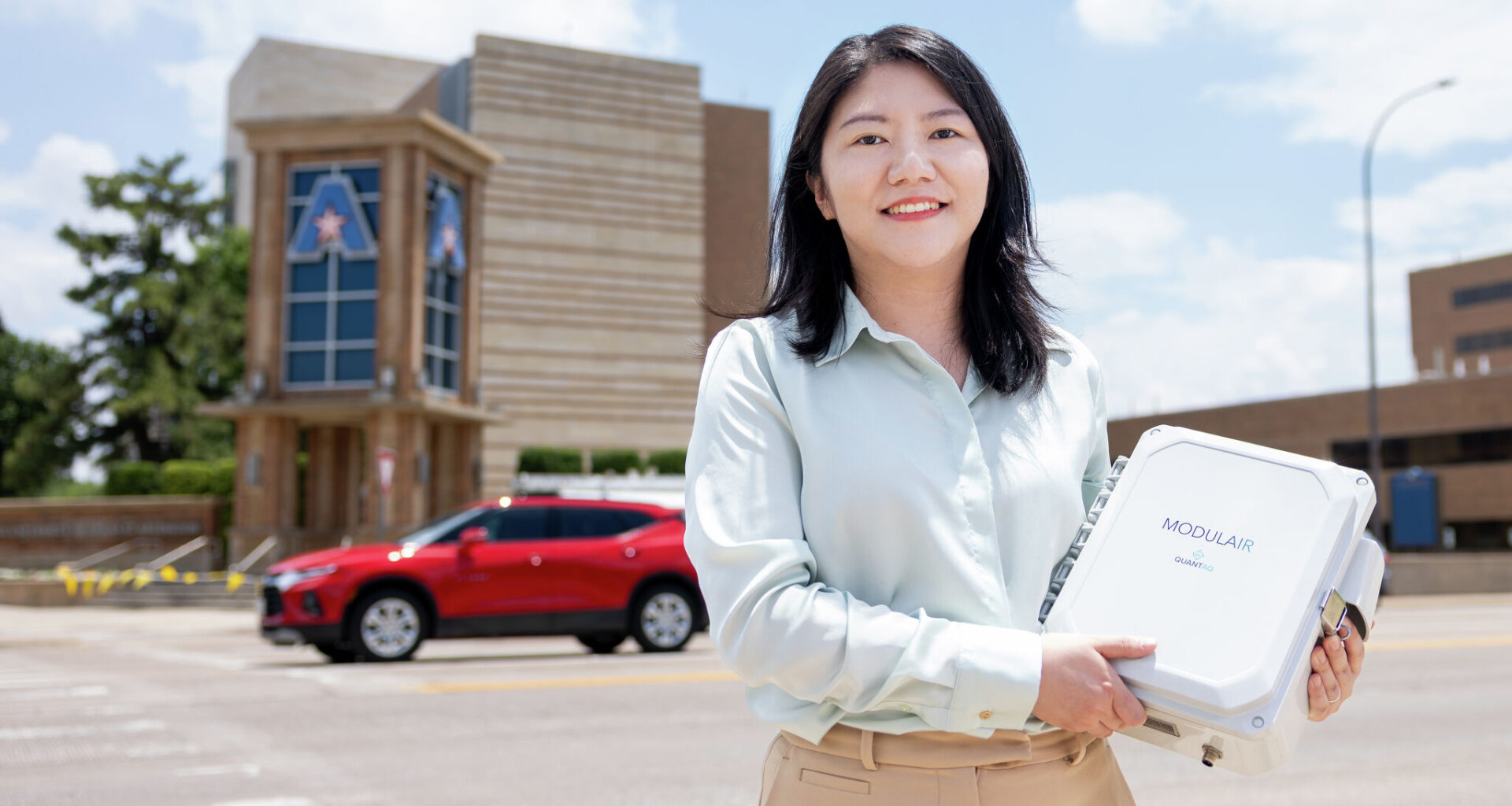
With Dallas expecting millions of visitors for the World Cup, researchers are measuring how an expected increase of pollutants will affect local air quality.
Researchers at the University of Texas at Arlington plan on using the World Cup matches in Dallas as a case study to better understand how large-scale events temporarily disrupt local environment conditions.
This research is being done in collaboration with the North Central Texas Council of Governments and the city of Arlington.
Environmental sensors have been deployed around AT&T Stadium, DFW International Airport, and UTA to continuously monitor air quality and pollution levels before, during and after the World Cup.
These boxlike sensors are solar-powered and collect a variety of environmental data, including temperature, humidity, particulate matter, ozone and wind. Data will also be collected from NASA satellites, and there are plans to add an additional sensor in Plano.
The Dallas-Fort Worth region is the fourth-largest metropolitan area in the United States. However, it has been covered far less extensively in air quality studies when compared to metropolitan areas of similar size, said Yunyao Li, UTA assistant professor of earth and environmental sciences and director of the Atmospheric Intelligence and Modeling Lab.
Li, who is leading the study, said it’s especially important to research D-FW because it’s a developing region, and many people have been moving here in recent years.
“We want to see how this development — how the city grows — affects the air quality,” she said. “We want to make sure we provide clean air and a healthy environment to all the people who live here.”
Volunteers are also being recruited to set up PurpleAir Flex air-quality sensors in their homes. Participation is free and the sensors are provided by the research team at no cost.
These sensors will increase the study’s area of coverage and measure weather conditions like temperature and humidity, volatile organic compounds and PM2.5, a kind of small particulate matter.
The results of the research can aid in the development of future air quality modeling projects. These projects, Li said, can help calculate the air pollution exposure experienced by different communities and guide future urban planning.
Niamh Ordner is a science reporting fellow at The Dallas Morning News. Her fellowship is supported by the University of Texas at Dallas. The News makes all editorial decisions.