
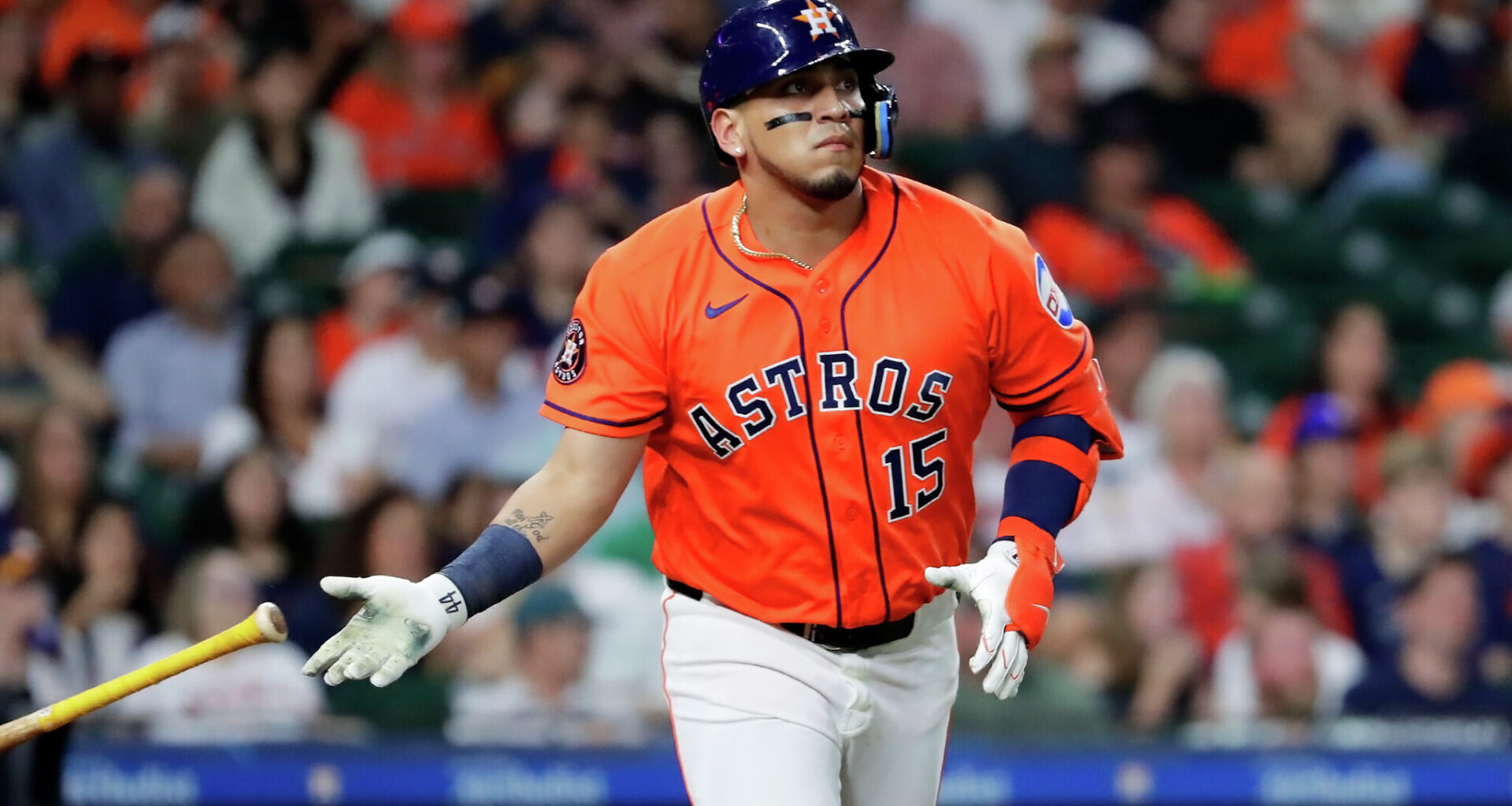
Houston Astros designated hitter Isaac Paredes flips his bat as he watches his hit against the Athletics during the third inning of a baseball game Friday, June 5, 2026, in Houston.
Michael Wyke/AP Photo/Michael Wyke
Isaac Paredes’ approach is predicated on patience, but on occasion he will pounce. Paredes had swung at the first pitch in 16.7% of his plate appearances this season before Friday. Just three qualified hitters had a lower rate than the Houston Astros’ ultra-selective third baseman.
For his first at-bat Friday night, Paredes came up with two runners on base in a scoreless game. A’s right-hander Jack Perkins started him with a 96 mph sinker in the zone. Paredes pounced. The result offered a reminder of something the Astros observed in Paredes’ first season with them.
“When he gets hot,” manager Joe Espada said, “he can really carry our team.”
Article continues below this ad
When healthy last season, Paredes was arguably the second-most productive hitter for an injury-wracked Houston lineup. He ranked second on the club in OPS-plus behind Jeremy Peña, who enjoyed a breakout, and tied for third in home runs despite injuries limiting him to 102 games.
Compared to that, Paredes’ first half this season has been relatively quiet. Yordan Alvarez’s rampage and Christian Walker’s resurgence have somewhat masked it. But neither diminishes Paredes’ significance to an offense for which Carlos Correa’s ankle injury makes him again the everyday third baseman.
“I started really slow, I recognize that,” Paredes said Friday night, through an interpreter. “But I think that it’s a long season and at any point it can turn around and I can help the team in the way that I know I can help them.”
Perhaps the last week-plus is proof. Paredes’ first-inning home run Friday was his third in as many games and his fourth in an eight-game stretch in which he has driven in 12 runs. He drove in four Friday night as the Astros began a series against the A’s with a 5-1 win at Daikin Park.
Article continues below this ad
Though a tiny sample, Paredes’ last eight games have increased his OPS from .694 to .748. That remains below the .809 mark he posted last season but must provide some encouragement to the Astros just as their offense, which slumped in May, appears close to whole again.
With Jose Altuve just reinstated from the injured list after missing 17 games to an oblique strain, Friday marked just the sixth time in 65 games this season that Peña, Alvarez, Altuve, Walker and Paredes have all started in Houston’s lineup — its core for the foreseeable future.
Paredes slotted cleanup for a fourth consecutive game, ahead of Altuve, who is still regaining his timing after his layoff. Peña has a .403 on-base percentage since returning from a hamstring and Alvarez a .429 OBP this season. Batting behind them portends traffic and requires those spots to produce.
Walker has taken the Astros’ most plate appearances with men on base and entered Friday with a .771 OPS in those situations. Paredes has taken the third-most and owned a .674 OPS in them before Friday, whereas league OPS with runners on base was .733.
Paredes had a .765 OPS in such situations last season, when he was one of the most discerning hitters for an aggressive Houston lineup. While he has continued to see a high rate of pitches this season, his chase rate has also climbed — from 21.4% last year to 28% entering Friday, per Baseball Savant.
Article continues below this ad
Last weekend, Espada noted there has been “a little bit of up-and-down on consistency of the quality of his swings, just based on the … pitches that he chooses to swing at.” According to Baseball Savant, much of the increase in Paredes’ chase rate has occurred on pitches off the plate away.
Paredes’ power is virtually all to his pull-side, which is devalued when he expands off the outer part of the plate. He pulled in-zone pitches into the Crawford Boxes on Wednesday and Thursday against the Pirates — the latter his 100th major-league home run — and sent Perkins’ sinker into the first archway in left-center field at Daikin Park in the first inning Friday.
“I think he’s just letting the ball get closer to him,” Espada said. “That home run was more left-center — that means he’s kind of working more towards the middle of the field. The sac fly to right field, those are really good signs of him just kind of staying within himself and not trying to do too much.”
That a full-strength lineup can ease the burden on all its hitters is Houston’s hope. The Astros remain seven games under .500 yet face a favorable upcoming stretch, with seven of their next eight series — including the current one against the A’s — against teams that were also .500 through Friday’s games.
Article continues below this ad
More impact from an offense that scored the majors’ fifth-fewest runs in May seems imperative. That will not fall to Paredes alone, but his recent stretch reinforces the part he can play in a lineup that has regained key pieces and must perform with them.
“You expect more from a deep lineup like that,” Espada said. “And they don’t feel like they have to do it all.”