
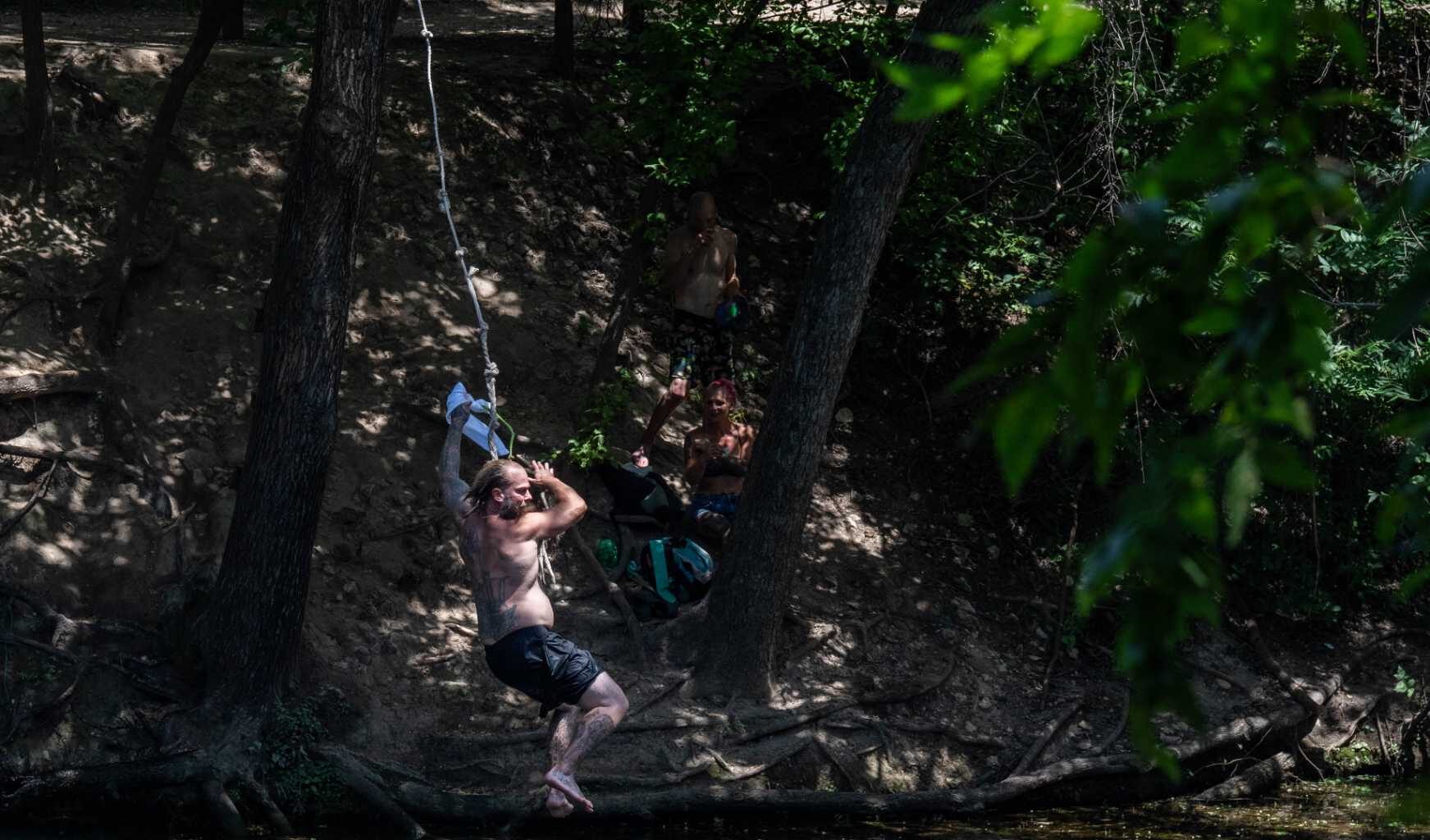
A man jumps off a rope swing into Barton Creek near Zilker Park last summer. Summer heat illnesses are beginning to be seen in local emergency rooms.
Mikala Compton/Austin American-Statesman
We have hit summer illness and injury season.

Texas Children’s Hospital in Austin has been seeing three common illnesses in its emergency room:
Article continues below this ad
Gastrointestinal illnesses including acute gastroenteritis. Stomach bugs come with nausea, diarrhea and sometimes vomiting. The key is keeping everyone hydrated. Get medical help for dehydration or if symptoms continue.
Rhinovirus looks and feels like a common cold with cough and fever. Test for flu or COVID-19 to rule those out, then treat the symptoms.
Enterovirus is the viral infection that causes hand, foot and mouth disease in young children. It’s highly contagious and presents as a fever with sores around the mouth and a rash around the hands or feet. See a doctor if the child has a fever that lasts more than three days or becomes dehydrated.
What about COVID, flu and RSV?
In Central Texas, only 0.1% of ER visits are for COVID, flu or RSV, according to the Centers for Disease Control and Prevention. Texas ranks very low for cases and wastewater samples for these respiratory viruses. St. David’s emergency room doctor Ryan McCorkle has been seeing more chest pain and stomach pain rather than respiratory viruses.
Flu and RSV probably won’t return until fall or early winter, but COVID-19 could surprise with a summer surge, which has been the pattern since 2020. The CDC marks Texas as one of only two states likely to have growing cases for COVID-19. Connecticut is the other. However, we missed a winter surge. We also might miss a summer surge.
Article continues below this ad
Even if you think it’s not respiratory season, stay home and isolate if you don’t feel well.
The heat is on
With temperatures only in the 80s to low 90s, McCorkle has started seeing heat stroke and heat exhaustion. On Sunday, he had a couple of cases and said so far it has been older adults and people who are unhoused. Even in those temperatures, people walking around on concrete can overheat. Certain medications also can increase the risk of heat illness.
Article continues below this ad
Watch for these warning signs:
Heat cramps: Sweating; muscle aches; prickly heat rash, especially in areas where clothing meets the skin; and dizziness. Move the person to a cooler area, hydrate, remove excess clothing and put cold compresses (a wet towel or shirt, or an ice pack) on the hands, feet, armpits, neck and forehead. Call a doctor to get an assessment.
Heat exhaustion: Flushed skin, sweating even more heavily, cold or clammy skin, nausea, not wanting to eat and a shallow heartbeat. Move the person to a cooler area, hydrate with water or an electrolyte drink, remove excess clothing and use cold compresses or spray them with water. Call a doctor to see if you need to go to the emergency room or a doctor’s office.
Heat stroke: No sweating, fast heartbeat, fainting or feeling faint, breathing quickly, confusion or delirium, loss of consciousness and a high temperature. This is a medical emergency. If you can quickly drive the person to the emergency room, great. If not, call an ambulance. While driving or waiting for the ambulance, do all the same interventions: hydration, a cooler area, less clothing and cold compresses.
Article continues below this ad
Texas Children’s reminds people to always check the back of the car for children or pets before getting out. Last year in Texas, eight kids, including two in San Antonio, died from heat stroke in cars.
West Nile virus can be transmitted by mosquitoes in the genus Culex. So far, Central Texas has not had cases, but those are expected to come as summer continues.
AMERICAN-STATESMAN FILE
Mosquitoes can bring more than itching
With the days of good rain in May, the mosquitoes got busy mating. Texas Children’s has been seeing children with what it calls “skeeter syndrome.” This is a localized allergy to mosquito saliva from a bite. Instead of a typical bump, people will get a rapidly spreading swelling, redness, heat and pain. Families often think that their child has a skin infection. You can treat a reaction to a mosquito bite or any other insect bite with antihistamines.
Article continues below this ad
Texas has started to see more serious mosquito-borne illnesses. This year, there have been three cases of dengue fever in Texas — one in Tarrant, one in Bexar and one in Hidalgo County. Texas also had a case of chikungunya in Collin County.
So far, Harris County is the only Texas county with a positive human case of West Nile virus. The state has identified 67 mosquito pools with West Nile, but none have been in Central Texas.
To avoid becoming infected, do these things:
Use insect repellent with DEET.
Wear loose-fitting, long-sleeved shirts and pants.
Use air conditioning and window screens to prevent mosquito bites indoors.
Dump out containers of water near your home to eliminate breeding grounds.
Avoid going outside at dusk and dawn when mosquitoes are most active.
Article continues below this ad
Just when you thought the mosquitos were bad, Texas has its first case of new world screwworm in a calf in Zavala County. New world screwworm is a parasite carried by a fly whose larvae burrow into the skin. It mostly infects animals, but can infect people.
Allergies are shifting
Summer grasses take over the allergies this month. We’ve been lucky so far with grass allergens less than normal for this time of year. The spring trees, including oak, should be waning, but at the end of May, Central Texas still had some relatively high oak pollen days, according to AustinPollen.com counts.
With the recent rains, Austin has experienced moderate mold counts, according to AustinPollen.com.
Article continues below this ad
E-bike injuries have been showing up in emergency rooms, including concussions and broken bones. Make sure to wear a helmet with bike, scooter or skateboard.
Ryan Maxin / Austin American-Statesman
Avoidable accidents
Texas Children’s is seeing a number of kids coming in with concussions and broken legs and arms from riding electric bikes and electric scooters. Summer is often a time for increases in these kinds of injuries, not just from e-bikes and e-scooters, but from regular bikes, trampolines, playground equipment and skateboards.
Children and adults alike should be using helmets when riding anything with wheels. Supervise playground and trampoline use and make sure kids are playing on age-appropriate structures.
Article continues below this ad
Car wrecks also increase as more people are on driving vacations or driving to unfamiliar spots. Avoid driving long distances at night or driving after using any substance. Make sure everyone is using seat belts and is in the right car seat positioned correctly in the car.
McCorkle is expecting to also see more motorcycle accidents as people take to riding on vacation and weekends.
Summer is known as trauma season. It is when shootings, stabbings and other assaults increase, McCorkle said. “Heat makes people angry,” he said.
Article continues below this ad
People cool off in Barking Springs just downstream of Barton Springs Pool. If you head to the pool, make sure to assign a person to watch all the swimmers in your group.
Jay Janner/American-Statesman
Watch for water injuries
In Texas, 25 kids have drowned this year, according to the Texas Department of Family and Protective Services. Many were in pools, but also in creeks, beaches, ponds, bathtubs and lakes. Have a designated sober person watching swimmers at all times and make sure there are barriers to prevent kids from getting into the water without an adult knowing.