
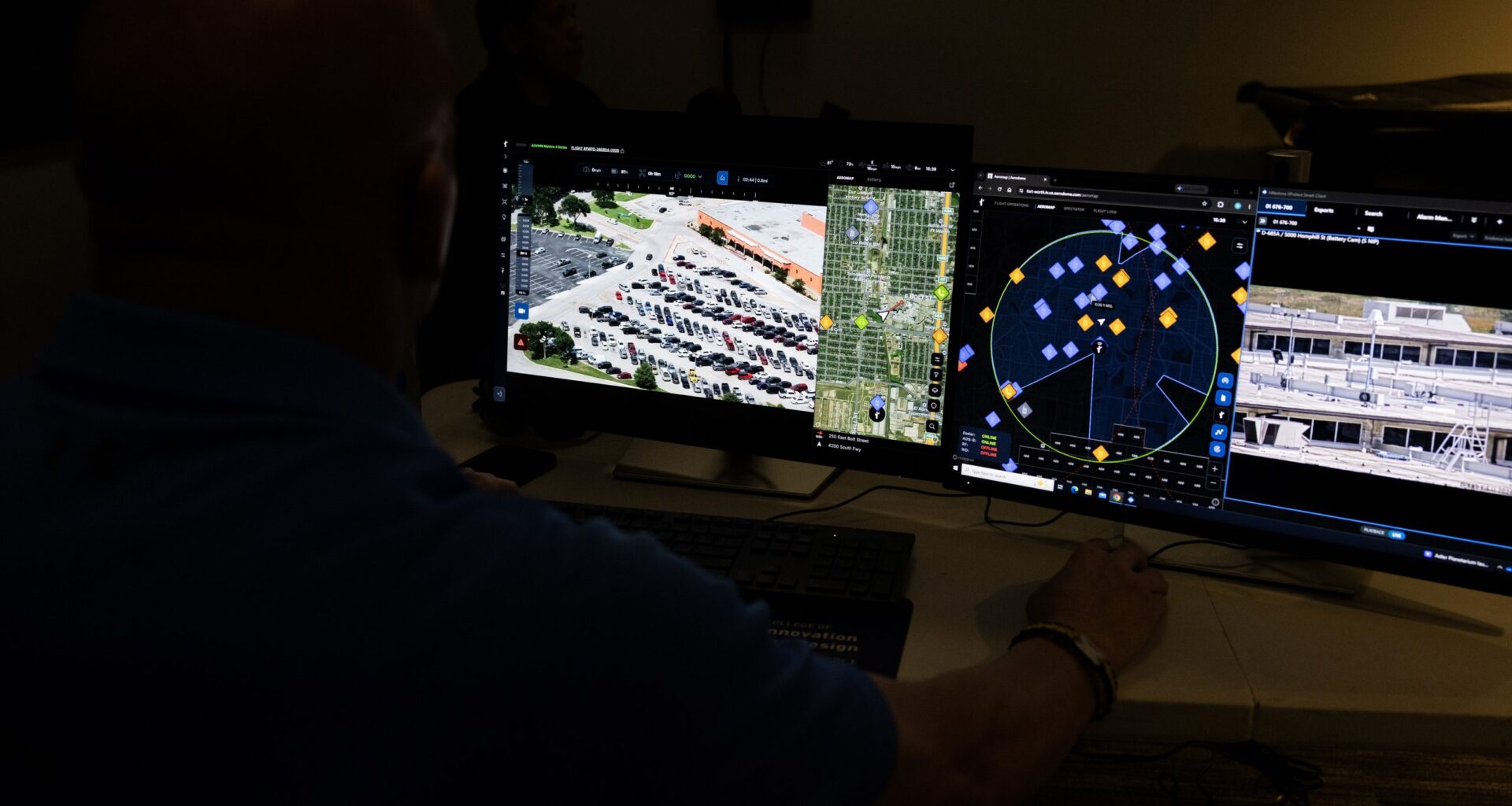
Drones used to help manage crime now provide Fort Worth police a bird’s-eye view of the action, officials announced Thursday.
The initiative sees the city partnering with Flock Safety — an $8.4 billion surveillance behemoth known for its automatic license plate readers — for a one-year, no-cost pilot of Flock’s Drone as First Responder program.
Using Flock drones and cameras, police will fly “eyes in the sky” to crime scenes, then use the live aerial footage to inform officers on the ground, Police Chief Eddie García said at a Thursday news conference.
“This is not about replacing officers, and it never will be,” García said. “This is about supporting them with better information before they arrive on scene.”
García said that, long term, the city hopes to have drones for all six of Fort Worth’s patrol divisions. The intel that drones provide can help search for missing persons, investigate major vehicle crashes and evaluate whether a suspect is armed, officials said.
 Chief Eddie García speaks during a Fort Worth Police Department press conference for the new Drone as First Responder program on June 4, 2026. (Maria Crane | Fort Worth Report/CatchLight Local/Report for America)
Flock has had a growing presence in Fort Worth for six years. Police have increased use of the company’s licence plate readers, and homeowners associations have planted Flock cameras into their neighborhoods to discourage crime.
The company leases its equipment to partnering cities, meaning Fort Worth does not own the cameras or the drones, said Paris Lewbel, Flock’s public relations manager.
“Just as important as safety is trust; we know that any conversation around public safety technology must include privacy, accountability and responsible use,” Lewbel said. “Those principles are core to how these programs are built and operated by Flock.”
Lewbel said the city owns the footage captured by drones. Asked whether Flock could access the footage as well, he said only in “support circumstances.”
The company’s rapid expansion into police departments across the country has been neither low-profile nor without controversy.
Critics like the American Civil Liberties Union have decried the cloud-based nature of the surveillance systems, arguing that the cameras can be weaponized to track individuals and assist in deportations.
In response to the controversies, several cities have disbanded agreements with Flock.
Lewbel argued that the drone program is no cause for concern for law-abiding residents, as Fort Worth police have total control over how the footage is used, and Flock’s license plate readers have withstood legal challenges across the country.
He noted that, while the drone records its entire flight in case of emergencies, its camera will remain pointed at the horizon line until the drone arrives at a crime scene, at which point it points down.
At a Thursday news conference, police officials demonstrated what a drone flight looks like by projecting live footage onto the wall. During the demo, the drone footage captured a person washing their car in a parking lot and individuals crossing streets. During the drone’s approximately 15-minute flight, its battery drained by about 40%.
Use of the drones on any given day would be subject to weather conditions and wind speeds, said Erik Lavigne, sergeant of Fort Worth’s Real Time Crime Center.
Lavigne said police are committed to being transparent about how they are using drones. The department will soon release a website that tracks the time, reason and flight path for each drone.
“We’re staying above the board with our flights,” he said.
Lewbel said he could not immediately provide a cost estimate for Fort Worth if the drone program were to be rolled out on a larger scale.
Flock has offered the program across the country for about a year and a half, and Fort Worth started using the drones about five weeks ago. The drones have since been used in several situations to determine whether a suspect was armed or appeared safe for officers to approach, Lavigne said.
García, who was sworn in as chief last year, said he’s often heard privacy concerns raised around Flock. But ultimately, he said, “this technology saves lives.”
“Departments would be back (to) when I started in 1992 … without this type of technology,” García said.
Drew Shaw is a government accountability reporter for the Fort Worth Report. Contact him at drew.shaw@fortworthreport.org or @shawlings601.
At the Fort Worth Report, news decisions are made independently of our board members and financial supporters. Read more about our editorial independence policy here.
This <a target=”_blank” href=”https://fortworthreport.org/2026/06/06/fort-worth-police-crime-fighting-drone-program-takes-off-in-partnership-with-flock-safety/”>article</a> first appeared on <a target=”_blank” href=”https://fortworthreport.org”>Fort Worth Report</a> and is republished here under a <a target=”_blank” href=”https://creativecommons.org/licenses/by-nd/4.0/”>Creative Commons Attribution-NoDerivatives 4.0 International License</a>.<img src=”https://i0.wp.com/fortworthreport.org/wp-content/uploads/2021/04/cropped-favicon.png?resize=150%2C150&ssl=1″ style=”width:1em;height:1em;margin-left:10px;”>
<img id=”republication-tracker-tool-source” src=”https://fortworthreport.org/?republication-pixel=true&post=592223&ga4=2820184429″ style=”width:1px;height:1px;”><script> PARSELY = { autotrack: false, onload: function() { PARSELY.beacon.trackPageView({ url: “https://fortworthreport.org/2026/06/06/fort-worth-police-crime-fighting-drone-program-takes-off-in-partnership-with-flock-safety/”, urlref: window.location.href }); } } </script> <script id=”parsely-cfg” src=”//cdn.parsely.com/keys/fortworthreport.org/p.js”></script>