
Doxa diving watches conjure images of subaquatic history. SEALAB Aquanauts pioneering saturation diving techniques in 1969; Stan Waterman aboard the Terrier searching for the Great White shark; and the crew of Jacques Cousteau’s Calypso galavanting around the world’s oceans. Thus, when I found myself in Fort Worth, Texas, to check out the new Doxa SUB 200 II, it seemed an unlikely pairing.
Fort Worth is, at first glance, an unlikely watch hub. Founded as a U.S. Army outpost in 1849, its population nearly dwindled to double digits following the Civil War; yet the historic center of the Texas Longhorn Cattle trade has since grown into one of the fastest-growing cities in the country. With that has come a thriving watch scene, in no small part due to independent retailers like The Watch Preserve. Primarily a vintage specialist, the shop also retails contemporary enthusiast brands like Doxa — the brand’s only retailer in Texas — and Nivada Grenchen.

As noted in Field of Dreams, “If you build it, they will come.” And they did. Nearly 400 enthusiasts turned out for The Watch Preserve’s Spring Cars, Coffee, and Chronographs show, offering enthusiasts and newcomers alike a chance to go hands-on with vintage timepieces and new models from sponsors Doxa, Bulova, Nivada Grenchen, and Christopher Ward. Nik Libby, founder of The Watch Preserve, noted that while the Dallas/Fort Worth area is outside the more traditional watch hubs of New York and California, it’s among the most rapidly growing metros in the country and has a ravenous appetite for watches to show for it.

With great cars often come great watches. Combining the two made it a certainty. From vintage-inspired Timexes to holy grail Daytonas, every corner of watch enthusiasm was represented. The worlds merged into one with the official debut of the Bulova Racing Team support vehicle, a truly lovely early 1960s Ford Econoline prepared by the Satterfield Group based on original Bulova vehicles from the period when the brand was actively involved with Formula Atlantic racing.
Alongside my camera, I had Doxa’s latest release, the SUB 200 II, for the event. Diving watches are the core of the brand’s contemporary DNA. Watches like the SUB 300 and 300T, veritable icons introduced in 1967 and 1968 respectively, cast long shadows, but the 200 is perhaps the most misunderstood of the brand’s model families. For one, Doxa nerds (guilty as charged) will note that the SUB 200 is better described as a pre-SUB. The original 1964 watch that the modern SUB 200 collection is based on saw the brand examine whether it, too, could have a piece of the diving watch business that was prolific in the mid-1960s. The rest is history.

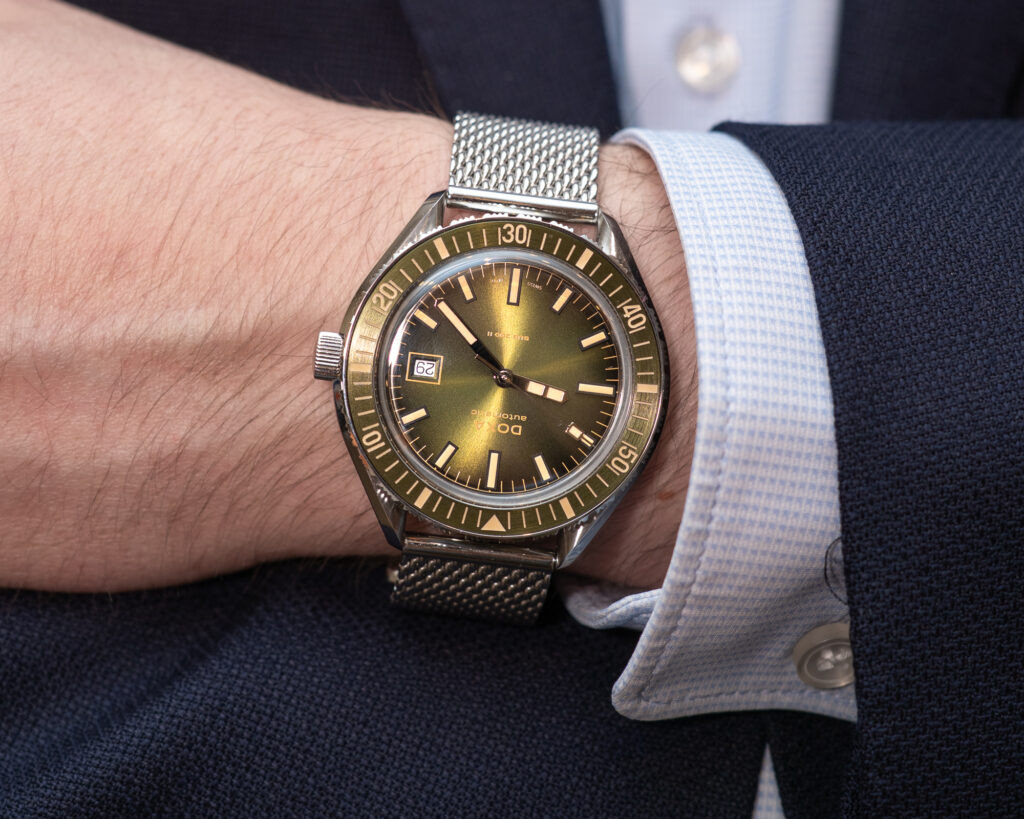
The SUB 200 II picks up where the original SUB 200 left off. The case has been upsized from 42mm to 44mm, though it remains surprisingly wearable on my 6.5-inch wrist thanks to the 48mm lug-to-lug length and reasonable 12.8mm thickness. The overall presentation feels like a 42mm case as a result. The package is capped off with a unidirectional, fully graduated timing bezel and 200m of water resistance, including a screw-down crown.
The dials mark the biggest change. Gone is the signature Doxa orange Professional colorway, with the SUB 200 II instead featuring fumé Sea Emerald Green, Caribbean Blue, Sharkhunter and Vintage Sharkhunter Black, and Redcoral dials. Each features a matching bezel insert, tan lume, and a date window at 3 o’clock. The SUB 200 II is paired with a stainless steel mesh bracelet or a matching rubber strap. Both the Caribbean and Sea Emerald variants I had hands-on time with were mounted on prototype mesh bracelets; the final production version will see the mesh and clasp both half as thick as pictured here. Also available is the Redcoral, pairing a cherry fumé dial with a distinct black DLC-coated case and optional matching DLC-coated mesh bracelet.
The mesh is a welcome change from the SUB 200’s beads-of-rice bracelet. While I am normally a bracelet fan, that watch’s lack of taper and thick clasp subtracted from its wearability. The new mesh is easily sized and, in its final form, will be appropriately thin to match the watch’s vintage inspiration. It still lacks taper, though that feels like less of a failing here. The rubber, by contrast, is supple and pliable in the Tropic style and features a clasp branded with the Jenny fish. Alternative strap choices are also opened up from the previous SUB 200, thanks to the latest iteration’s upsized 20mm lug width.
Movements are often the least interesting portion of a dive watch, and the SUB 200 II is no exception. The Doxa SUB 200 II is powered by the Swiss-made Sellita SW200-1. Featuring automatic winding, an adequate if uninspiring 38-hour power reserve, hacking, and a 4Hz beat rate, it is a workhorse movement appropriate for a tool watch. It also feels right in line with the SUB 200 II’s price point. The lower power reserve may be a dealbreaker for some buyers, who anticipate closer to a two-day minimum at this level.
When the SUB 200 II was first announced, it was not what I had been expecting. The increased size was an immediate turn-off, and I found myself ambivalent to the fumé dials. Perhaps a better way of thinking about the design is to consider it as an alternative history: What if Doxa never stopped developing the SUB 200 after launching the SUB 300? Increased size aside, items like the fully graduated bezel and increased dial texture make a decent historical argument, favoring some of the slick designs to come out of the late 1960s and early 1970s.

The SUB 200 II’s reduced thickness is a welcome change, yet I couldn’t help but wonder that a smaller version in the 39mm range would have been more appealing. The Doxa catalog has no shortage of >42mm models, and the SUB 200 and 250T are the only game in town below that threshold. A more conventionally styled, smaller dive watch could serve as an introduction for the Doxa-curious without forcing the brand to compromise on its signature style. Small watches are having a moment right now, but do not mistake that for larger watches being out of favor. Or, as the saying goes, perhaps things are just simply larger in Texas. With any luck, I’ll be invited back in for the autumn show to find out.
Doxa has spent much of its recent time pushing its historic design language forward and experimenting with ways to modernize a look that was codified in the late 1960s and has seldom changed since. Despite my misgivings, I watched hardcore enthusiasts and newcomers alike at The Watch Preserve be drawn to the SUB 200 II and appreciate its style and wearing experience. In the end, that goes farther in showing its success than a thought exercise ever could. The Doxa SUB 200 II is priced at $1,690 on rubber and $1,750 on the stainless steel mesh. The DLC-coated Redcoral retails for $1,790 on rubber and $1,890 on a matching DLC-coated mesh bracelet. To learn more, please visit the Doxa Watches website.