
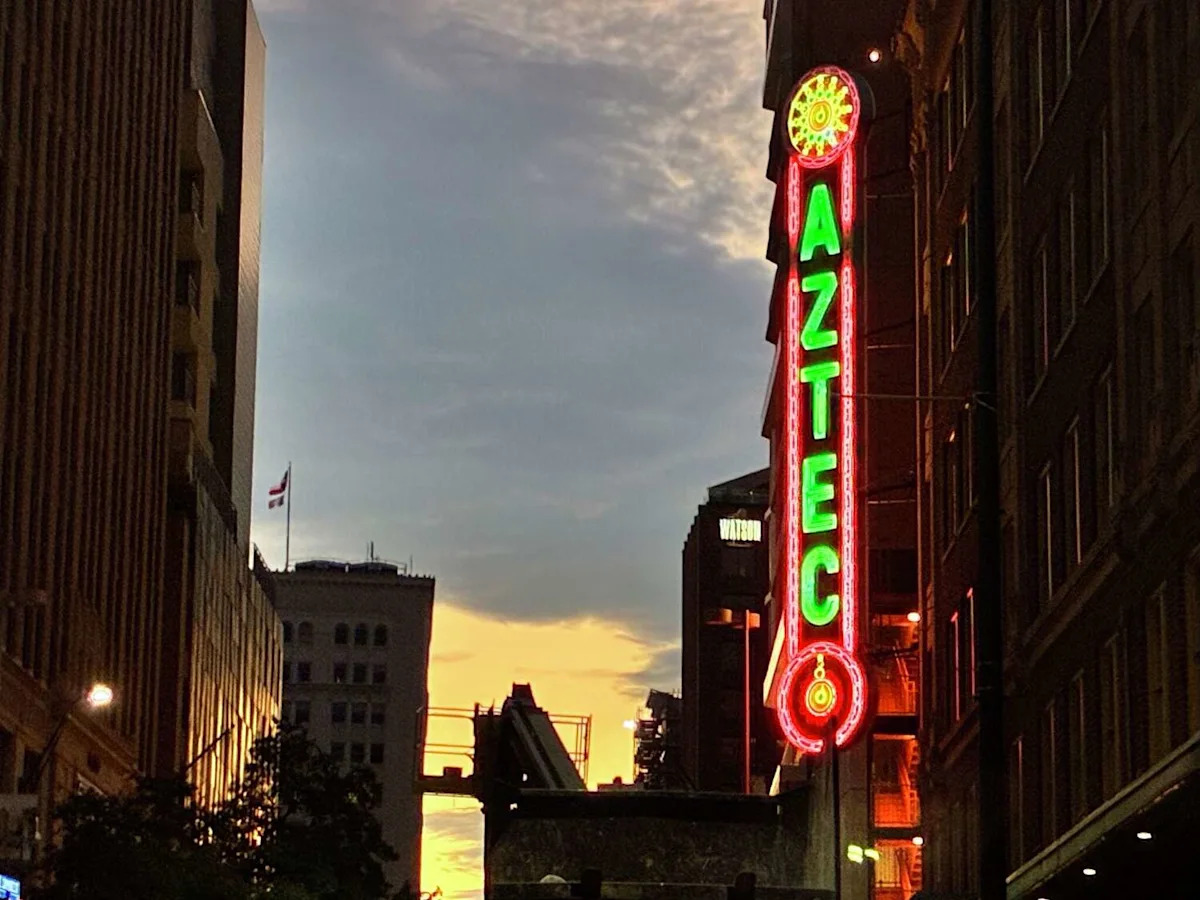
Not much in San Antonio looks the same as it did 100 years ago. In 1926, the River Walk didn’t exist, and neither did the pain of Loop 1604 traffic or the joy of rooting on the Spurs. What does connect the San Antonio of the present to its past is one iconic downtown landmark that just celebrated its centennial anniversary.

On opening day – June 4, 1926 – the iconic chandelier hadn’t yet been installed, so the theatre put plants around the lobby to create an exotic feel. (Courtesy of Aztec Theatre)
History of San Antonio’s Aztec Theatre
The Aztec Theatre opened on June 4, 1926, as a silent movie theatre. Designed by Meyer and Holler (the firm behind Los Angeles’ Egyptian and Chinese Theatres) it mimics a Mesoamerican temple with stone walls, statues of warriors and masks, elaborate columns and murals, massive painted jars and an overall air of mystique. Walking in, you’ll be greeted with the same ticket booth you’d have seen if you had come in to watch a movie like Buster Keaton’s The General or The Sea Beast starring John Barrymore.
“That era, there was an emphasis on really feeling like you’re stepping into another place and just kind of highlighting the potential and opportunities for people to travel and experience different cultures,” general manager Kevin Clutz told MySA during a tour. As for maintaining its historic appearance, staff aren’t allowed to affix any signage to the plaster, so they opt for projectors. They frequently do walk-throughs to work on the seats and doors, touch up the plaster or fix chipped paint.

Another piece of preserved history is the original ticket booth, which is one of the first things you’ll see when you walk in. (Emma Weidmann/MySA)
A year after opening, the Aztec played its first talking film, Barrymore’s Don Juan. Silent films quickly went out of fashion, but the original Wurlitzer organ (which would have been situated near the stage on the audience’s left) is on display in the Warrior Room, the theatre’s VIP lounge. Clutz said some of the pipes are still hidden behind the decorative serpent heads on either side of the stage.
Two years later, the massive, two-ton chandelier that hangs over the lobby and has to be cleaned via scissor lift was installed. That would be Tuesday, October 29, 1929, a day that’s more famous for marking the stock market crash that kicked off the Great Depression. One might think that would be the end for a new theatre, but Clutz believes the Aztec owes its survival to locals looking for an escape.
That still rings true.

The iconic chandelier in the middle of the lobby was installed the day the stock market crashed in 1929. (Emma Weidmann/MySA)
How has the Aztec Theatre in San Antonio changed over the years?
However, it isn’t as if the Aztec hasn’t undergone its fair share of changes. In the 1970s, it was separated into three screens and dubbed the Aztec Triplex, turning the upper level into two auditoriums, which Clutz said must’ve felt “intimate.” It didn’t last long. That closed in 1989, and the theatre would lay dormant for quite a while.

The stage is meant to mimic a temple, and the roof is painted a deep shade of nearly-black blue so that it feels like you’re under the night sky. (Emma Weidmann/MySA)
It was bought in the ’90s and turned into a special effects attraction called Aztec on the River from 2006 to 2007. It wouldn’t be until 2015 that Live Nation took it over as a concert venue – in roughly a decade since, locals have been able to catch acts like The Psychedelic Furs, drag queens Alyssa Edwards and Sash Colby, rappers T-Pain and Juvenile, hyperpop act 2hollis and many more.
Keeping the historic theatre alive “speaks directly to the spirit of San Antonio,” according to talent buyer Amy Brauchle.
“We have this deep cultural history that has been preserved, and many I feel like maybe disgruntled by the rate at which we’re progressing into the future, but I think [maintaining] these theaters – the Aztec, Woodlawn, any of the other historical spaces, Majestic, now the Alameda – keep real places and spaces that root us together in that same shared experience.”
Find it: 104 N. St. Mary’s St., San Antonio, TX 78205
This article originally published at How San Antonio’s Aztec Theatre became a landmark for 100 years.